Monday, May 12, 2014

12/5/2014: Norway: Heading for Some Rough Economic Waters?


AN interesting article on Norway's petrodollars 'curse of oil' economy's future from Reuters, headlined "End of oil boom threatens Norway's welfare model" (see: http://www.reuters.com/article/2014/05/08/us-norway-economy-insight-idUSBREA4703Z20140508)

This begs a question - are things really going South for Norway?

Sure, the country has basically nothing to show for its oil bonanza in terms of indigenous industries development or investment. Sure, it is giving cash left-right-and-centre to various social entrepreneurs, native enterprises, cultural ventures etc which produce virtually nothing of any demand outside Norway and questionably fulfil real demand inside Norway.

But, really, are things getting visibly bad on the horizon? And are they getting worse than in other Nordic countries?

Here are some charts summarising economic and fiscal performance of Norway compared to the rest of Nordics and Sweden.

Starting with General Government Revenue as % of GDP:


The above shows couple of things:

  • Norway's revenues are comfortably above those for Sweden and for Nordics. Which is the same as to say that Norway's economy is more heavily dependent on Government sector. This, of course, includes gas and oil revenues. 
  • But the share is has been rising between 1994 and 2008 not only because revenues from North Sea are rising, but also because rest of economy activity was getting trapped in state-dependency.
  • Crucially, the revenues have been on downward trajectory since 2009 and this is forecast to continue into 2019. Pressure is mounting.
  • The opposite to Norway's trajectory is happening in the rest of the Nordics and Sweden. In particular, following massive Swedish and Finnish crises on the early 1990s, share of Government in the economies of the Nordics ex-Norway has fallen steadily from 1988-1991 peak toward the trough around 2010 in the Nordics and still heading down for Sweden.

All in, Norway is showing signs of serious strain on revenue side, but it is not in a crisis… not yet.


What about the Government Expenditure?


The above shows the following:

  • Basic expenditure side of the fiscal equation is still better in Norway than in the Nordics and Sweden. 
  • However, out on 2019 range forecasts, Norway is starting to actively catching up with Sweden and converging toward the Nordics.

Again, not a crisis yet… but dynamics are not encouraging.


On Government Debt front, Norway is doing well, especially compared to the Nordics:


And it still outperforms the Nordics on Current Account side:


  • One caveat here is that Norway's current account surpluses are solely down to oil and gas revenues. The country does not deliver value for money in any other sector, including, increasingly in its aqua-farming sector. Meanwhile, Sweden generates current account surplus ex-energy and raw materials.


On balance, there is a serious problem emerging for Norway: current account surpluses are on downward trajectory since 2006, and decline is forecast to accelerate. Good news for Norway: there is no deficit in sight. Bad news: in order to achieve quick transition of its economy away from oil & gas dependency, it will need massive investments and capital imports - which can force the current account balance into deficit very quickly.

The problem of fast rising public spending against revenues and declining public surpluses is often best can be seen in level terms, in current spending, instead of as a share of GDP. Here is the summary chart:

As noted earlier, this shows:

  • Rapidly rising state spending, for not rather well matched by revenues.
  • Rate of revenues increases declining from 2012 on and being outstripped by projections for expenditure increases for 2013-2019 period. These are mostly down to forecasts, so not materialised yet… but still - a warning shot.
  • Exchequer surpluses declining from local peak in 2012.
  • On positive side, surpluses are still present in forecast out to 2019, which is a strong position to have.


Here is a net summary on various growth rates over decades averages:

and a chart showing the gap between Sweden's GDP growth rate and public spending rate, and that for Norway:

Key takeaways: Norway is not yet flashing red, but its growth in public spending is not sustainable in the environment of falling net revenues from energy sector. Structural weakness in the Norwegian economy is basic lack of real economic growth outside the energy sector, compensated for by the over-reliance on public spending and investment.

Sunday, May 11, 2014

11/5/2014: Super Mario: Whatever It Takes Will Now Happen in June… Likely, Like…


This week, the ECB has sent a barrage of signals. Blanket-bombing the Forex markets, Super Mario laid it thick with the promises. Behind this there is less of the classical monetary policy and more of the classical exchange rates expectations balancing. Inflation is low, for sure. Euro is stubbornly stuck in the highs, for sure. The former is just fine for retirement-bound Germany. The latter is not fine for growth centres-bound BMWs and Mercs. So the majority of the Governing Council decided to move… but only in the future… and only once new forecasts are made available.

Basically, Draghi pre-committed to acting in June to ease policy. This is not the same as a promise of QE, neither in the form of actual printing or unconventional measures of any serious significance. Instead, my expectation is the ECB will pass through another refinancing rate cut or do some re-arranging on liquidity support measures side (maturity or volume or both). The Governing Council can then sit back and watch if the marginal move induces downward pressure on the euro. This being June, real economy in Europe will be heading into Summer, buying ECB some time for navel gazing.

Most likely outcome: as long as ECB does not drastically depart from the Fed and BofE, things will remain hard for the euro.

The ECB stance overlays the fundamentals that are consistent with medium-term low inflation and anaemic, albeit improving, growth (see http://trueeconomics.blogspot.ie/2014/05/752014-eurocoin-leading-indicator-april.html). Any easing the monetary policy from here on is therefore consistent with ECB responding to deflationary pressures and Forex pressures, and not to the issues relating to fragmented lending markets. Thus, any easing in June remains conditional on ECB forecasts. Draghi noted as much, stating that

  • Going forward, the ECB is still mindful of low inflation and is concerned with the medium-term trajectory in inflation, so that both levels and dynamics seem to matter now (it was the former and not the latter that were of concern before)
  • The ECB is also worrying about the high valuation of the euro, especially consistent with low inflation. The two factors reinforce each other in the longer run.
  • The fact that geopolitical crisis in Ukraine is now spilling over into the euro area more than to any other region.


The ECB still appears to be undecided on specific tools that it is going to use. Much of this indecision is probably down to the difficulties with structuring some less conventional measures. Much is due to the uncertainty as to how much easing will be required. Intervention for Forex sake will have to be initially smaller than intervention aimed at unlocking fragmented lending markets. This is my expectation for any June action, if any were to take place: symbolic act to alter forward expectations and buy time before end of summer.

The tool kit for this includes potential

  • Shallow cut to refinancing rate: -10 to -15 bps
  • Extending to full allotment of fixed rate liquidity provision. As Bloomberg puts it: "The ECB could extend its policy of granting as much cash as banks need against eligible collateral. The measure was introduced in October 2008 after the collapse of Lehman Brothers Holdings Inc. sparked a global credit crunch and is scheduled to run until at least July 2015."
  • New LTRO. Again, via Bloomberg: "The ECB’s emergency 3-year loans to banks are losing their effectiveness as they approach maturity at the start of 2015, prompting speculation that a new round may be offered. Another LTRO might look different from the previous ones, when banks used most of the liquidity to buy government bonds. “We will want to make sure that this is being used for the economy,” Draghi said in December."
  • Non-sterilisation of SMP (I wrote about this earlier here: http://trueeconomics.blogspot.ie/2014/03/07032014-to-sterilise-or-not-to.html). This can ad up to EUR168 billion to liquidity supply.
  • Reserve requirements can be lower or ECB can remove the reserve ratio of 1%. Both measures will increase liquidity supply.
  • Negative Deposit rate from current zero rate to -0.05 to -0.1 percent (negative rates were used recently in Denmark: http://www.bloomberg.com/news/2014-04-24/danish-central-bank-exits-negative-rates-first-time-since-2012.html). 


I suspect ECB will not go for negative rates, or opt for the outright non-sterilsation of SMP, albeit it can slow down the rate of sterilisation. Negative rates is a nuclear option that will have more significant impact on reducing euro strength. And it might add credit supply in the euro area on the aggregate, though I doubt this will have much of an effect on breaking the vicious cycle of market fragmentation (I find it unlikely that negative rates can trigger restart of credit supply in euro area impaired economies).

In the longer term, I suspect ECB is going to take a wait-and-watch approach through summer. If economic growth continues to pick up and inflation starts to rise, we shall see ECB abandoning any further action beyond the token signalling in June. If things deteriorate over the summer, ECB will look into more QE-focused policies in September-October. Corporate bonds purchases might be on the books then.

Couple of charts to illustrate ECB's long term dilemma:

Policy rates are at historical lows and moving out of synch with Euribor (fragmentation)


Meanwhile, the euribor-ECB spread rose to the highest level since April 2012... The Draghi Put period average spread is at 0.054, pre-Put at 0.594 and current spread is at 0.354. The cost margin in inter-bank markets is now closer to the crisis peak averages than to the Draghi Put average, showing the effects of LTROs and ECB easing wearing out.

And duration and magnitude of deviation from historical averages are frightening:


All of which shows that ECB will have to seriously push the bounds on unconventional measures, if it really wants to make a dent in the pile of problems (forex rates, fragmentation, aggregate liquidity supply, inflation, growth...) the ECB is facing.

Saturday, May 10, 2014

10/5/2014: Irish Unis: Excellence in Areas of State Neglect...

No comment needed. Headline says it all:


As @brianmlucey said:


Oh, and all top departments are in the Universities that are not designated as greenfield 'centres of excellence' during the Celtic Tiger and were not in receipt of massive specially-designated 'convergence' infrastructure funding from the National Development Plans.

Friday, May 9, 2014

9/5/2014: Irish Credit Conditions Worsened in Q1 2014


Latest data on interest rates (covered here: http://trueeconomics.blogspot.ie/2014/05/952014-cost-of-credit-in-ireland-kept.html) and credit outstanding in the Irish banking system shows continued deleveraging in the economy:

At the end of Q1 2014,
-  Total volume of loans outstanding declined 5.6% y/y,
-  Loans to Households were down 1.54% y/y and
-  Loans to NFCs were down 9.29%.
-  Loans for house purchases were down EUR1.46bn,
-  Households' overdrafts rose EUR1.39bn, while
-  Consumer credit loans were down EUR1.43bn.
-  NFCs overdrafts fell EUR2.81bn and
-  Non-overdraft NFCs credit fell EUR5.2bn.

So credit available to enterprises and households in Ireland is still falling. More significantly, households are accumulating overdraft liabilities. And the cost of these facilities is rising.

Not a good sign, suggesting households and corporates are being squeezed on both ends of the debt deflation pump.


9/5/2014: Cost of Credit in Ireland Kept Rising in Q1 2014


Latest data from the Central Bank shows continued increases in cost of credit in Ireland in Q1 2014:
- Overdrafts rates for households are up 0.46 percentage points in Q1 2014 compared to Q1 2013;
- Loans for house purchases with original maturity up to 1 year: up 0.29 percentage points
- Loans for house purchases with original maturity of over 1 year and up to 5 years: up 0.08 percentage points
- Loans for house purchases with original maturity over 5 years: down 0.2 percentage points

- Consumer loans with original maturity up to 1 year: up 0.82 percentage points
- Consumer loans with original maturity of over 1 year and up to 5 years: up 0.3 percentage points
- Consumer loans with original maturity over 5 years: down 0.02 percentage points

- Non-financial corporations loans with original maturity up to 1 year: up 0.1 percentage points
- NFC loans with original maturity of over 1 year and up to 5 years: up 0.16 percentage points
- NFC loans with original maturity over 5 years: up 0.01 percentage points
- NFC overdrafts rates down 0.36 percentage points.

Thus, Irish 'repaired' banking system continues to extract higher costs out of households and businesses already strained by debt burdens.

9/5/2014: Latvian Military Report on the Lessons from Russia-Ukraine Crisis


National Defence Academy of Latvia, Center for Security and Strategic Research, recently published a hugely insightful analysts of Russia-Ukraine conflict. The paper, titled "RUSSIA’S NEW GENERATION WARFARE IN UKRAINE: IMPLICATIONS FOR LATVIAN DEFENSE POLICY" (http://www.naa.mil.lv/~/media/NAA/AZPC/Publikacijas/PP%2002-2014.ashx) achieves several things.

Firstly, it outlines step-by-step what appears to be a shift in conflict strategy adopted by Russia. This is summarised in Figure 1 below and in 10 points list on page 6 of the report.


Secondly, it outlines existent weaknesses in Nato's legal framework. In particular, these weaknesses relate to Article 5 clause operationality in the case of modern conflict that involves no formal military presence on Nato territory. De fact, the report acknowledges that Ukraine conflict to-date does not amount to a normal, legally definable war.

Thirdly, Latvian potential response to the second issue above is to attempt to address the existent and severe national imbalances that exist between ethnically Latvian population and population that is Russian-speaking (encompassing many more ethnicities other than Russians). In this, the report de facto acknowledges that there are political, cultural, social and economic disadvantages that are being placed on ethnic minorities in Latvia today.

Fascinating as this is, my focus here in on the report's coverage of the events in the conflict, contained in the first part of the paper. In this:

1) The report clearly shows that Russia's position in the region as a country with natural geopolitical interest toward neutrality and/or alliance with neighbouring states is in direct confrontation to Western European and US ambitious in that region.

2) The report also places Russian geopolitical interests in the region as ethically and legally senior to those of Western Europe and the US.

3) The report clearly identifies a major problem created by the Nato Eastward expansion during the 1990s as a legitimate threat to Russia.

4) The report also shows that Russian acceptance and endorsement of February 21st was a major concession on Russian side and that the February 21 accord was a constructive engagement for all sides concerned that could have led to fundamental change in leadership, reforms and stabilisation in Ukraine. The report clearly puts blame for violation of February 21st agreement at the feet of Maidan leaders.

5) The report clearly states that Yanukovich Government was overthrown under the threat of a coup from Maidan: "…the opposition continued to push for Yanukovitch's resignation. Speaking to the crowd from the stage on Maidan, Volodymir Parasiuk declared that if Yanukovitch did not resign by 10am on 22nd February an armed coup would occur. Police withdrew, leaving government buildings, including the President's residence, unguarded. A new coalition was created in the Ukrainian parliament, with 28 members of its members leaving the pro-Russian Party of Regions' faction."

6) The above quote clearly shows that Yanukovich's flight to Russia was carried out due to security forces withdrawal and direct threat to his life, which makes impeachment proceedings against him (based on the claim that he abandoned the seat of Government for personal reasons) invalid. It also shows that Maidan was the direct source of current interim Government - as opposed to democratic process legitimacy.

7) On Maidan snipers, the report does not endorse the official Kiev position, but gives two theories currently working their way through various media channels: "Snipers started shooting at both protesters and the police, with two versions emerging of what was happening. One, supported by Russia, was that the opposition, backed by Western countries was behind the shootings; the other, was that the snipers were from the Ministry of Internal Affairs and the SBU, acting on Soviet era type plans, with the objective of escalating the conflict, thus justifying an operation to end the protests." The problem is that, as report notes, the second version is not consistent with the outcome: "If this was true, the result was the opposite, since it gave more power to the opposition…"

8) On legitimacy of the Kiev Interim Government: "First, Russia considered Yanukovitch's impeachment to be illegal, therefore the new government was not legitimate. According to the Constitution of Ukraine, the procedure to impeach the President must observe the following procedure: a.) the President is formally charged with a crime; b.) the Constitutional Court reviews the charge; c.) the Parliament votes. The impeachment takes place only if there is a three-fourths majority." The problem is that (a) and (b) were not followed through, as far as I am aware. Crucially, there is a cooling-off period over which the Supreme Court can produce its verdict on validity of impeachment. This also was not followed through, as far as I am aware.

The report does not endorse Russian actions, but it presents the basis for them - calmly and without hysteria and subjective claims that usually accompany these in the media.


The report summarises six reasons why Russia had to act in Crimea [comment is mine]:

"Ukraine always represented a red line for Russia; therefore, it decided to act to preserve its regional interests.

  • First, and most important, its military interests. Crimea has been the base of the Russian Black Sea fleet for more than 250 years. An anti-Russian government could cancel the agreement which permits Russia to have military bases there. [This is significant as it is supported by the evidence of past Ukrainian demands relating to naval bases leases and disputes the common claim that Russian bases were not subject to political threats from Kiev. They were and the only way of securing them in March 2014 was to take them over. Alternative was to withdraw from Black Sea bases and face zero presence in the Black Sea arena. Does anyone rationally expects Russia to accept such an outcome?] 
  • Second, because it considers Crimea’s becoming a part of Ukraine in 1954 a mistake, since it has always been a part of Russia. [This is not an unreasonable argument from Russian side. But it does present a problem as to the previous international agreements entered into by Russia with respect to Ukraine. Of course, Moscow's response to this is that as long as Ukraine had neutral and legitimate Government, the old treaties applied. Change in the underlying conditions warrants change in treaties status and validity.] 
  • Third, to give a clear message to the West that the Ukrainian issue is a real red line and it should remain in the Russian sphere of influence. 
  • Fourth, to show that Russia is to be respected and considered to be of a similar stature to the United States. It does not want to be integrated into the West, but to be an independent actor. [And this status of an independent state, in Moscow's view, requires maintenance of deep territorial buffer between Nato and Russia - the buffer that shrunk from 1,600 km distance between Nato territory and St Petersburg - major Russian city - in 1989, to 160 km now] 
  • Fifth, to divert public attention from Russia's own internal social and economic problems… 
  • Sixth, to make clear that any attempt to split off from the Russian Federation will not be tolerated."


On Crimea operations, the report states that "…although it is true that the number of troops stationed [in Crimea before and during the referendum] increased, this is still within the limits of the bilateral agreement between Russia and Ukraine." The report does not reference legality of the troops actions in Crimea.

The report describes the outcome of the Crimean campaign as follows: "Its success can be measured by the fact that in just three weeks, and without a shot being fired, the morale of the Ukrainian military was broken and all of their 190 bases had surrendered. Instead of relying on a mass deployment of tanks and artillery, the Crimean campaign deployed less than 10,000 assault troops – mostly naval infantry, already stationed in Crimea, backed by a few battalions of airborne troops and Spetsnaz commandos – against 16,000 Ukrainian military personnel. In addition, the heaviest vehicle used was the wheeled BTR-80 armored personal carrier."

In other words, Ukrainian forces were not outnumbered by Russian forces. Nor were they overpowered. Instead, someone should ask serious questions as to whether lack of legitimacy and/or leadership from Kiev led to the situation where 16,000 Ukrainian troops in Crimea were simply unable/unwilling to engage 10,000 Russian troops and pro-Russian militias.

Thursday, May 8, 2014

8/5/2014: Pew Research on Public Opinion of Ukraine-Russia Conflict

Pew Research are providing some interesting data on public opinion in Ukraine relating to country geopolitical 'drift': http://www.pewglobal.org/files/2014/05/Pew_Global_Attitudes_Ukraine-Russia_Report_FINAL_May_8_2014.pdf


"Most Ukrainians have soured on Russia, with many saying Russia is having a negative influence in their country and that it is more important for Ukraine to have strong ties with the European Union. Nonetheless, Ukrainians are divided in their evaluations of the influence of western nations in their country and express doubts about German Chancellor Angela Merkel’s and U.S. President Barack Obama’s handling of foreign affairs. In addition, Russian-speakers in the east, as well as residents of Crimea, have greater confidence in Russia than either the EU or the U.S."

The significance of this can be overstated (sample is only 1,659 adults or understated (given the immense degree of uncertainty in the current situation, the divide between Western and Eastern Ukraine is striking).


In relation to the role the West-East division plays in the crisis going forward, since the past is now likely to remain the past:

So here is a series of tweets I sent out over the last two days that explain my view of the 'next step' strategy that might be playing out in Ukraine:

Starts:

My replies:


Also, in reply to today's announcement from Donetsk that pro-Russian separatists intend to continue pushing for a referendum despite Moscow standing down on one (read from bottom up):


8/5/2014: Irish Composite Activity indicator for Services & Manufacturing: April 2014


In the previous post I covered Irish Manufacturing and Services PMIs as released by the Investec/Markit. With both PMI indices out, time to update my own Irish Composite Activity Indicator (CAI) based on PMIs and showing a measure of aggregate economy-wide activity in private sector.

The CAI is based on quarterly (or closest 3mo average) readings for two PMIs.

Chart below illustrates the series.


Q2 2014 reading to-date is for CAI of 58.8 which is slightly up on Q1 2014 reading of 58.4 and is up 11.3% y/y. With Q1 2014 up q/q by 0.36% and Q2 (to-date) reading up 0.62% q/q, the pace of expansion is rising.

So far, in Q2 2014 we are marking 17th consecutive quarter of expansion in economic activity. Which, of course, stands contrasted by the fact that GDP posted 8 quarters of q/q declines over the last 16 quarters for which we have data, while GNP posted 7 quarters of contractions.

Basic point is the old one: PMIs have virtually no connection to either GDP or GNP.

Still, good feeling is worth something (which is why we are willing to pay to see soft-ball comedy and entertainment) and on this measure, CAI shines some warmish light on us all... 

8/5/2014: Irish Manufacturing & Services PMIs: April 2014

Irish Manufacturing and Services PMIs were out for April both showing aggregate gains, both not reported sufficiently in terms of data coverage to make any verifiable statements about composition of these gains.

Let's start from Manufacturing figures first:
  • April 2014 PMI reading was at 56.1 - which is well above statistically significant bound of expansion. 
  • 3mo MA through April is now at 54.8, some 1.9 points above 3mo MA reading though January 2014 and 5.5 points ahead y/y. Both good indicators of improving growth in the sector.


On Services side:
  • April 2014 PMI reading was at blistering 61.9 - which is strongly above statistically significant bound of expansion. 
  • 3mo MA through April is now at 60.0, basically flat on 3mo MA reading though January 2014 (60.13) and 2.8 points ahead y/y. Both good indicators of continued strong growth in the sector.


However, 3mo MA on 3mo MA changes are not spectacular in Services sector, as the chart below shows. This might simply be due to already sky-high readings attained in recent months.


Both indices show expansion in the economy (a changed from same period 2013) and as the chart below shows, correlation between the two indices is running strong (both co-move currently).


So based on top-level data, things are improving. The caveats are as usual:
  1. We have no idea what is happening on the underlying side of the above stats as Investec & Markit no longer make available sub-indices information
  2. Much of the PMIs-signalled activity is not coinciding with actual activity on the ground over the medium term (although some indications are that once we are firmly on growth trend path, the two sets of data - CSO and PMIs - will start comoving again).
In short, just as sell-side stockbrokers reports and Consumer Confidence Indicator, PMIs are least useful in telling the real story just when the demand for such story is most acute. 

Wednesday, May 7, 2014

7/5/2014: SEC's Bitcoin Alert... Much ado about little

As reported by FT.com: http://www.ft.com/intl/fastft

SEC (US financial watchdog) issued an "investor alert" relating to Bitcoin, "warning that it could expose investors to fraud and unforeseen risks."

"The alert, …said that both fraudsters and promoters of "high-risk investment schemes" could target Bitcoin users, and cautioned consumers to be wary."

"...today's release was a more general warning, arguing that the virtual currency presented "unique risks" to potential investors. Below are the risks the regulator listed.

1) Not insured. Which we all know...

2) History of volatility. Which I noted earlier… http://trueeconomics.blogspot.ie/2014/02/1722014-is-bitcoin-real-currency.html

3) Government regulation. A new-ish one for the US: "Bitcoins are not legal tender. Federal, state or foreign governments may restrict the use and exchange of Bitcoin." But not so new for global markets, where we've seen bans on BitCoin in the likes of China...

4) Security concerns. Nothing new there...

5) New and developing. Aka: reputational: "As a recent invention, Bitcoin does not have an established track record of credibility and trust. Bitcoin and other virtual currencies are evolving."

7/5/2014: 1980s and 2010s: Live Register tells the tale...


Here are some comparatives relating to un- and under-employment between the current crisis and the dreaded 1980s malaise summarised in a chart :

Click on chart to enlarge

Remember, Ireland today is not Ireland in the 1980s...

7/5/2014: Simple vs Complex Financial Regulation under Knightian Uncertainty

Bank of England published a very interesting paper on the balance of uncertainty associated with complex vs simplified financial regulation frameworks.

Titled "Taking uncertainty seriously: simplicity versus complexity in financial regulation" the paper was written by a team of researchers and published as Financial Stability Paper No. 28 – May 2014 (link: http://www.bankofengland.co.uk/research/Documents/fspapers/fs_paper28.pdf), the study draws distinction between risk and uncertainty, referencing "the psychological literature on heuristics to consider whether and when simpler approaches may outperform more complex methods for modelling and regulating the financial system".

The authors find that:
(i) "simple methods can sometimes dominate more complex modelling approaches for calculating banks’ capital requirements, especially if limited data are available for estimating models or the underlying risks are characterised by fat-tailed distributions";
(ii) "simple indicators often outperformed more complex metrics in predicting individual bank failure during the global financial crisis"; and
(iii) "when combining information from different indicators to predict bank failure, ‘fast-and-frugal’ decision trees can perform comparably to standard, but more information-intensive, regression techniques, while being simpler and easier to communicate".

The authors key starting point is that "financial systems are better
characterised by uncertainty than by risk because they are subject to so many unpredictable factors".

As the result, "simple approaches can usefully complement more complex ones and in certain circumstances less can indeed be more."

The drawback of the simple frameworks and regulatory rules is that they "may be vulnerable to gaming, circumvention and arbitrage. While this may be true, it should be emphasised that a simple approach does not necessarily equate to a singular focus on one variable such as leverage… [in other words, simple might not be quite simplistic] Moreover, given the private rewards at stake, financial market participants are always likely to seek to game financial regulations, however complex they may be. Such arbitrage may be particularly
difficult to identify if the rules are highly complex. By contrast, simpler approaches may facilitate the identification of gaming and thus make it easier to tackle."

Note, the above clearly puts significant weight on enforcement as opposed to pro-active regulating.

"Under complex rules, significant resources are also likely to be directed towards attempts at gaming and the regulatory response to check compliance. This race towards ever greater complexity may lead to wasteful, socially unproductive activity. It also creates bad incentives, with a variety of actors profiting from complexity at the expense of the deployment of economic resources for more productive activity."

The lesson of the recent past is exactly this: "These developments [growing complexity and increased capacity to game the system] may at least partially have contributed to the seeming decline in the economic efficiency of the financial system in developed countries, with the societal costs of running it growing over the past thirty years, arguably without any clear improvement in its ability to serve its productive functions in particular in relation to the successful allocation of an economy’s scarce investment capital (Friedman (2010))."

And the final drop: clarity of simple systems and implied improvement in transparency. "Simple approaches are also likely to have wider benefits by being easier to understand and communicate to key stakeholders. Greater clarity may contribute to superior decision making. For example, if senior management and investors have a better understanding of the risks that financial institutions face, internal governance and market discipline may both improve."

Top line conclusion: "Simple rules are not a panacea, especially in the face of regulatory arbitrage and an ever-changing financial system. But in a world characterised by Knightian uncertainty, tilting the balance away from ever greater complexity and towards simplicity may lead to better outcomes for society."

7/5/2014: Eurocoin Leading Indicator: April 2014


The latest Eurocoin leading growth indicator for the euro area is at 0.39 in April, statistically unchanged on 0.38 in March.

Q1 2014 forecast based on Eurocoin is now at 0.34% q/q growth and Q2 2014 forecast is now running closer to 0.38%.

In other words, things are slack.

Here are some charts:


Crucially, Eurocoin reading in April was driven by "favourable performance of the financial markets and by household and business confidence, although these were counterbalanced by the small downwards revision of euro-area GDP in the fourth quarter of 2013." Actual industrial activity and external trade data was not supportive to the upside.

In other words, much of the improvement in Eurocoin since December 2013 is down to financial and confidence effects and not to underlying real economy.

Monetary policy side and inflation remain stuck in slow-growth corner:


7/5/2014: Eurostat backs out of Greek data mess


Here's Ifo Institute press release on Eurostat and data manipulation for Greece:


I have covered the issue here: http://trueeconomics.blogspot.ie/2014/04/2542014-stretch-of-numbers-here-bond.html

7/5/2014: Russia PMIs: signalling second month of recessionary pressures


Russia's HSBC-Markit PMIs are signalling contracting economy for the second month in a row.

Manufacturing PMI is down at 48.5 which is marginally better (slower rate of contraction) than in March (48.3) and on par with the rate of decline measured in February (48.5). April marks the sixth consecutive month of below 50 readings.

3mo MA now stands at 48.4 which is down marginally from 48.7 for 3mo average through January 2014 and is down significantly on 51.1 3mo average back in February-April 2013.

Current 3mo average is statistically barely at the bound of recessionary reading (48.3).


Meanwhile, services index weakened further from March 47.7 to 46.8 in April. This is the second consecutive month of below 50 readings. 

3mo MA now stands at 48.4 which is down strongly from 52.2 for 3mo average through January 2014 and is down massively on 54.5 3mo average back in February-April 2013.

Current 3mo average is statistically below the bound of recessionary reading (47.2).


Composite PMI is also in a second consecutive monthly reading below 50.0 - March 2014 was 47.8 and April 2014 came in at 47.6.

3mo MA is at 48.5 which is down on 51.5 for 3mo average through January 2014 and is down significantly on 53.6 3mo average back in February-April 2013.

Current 3mo average is statistically above the bound of recessionary reading (47.6).


It is worth noting that weaknesses in Russian Composite PMI started well ahead of the current geopolitical risks amplification and reflect structural issues with the Russian economy. However, the rate of decline as well as weakness spread across two sectors increased since the beginning of this year.

Tuesday, May 6, 2014

6/5/2014: BlackRock Institute Survey: EMEA, April


BlackRock Institute published their April 2014 survey of economic conditions in EMEA region. Here are some takeaways:
  1. "The consensus of respondents describe Russia, Slovenia, Croatia, Turkey and Turkey to be in a recessionary state, with an even split of economists gauging Kazakhstan and Egypt to be a in a recessionary or contraction."
  2. "Over the next two quarters, the consensus shifts toward expansion for only Egypt."
  3. "At the 12 month horizon, the consensus expecting all EMEA countries to strengthen or remain the same with the exception of Slovenia, Turkey, Russia and the Ukraine."


Russian economy specifics:
  • "How do you think Russia's economy will develop over the next 12 months?" 72% of respondents expect economy to become weaker or a lot weaker
  • "At this time, in which phase of the economic cycle would you say Russia's economy is?" 100% of respondents estimate that the Russian economy is currently in a recession.
  • "Over the next 6 months, in which phase of the economic cycle would you say Russia's economy will be?" 86% of respondents expect Russian economy to remain in a recession.
  • 57% of respondents estimate that currently Russian economy is operating with a positive or zero output gap.
  • 71% of respondents estimate that currently Russian economy operates at above trend inflation that is increasing.


"Globally, respondents remain positive on the global growth cycle with a net 78% of 40 respondents expecting a  strengthening world economy over the next 12 months – an 9% decrease from the net 87% figure last month. The consensus of economists project mid-cycle expansion over the next 6 months for the global economy."

Note: Red dot represents South Africa, Czech Republic, Hungary, Romania, Israel, Poland and Slovakia.


Note: these views reflect opinions of survey respondents, not that of the BlackRock Investment Institute. Also note: cover of countries is relatively uneven, with some countries being assessed by a relatively small number of experts

Sunday, May 4, 2014

4/5/2014: Ireland's Fabled External Balance Performance: 1990-2013


Ireland's external balance performance has always been a major point for departure in analysis of our economic growth, sustainability of our debt and overall consideration of our economic infrastructure quality. As a Small Open economy, Ireland is trade-intensive. As an MNCs-led economy, Ireland is even more trade-dependent, in so far as we need larger external surplus to deliver same jobs creation as other European economies with smaller MNCs-induced GDP/GNP gap.

Since the start of the crisis, Irish current account performance was invariably brought forward as evidence of significant improvements in the underlying economy's competitiveness. And our gains were pretty strong - judging by this metric:
  • In the 1990s, Ireland averaged current account surpluses of 1.85% of GDP annually
  • In the 20002, we run current account deficits averaging -2.29% GDP per annnum
  • Since 2010 through 2013 we have been running current account surpluses averaging 3.35% per annum
  • The swing - from the deficit to surplus is 5.43% of GDP for Ireland - seemingly strong stuff.


The question is, of course, are the above numbers really strong, as in exceptionally strong or very strong as judged by comparison with other similar economies?

Let's consider EEA24 - 24 advanced economies of EEA community (excluding those economies of EEA that are not making it into 'advanced economies' club).
  • In 1990-1999 Ireland's performance was strong in terms of the current account, but it was not exceptions - we ranked 5th in the EEA24 in the size of average current account surplus, behind Belgium (4.67% of GDP), Luxembourg (10.52% of GDP), the Netherlands (4.16% of GDP), and Switzerland (6.93% of GDP).
  • In 2000-2009 we ranked 14th (no need to list the countries we were behind in this metric during this period - we were doing badly).
  • In 2010-2013 we ranked 7th - behind Denmark (6.09%), Germany (7.05%), Luxembourg (6.91%), the Netherlands (9.17%), Sweden (6.08%) and Switzerland (10.74%).

Here's a chart illustrating this performance - for legibility, I only left in the chart Small Open Economies.


But what about the overall period of the crisis, you might ask? 

Instead of decades-averages, let's take a look at the average current account balances over 2008-2013 period. Here we rank 8th in the EEA24 with our current account surplus averaging 5.4% of GDP.


The key point here is that Ireland's current account performance has been strong, but it has not been exceptional. Certainly not exceptional given the need of this economy for deleveraging (and associated requirement for higher current account surpluses). 

The good news is that at 5.4% of GDP, our current account surpluses since 2008 are above those in the deleveraging period of 1992-1997 when these averaged 3.13% of GDP.

The bad news is that we are still to undo the aggressive current account leveraging accumulated during the 2000s. In the decade of 2000s, Ireland's cumulated current account deficit amounted to USD52.42 billion. During the 1990s our cumulated surplus was USD12.49billion and in 2010-2013 our cumulated surplus was USD28.88 billion. In other words, from 1990 through 2013 we are still in a deficit of USD11.04 billion and if we take 2000 as the starting point, our cumulated deficit is USD23.54 billion.

For comparison, Switzerland's cumulated 2000-2013 surplus is USD644.86 billion, Sweden's USD377.99 billion, Denmark's 149.18 billion. 

In fact, non-euro EEA24 members are in a vastly stronger current account position than their euro area counterparts, but that is probably a matter best covered separately, although it does probably explain why euro area needs ESM and other means for borrowing externally.

Lastly, however, let's come back to that 'swing' in our current account from deficits in the 2000s to surplus in 2010-2013. Remember, the swing was a sizeable 5.64% of GDP. But it only ranks us as 5th economy in the EEA24 in terms of the magnitude of improvement in our competitiveness. Not exactly an 'exceptional case' either.

4/5/2014: Some links & quotes from the week past


Few links to my recent comments in the media:


Saturday, May 3, 2014

3/5/2014: Crisis Impact Comparatives: GDP changes 2007-2013

A very interesting map plotting changes in the GDP across various European countries since 2007:


My own calculations using IMF database and showing more up-to-date data and broader set of GDP metrics covering all advanced economies ex-Luxembourg, San-Marino, and Latvia (you can click on the image to enlarge):


One sample of just European economies:


And two sets of summary tables pooling together Euro area 'peripherals' plus Iceland:


We can't really say we are much better off than Iceland, and we are certainly to-date worse off than Portugal, although we are better off than Greece.

Friday, May 2, 2014

2/5/2014: Ethnic Russians in Ukraine are Centuries-Old, Not Decades-Deep...

As someone just remarked on twitter, the proverbial sh*t just got real in Ukraine. And mightily it did - Ukrainian authorities report 31 dead in clashes in largely Russian-speaking Odessa. Other sources report 'dozens killed' - e.g. http://www.bbc.com/news/world-europe-27259620.

Here are two stills from the live broadcast by a Ukrainian channel of events in Odessa, showing the civilian firetruck being used by the pro-Kiev forces to attempt to break through opposition barricades. The broadcast showed personnel with what appeared to be field helmets on hiding under the cover of the truck.


Odessa is a serious flash point for three major reasons:

  1. It is largely Russian-speaking and highly ethnically diverse. The city has a very old Jewish diaspora (greatly reduced by the nazis during the WWII) and of its large (1 million) population, roughly 60% are ethnic Ukrainians, followed by 29% of Russians. It also has Armenian, Albanian, Azeri, Crimean Tatar, Bulgarian, Romanian etc diasporas. Even a Greek diaspora. The city is very much reflective of the current ethnic tensions - although majority of population is not ethnically Russian, main spoken language remains Russian, despite the language not being recognised as official. Historically, like most of Eastern Ukraine, Odessa was Russian - it was Russian in the 19th century when the city was the fourth largest in the Russian empire after Moscow, St Petersburg and Warsaw. Crucially to its history, Odessa was Russian ethnically all the way until mid 20th century. Notice that this is a direct contradiction to the extreme nationalist views being propagated in Ukraine that Russian population of Eastern and Southern Ukraine represented 'new colonisers' who arrived there after Stalin-induced Soviet Union-wide famine of the 1920s.
  2. Odessa is culturally and strategically aligned with Crimea (via sea linkages) and its Oblast borders Transnistria region of Moldova.
The push point in the conflict is, in my view, moving closer and closer to an open confrontation between Russia and Ukraine. 

And here is a voting map from the last elections, showing just how closely the South-Western Ukrainian area - including Odessa region - is aligned with the Eastern Ukraine:


Here is a handy map showing movements of Russian and Ukrainian troops (http://www.washingtonpost.com/blogs/worldviews/wp/2014/05/02/map-how-ukraine-and-russia-are-moving-toward-war/):


How did the Russians get into Ukraine, you might ask? Well, here is a handy guide (see note below):
  • Eastern Ukraine was added to Russian Empire in 1654-1667 with western border defined by River Dniper. These parts were first incorporated into the Ukrainian territories in 1919-1920 and then in 1922 Treaty that created the USSR. Here are the lands lost in the Polish War by Polish-Lithuanian Commonwealth and gained by Ukraine via Russia: http://en.wikipedia.org/wiki/File:Polish-Lithuanian_Commonwealth_1635.svg
  • Today's Western Ukraine was formed during one of the subsequent three partitions of Poland: http://en.wikipedia.org/wiki/File:Rzeczpospolita_Rozbi which also added significantly to the Ukrainian territories claimed today.
  • In 1783 Russia added Crimea and other parts of Tatar Crimean khanite, including Odessa.
  • Irony has it, as http://www.britannica.com/EBchecked/topic/612921/Ukraine/30071/Ukraine-under-direct-imperial-Russian-rule points, it was Russian imperial control that allowed Ukrainians to settle into Crimea and Southern Ukrainian territories. 
  • After WW2, Soviet Union largely expanded Ukrainian territory adding over 65,000 square miles and 11 million population (an increase of over 1/3 on pre-war period. The main expansion took place along the Curzon Line at the expense of Poland, Romania, Czechoslovakia.
  • Lastly, in February 1954, Russian Republic (RSFSR) 'gifted' Crimea to the Ukraine - from legally Russian territory (sub-part of the USSR). Only 22% of Crimean population at the time was Ukrainian (the rest were Tatars, other ethnic minorities and those, who Kiev supporters today frequently call post-genocide occupants of Ukraine coming from Russia, but in reality are Russian ethnicity residents of Crimea and Eastern Ukraine since 17th century).
Here is a summary map of what shaped the territory of the Ukraine prior to 2014:


These changes in the territories clearly indicate that ethnically Russian population is not a phenomena of colonisation post 1922 famine, but an outcome of centuries old movements of people with changes and reshaping of national, political, economic and cultural boundaries.

In my view, nationalist Kiev position resisting the initiation of the democratic process on federalisation of Ukraine is not sustainable. Ukraine now has to move fast into securing a roadmap to
  1. Orderly elections in May (the timing is unfortunate, but the commitment is irreversible); 
  2. Followed by pre-committed regional referenda on membership in the Ukrainian Federation (respecting any region that votes to exit); and
  3. Pre-committed process of democratic federalisation post exits of the secessionist regions.
I would have preferred to see Ukraine remain fully unified, territorially unaltered state with greater autonomy extended to the regions that wish to have it. I think that such Ukraine was possible under February 21st agreement, violated by the Maidan forces and by the current leadership in Kiev.

Alas, with every day passing, this hope of a unified Ukraine is becoming less and less feasible in the longer run and Kiev's insistence on avoiding orderly, democratic federalisation now threatens to lead to a civil war in the short run.

I hope I am wrong in this assessment...


Note: I do not care to make any of the above points to justify territorial break up of Ukraine. I never supported such a break-up in the first place. I am, however, interested in pointing out that nationalist rhetoric treating ethnic Russians (or any other ethnic group living in Ukraine) as being 'foreign' presence in the country is absurd, vile and does not contribute to the cause of unifying Ukraine and helping it preserve its own territorial integrity.

And, I am no less concerned about emerging Russian nationalism - not only in Ukraine, but also in Russia proper. This, however, is a matter for separate posts, maybe in some near future.

Sunday, April 27, 2014

27/4/2014: Ukraine-Slovakia Agreement on Reversed Shipments of Gas


Per today's reports (see: http://www.rosbalt.ru/main/2014/04/27/1262169.html), Ukraine reached an agreement with Slovakia for reverse-delivery of natural gas via Vojany-Uzhgorod pipeline. Shipments can start in October with maximum delivery of 3 billion cubic meters per annum, and from March 2015 the capacity can be raised to 10 billion cubic meters per annum.

As the article notes, from April 2, Russian President Vladimir Putin signed the decree annulling Kharkiv agreements that provided a discount on gas price for delivery to Ukraine of USD100 per 1,000 cubic meters, so starting from Q2 2014 Ukraine delivery is priced at USD385.5 per 1,000 cubic meters from USD268.5

Following this, on April 3, head of Gasprom Aleksey Miller said that taking into the account arrears on past gas deliveries, Ukraine gas deliveries will be priced at USD485 per 1,000 cubic meters.

Here is my earlier note on Ukrainian arrears relating to Russian gas deliveries and Ukrainian Government debt held by Russia: http://trueeconomics.blogspot.ie/2014/04/1042014-game-of-chicken-ukraine-debts.html.

Saturday, April 26, 2014

25/4/2014: A stretch of numbers here... a bond sale there... Greek Deficit in 2013


This week we had the data release by Eurostat showing the fiscal position of the euro area sovereigns for 2013, followed by the statement by the Troika (EU Commission, the ECB and the IMF) on Greece's fiscal position.

Based on data-driven Eurostat conclusions (see details here: http://trueeconomics.blogspot.ie/2014/04/2342014-some-scary-reading-from-eurostat.html) Greek fiscal deficit was 12.7% of GDP in 2013. Based on the Troika conclusions, Greece has managed to generate a budget surplus of 0.8% of GDP in 2013. The two numbers are so widely apart that the case of 'thou shalt not spin too much' comes to mind.

In reality, to arrive at 0.8% surplus, the Troika had to do some pretty extreme dancing around the real figures: they took out non-recurring spending out of the Greek deficits (all banks measures and all interest paid on gargantuan 175.1% of GDP Government debt). Just how on earth can debt interest payments be non-recurring is anyone's guess. But even removing that (to arrive at normal definition of primary deficits), the official primary deficit for Greece at the end of 2013 stands at 8.7% of GDP. The swing of 9.5% of GDP bringing this to a surplus of 0.8% is 'banks measures'.

The problem is that with 12.7% of GDOP deficit and 8.7% primary deficit in 2013 and with debt of 175.1% of GDP, Greece is plain simply and undeniably an insolvent state. This is precisely why exactly at the time of the above data publication and at the time when the Troika was extolling the virtues of the fiscal surplus in Greece, the very same European authorities praising Greek Government were announcing that they have engaged in a new round of debt relief negotiations with Greece (http://www.ft.com/intl/cms/s/0/9ec817d8-cadf-11e3-9c6a-00144feabdc0.html#axzz301XTTXyT).

Meanwhile, bust, bankrupted and in new default talks, Greek Government is hell-bent on buying votes into the upcoming European elections. Per FT account linked above:

"About 70 per cent of the [bogus Greek] primary surplus has already been allocated for current expenses rather than for writing down existing debt, according to the finance ministry. The government has set aside €524m as a one-off payment to low-income families and pensioners ahead of next month’s European elections. Another €320m will cover a projected deficit this year at IKA, the main social security organisation, following a decision agreed with international lenders to cut employers’ contributions."

This is truly epic: European authorities praising national Government for bogus surpluses that are explicitly being used to fund giveaways to vulnerable voters groups at the time of elections. This is 'reformed Europe'?

This is precisely the circus that is driving up valuations of peripheral bonds (http://mobile.bloomberg.com/news/2014-04-23/samaras-met-dimon-for-greek-bonds-on-way-to-a-400-return.html?alcmpid=markets) and that has an exactly negative correlation with the underlying strength / structural health of some of the peripheral economies (see my comment on this here: http://trueeconomics.blogspot.ie/2014/04/2542014-ecb-denmark-negative-rates.html).

26/4/2014: After-tax Disposable Incomes Around the World


Here is a very revealing set of data on income based across percentiles around the advanced economies:
http://www.nytimes.com/2014/04/23/upshot/the-american-middle-class-is-no-longer-the-worlds-richest.html?rref=upshot&_r=1

I encourage you to play with the chart - for example take a look at Germany vs US comparatives. Set aside Norway - a petro-dollars-fuelled minor economy by all possible metrics (I challenge you to find any serious Norwegian company in the modern economic sectors space - there will be barely any in sight). And keep in mind - the article fails to mention anything about the exchange rates effects on the comparable incomes across the world.

Look also at Ireland and Finland...

26/4/2014: How real was the property markets recovery in 2013?


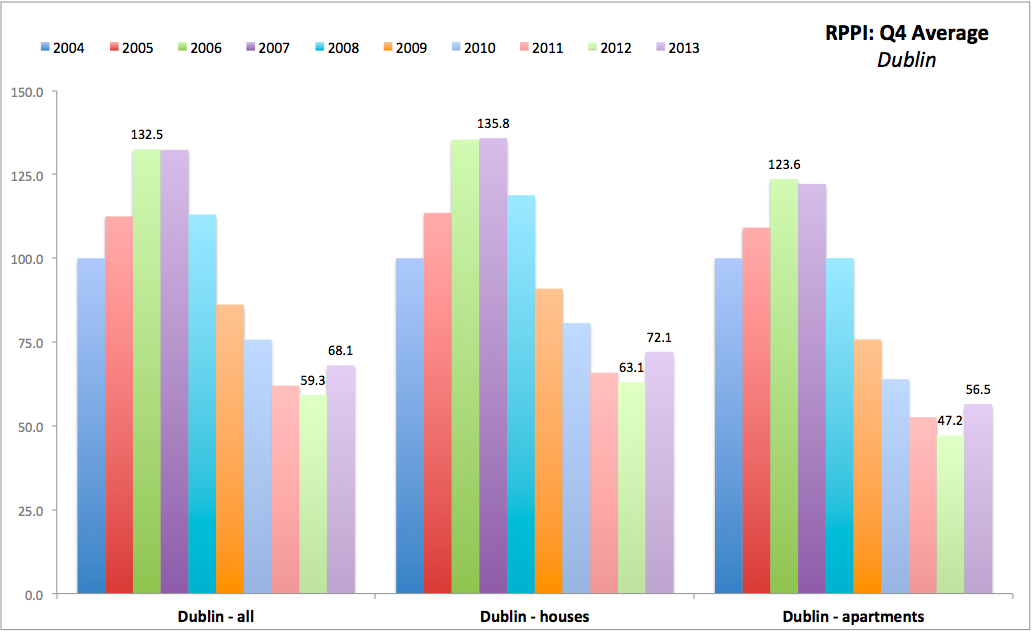
I am updating the annual series for Residential Property Prices in Ireland and here are some of the summary charts showing Q4 averages (end-of-year smoothed prices, that remove some of the volatility):


Key takeaways:

  • Reports of major recovery in the property markets over 2013 are a bit overdone. Here are the reasons why.
  • The recovery in Dublin in 2013 took the prices above the levels of 2011 and closer to 2010. Dublin all properties index finished 2013 at Q4 average of 68.1 which is well above 59.3 trough recorded in Q4 2012 and ahead of 62.0 recorded in Q4 2011. We are still less than 1/2 way to 2010, but overall jumping tow years back is a rather strong recovery.
  • Dublin recovery was also broadly supported in both houses segment and apartments segment.
  • However, outside Dublin - aka in the rest of the country - there is no recovery. National ex-Dublin all properties prices have fallen again in 2013 as they did in all other years starting with 2008 on. 
  • As the result of the prices dynamics in the rest of the country, 2013 'recovery' nationwide was able to lift prices off their crisis period troughs, but not enough to reach above the 2011-2012 declines. Thus overall index of nationwide properties is at 69.7 in Q4 2013 against 70.1 in Q4 2011. 
Are prices rising? They seem to be. Are prices rising above inflation? Yes. And this is one sign of a robust recovery. But are prices rising to make meaningful recovery toward pre-crisis levels (something that is required in order to rebuild household finances)? No. See more on this here: http://trueeconomics.blogspot.ie/2014/04/2642014-its-long-long-long-road-to.html