Friday, September 28, 2012

28/9/2012: 2012 Emigration hits record levels


Latest data from the CSO on Migration and Population changes estimates for the 12 months period April 2011-April 2012 shows that during the period of so-called 'economic turnaround' marked by the officially 'EU-average growth' attained in Ireland, Irish emigration has hit new post-1990 record levels.

Top line numbers are:

  • In April 2011-April 2012 Ireland registered 74,000 new births - a number representing the fourth highest number of births in any year since 1987.
  • Over the same period, the number of deaths stood at 29,200, implying the natural rate of increase in Irish population of 44,900 - also the fourth highest rate in history of the series, tied with the identical rate achieved in 2008.
  • In April 2011 - April 2012 52,700 people migrated into Ireland well below 69,900 average for 200-2006 period.
  • Over the said period 87,100 people left Ireland - a historical record level, beating 80,600 record set in April 2010 - April 2011 period and more than tripple the average rate of outward emigration (28,500) for 2000-2006 period. Overall rate of emigration is now 23% above that attained in the peak pre-crisis year of 1989.
  • Net emigration reached 34,400 in April 2011 - April 2012, marking the third highest rate of net emigration in history of the series. In 2000-2006 we averaged 41,400 net immigration per annum, implying a downward swing of 75,800 per annum. Net emigration hit the post-1990 record in the 12 months through April 2012.
  • As the result, Irish population expanded by only 10,500 in April 2011 - April 2012 period - the slowest rate of growth since 1990. In 2000-2006 period, Irish population grew on average at the rate of 71,200 per annum.
Charts to illustrate these trends:


Breakdown of net emigration by nationalities shows that the principal driver of emigration from Ireland is outflow of Irish nationals from the country, confirming the trend established in 2011.


Referencing the trends in migration that existed prior to the crisis, the current crisis period is associated with potential net loss of 219,300 persons in the period of 2008-2012. In gross numbers terms, 358,100 people actually emigrated from Ireland in 2008-2012.


If there is such a thing as 'demographic dividend' Ireland today is running at a massive demographic 'loss'.

Thursday, September 27, 2012

27/9/2012: Planning Permissions, Ireland, Q2 2012


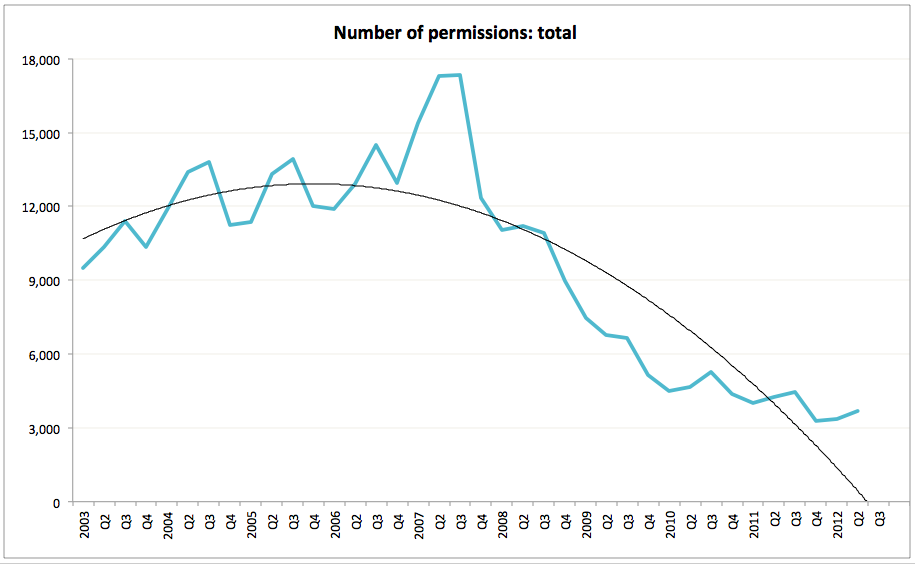
Planning Permissions for Q2 2012 were published today for Ireland, offering basically continuation of the trend established the end of 2010 which marks slower rate of decline in overall planning permissions. Chart below illustrates:


Total number of planning permissions rose 9.03% q/q in Q2 2012 to 3,672 (still 13.48% down on Q2 2011 and 78.8% down on peak).

In Q2 2012, overall number of planning permissions in Ireland for new dwellings dropped to 942 from 957 in Q1 2012 (-1.57% q/q), which is down 25.47% y/y and down 87.5% on peak. In contrast with new dwellings, other new construction permissions rose from 695 in Q1 2012 to 828 in Q2 2012 (up 19.14% q/q and up 14.84% y/y), which is still down 86.7% on peak.


Annual rates of change clearly show that the slowdown in the rate of decline is now persistent over two quarters for total number of planning permissions, while there is an acceleration in the rate of decline in the planning permissions for new dwellings.


Average square footage relating to new permissions granted is now moving sideways since Q3 2011, suggesting there is really no life in the market for new construction, even in the potential pipeline of work planned.

Sorry to say this, but no good news here.

Wednesday, September 26, 2012

26/9/2012: Nama valuations & August property prices


As promised - in the last post on today's data release for Irish Residential Property Price Index (RPPI) here's the summary of impact of latest price index movements on Nama valuations.

Note: the figures referenced are approximate and relate to averages of valuations, so these should be treated as a guide. Keep in mind that property prices reaching Nama valuations levels (adjusted for risk-sharing cushion and long-term economic value premium) still imply a loss on Nama books, in my view, due to costs associated with operations, plus the discounts on disposals of properties in volume and over time. Inflation adjustment further increases real loss.

Summary table:

In other words, we need 60%+ uplift on current price levels to achieve a break even on Nama average valuations.

26/9/2012: 2012 forecast for property prices in Ireland


In the previous post I covered main data for August Residential Property Price Index for Ireland. Now, annual forecasts based on data through August:


These imply a cumulated decline of ca3.2% on August 2012 through December 2012, a decline of 2.4-2.5% for Houses, a decline of 3.4-3.5% for Apartments, and a rise of 0-0.25% for Dublin. Obviously, these are not precise figures, so treat with caution.

I currently foresee decline of 51.5% for all properties in 2012 relative to the peak with range of forecasts of 55-61% decline through 2013 relative to peak for all properties index.

I have not updated these figures for some time now - over 6 months so there you go...


26/9/2012: Residential Property Price Index for Ireland, August 2012


Residential Property Price Index for Ireland (RPPI) for August 2012 is out today, triggering a torrent of usual commentary - some optimistic, some more bleak, depending on the focus of the analysis reported. Here are the facts:

Overall RPPI:

  • Index for all properties nationwide has risen marginally to 65.2 in August against July reading of 64.9 and this represents second consecutive monthly rise. M/m index rose 0.46% in August after posting a 0.15% rise in July. 
  • However, index reading remains below May when it stood at 65.5 and marks the third lowest reading in history of the series. 
  • 3mo MA for the overall index is now 64.97 in August and that is below 3mo MA ever recorded in the history of the series.
  • Y/y index fell 11.77% in August, which is an improvement on the fall of 13.58% in July and the shallowest annual rate of decline in any month since February 2011.
  • Overall residential properties prices are now 50.04% below their peak which is an improvement on the absolute bottom level of -50.34% on the peak, albeit statistically-speaking there is no discernable difference.
  • YTD average monthly change in the index is -0.68% and 12mo MA change is -1.03%. In other words, however you spin annual or monthly date, from September 2011 through August 2012 prices have fallen on average at a monthly rate of 1.03%.
Chart to illustrate:

Note, not a factual, but 'interpretative observation, we are seeing some attempts in the market to 'bottom out'. This does not mean that the market will bottom out here, but it does represent a first such instance of an attempt in the market.

Houses prices:

  • Safe as houses stuff prices rose to 68 in August from 67.8 in July marking second consecutive month of increases (in July prices rose 0.296% m/m and in August the rise was 0.295% - both statistically indistinguishable from zero).
  • However, as with overall residential prices, house prices through August failed to regain levels registered in May (68.2).
  • Y/y house prices are down 11.69% in August - slowest rate of annual drop since March 2011.
  • Relative to peak house prices are now down 48.48%
  • YTD average monthly drop is at 0.66% and 12mo MA monthly drop is at 1.03% so the same analysis for dynamics stands as for the overall RPPI above.
Chart on this below (after Apartments analysis).

Apartments prices:
  • Apartments prices firmed up to 46.9 in August from 45.8 in July and are still below the levels attained in June (47.6), implying the index is at the second lowest point in its history.
  • M/m prices rose 2.40% posting the first rise since April 2012. Y/y apartments prices are down 14.57% - the slowest rate of annual decline since February 2011.
  • Relative to peak, shoe boxes (err.. apartments) are now trading at a discount of 62.15%.
  • 12moMA of monthly deflation is at -1.53% and YTD average monthly price drop is -1.59%. Good luck if you are taking any solace from the one month blip.


Dublin prices:

  • Unlike the rest of the country (where I suspect prices changes are driven primarily by thin and selection-biased markets), Dublin property prices have continued steady decline dropping 0.52% m/m in August after 0.35% drop in July. 
  • August thus marks the second consecutive month since prices posted shallow increases in March-May 2012.
  • August also marks the month in which Dublin property prices have hit another record low at 57.3, with the previous record low attained in July (57.6) and in February 2012.
  • Dublin prices are now 57.40% below their peak.


I will be blogging later tonight on my forecasts for 2012 prices and on impact of these prices changes on Nama balancesheet, so stay tuned.

Tuesday, September 25, 2012

25/9/2012: Some questions on foot of latest ESM statement


From today's Joint Statement of the Ministers of Finance of Germany, the Netherlands and Finland (link here):
"Specifically, we discussed the governance, independence, decision making and accountability of the new Single Supervisory Mechanism involving the ECB. The new framework has to ensure that the ECB can continue to conduct effectively and independently its current tasks, and it has to take into account the concerns of non euro area Member States regarding governance of the new supervision. This requires appropriate governance structures and a clear division of responsibilities between a new ECB Supervisory Council, which may include representatives from all Members States, and the Governing Council of the ECB. To ensure the accountability of the new Supervisory Council, it should report on the stability situation and its decisions to European Finance Ministers (Ecofin Council or Eurogroup ) as well as provide reports to the European Parliament and national Parliaments."

Key points in my view are:

  • Core problem is the coordination of regulatory systems for euro area banks and non euro area banks is now further fractionalized into the space of 'supervised Euro area banks', 'non-supervised Euro area banks' (assuming the new Single Supervisory Mechanism (SSM) applies only to systemically important banks), 'non-Euro area banks in countries under mechanism', 'non-Euro area banks outside mechanism but inside the mechanism-covered countries', 'non-Euro area banks in countries outside the mechanism'.
  • The role of the Supervisory Council vis-a-vis the Governing Council of the ECB
  • The extent and nature of reporting by the Supervisory Council as well as the extent of the Ecofin / Eurogroup and EU Parliament oversight (if any) over the Supervisory Council activities.

"Regarding longer term issues, we discussed basic principles for enabling direct ESM bank recapitalisation, which can only take place once the single supervisory mechanism is established and its effectiveness has been determined. Principles that should be incorporated in design of the instrument for direct recapitalization include: 
1) direct recapitalisation decisions need to be taken by a regular decision of the ESM to be accompanied with a MoU; 
2) the ESM can take direct responsibility of problems that occur under the new supervision, but legacy assets should be under the responsibility of national authorities; 
3) the recapitalisation should always occur using estimated real economic values; 
4) direct bank recapitalisation by the ESM should take place based on an approach that adheres to the basic order of first using private capital, then national public capital and only as a last resort the ESM."

Points of note here are:

  • ESM recapitalization of the banks can only take place after the SSM is both established and proven in its effectiveness. Time scale for this? Anyone's guess. While time scale for Spanish economic meltdown is pretty well in front of our eyes.
  • Full and formal MoU will be required - a political no-go territory for some countries, though in fact the EU can fudge this requirement by simply re-printing as an MoU already ongoing 'reforms' processes.
  • Legacy assets should remain under the responsibility of national authorities, which means there is no coverage under the ESM for crisis-related assets. One can interpret this, possibly, as a de facto no to any removal of the Irish banks assets off the hands of the Irish state. One can also read this as a potential for restructuring some of the Irish Government liabilities relating to banks, but only to the extent of altering the cost of funding these liabilities (e.g. ESM loan with no change in actual liability risk, so that Irish banks-related debts will remain Irish Government liability).
  • Point (3) implies no 'future economic value' in computing ESM-available funding. In other words, losses incurred will not be covered. Which opens the question - who will cover the losses?
  • Point (4) is clear with respect to equity holders (these take the hit first, then the state owned equity is wiped out, only after that - ESM), but what about lenders to the banks (private bondholders and official lenders, including ECB)?


25/9/2012: One hell of a mess...


A quick quote from the recent Citi report on euro area economics, relating to ESM (emphasis is mine):

"Of the €500bn, €100bn is earmarked for future Spanish bank recapitalisation. If Ireland retroactively gets full mutualisation of sovereign debt issued to recapitalise its banks, that would require another €64bn. Equivalent treatment for Greece would cost €45bn and for Portugal €8.5bn. That would leave €282.5bn, a pittance compared with the likely future funding needs of Spain and Italy, unless the ECB
does most of the heavy lifting through the OMT."

Puts matters into perspective: Irish banking mess would cost EZ more funds than Greece and Portugal combined. Put alternatively, Irish taxpayers have done more to underwrite risks within the EZ banking system than Greek and Portuguese taxpayers combined. Take your pick of the option for interpreting...

To wet your appetite for explicatives further, here's another quote:

"We are still likely to see multiple sovereign debt restructurings of EA periphery sovereigns, starting possibly with Greece and probably lasting into 2015.

  • We expect Portugal will likely require sovereign debt restructuring, possibly in 2014-15, but could happen even earlier, both through OSI and through PSI (Private sector involvement). 
  • Unless Ireland benefits from major OSI, say in the form of a mutualisation through the ESM of up to €64bn worth of sovereign debt – the counterpart of the capital injection into its banking system provided by the Irish authorities between 2008 and 2010 – we believe it too is likely to see sovereign debt restructuring.
  • The Spanish sovereign and banking sector taken together are most likely insolvent. The relevant question then becomes what combination of mutualisation, bank debt restructuring and sovereign debt restructuring will occur...
  • Italy should never suffer a sovereign default due to inability to pay in our view. It is a rich country with massive private wealth and, by the standards of the periphery, is in a relatively good economic shape, although massive structural reforms are required to get out of the swamp the country now finds itself in."

25/9/2012: Some thoughts on US Government debt


There's much of a debate going on about which US President has added most to the US Government debt stockpile. The question is far from trivial.

Here's the chart plotting overall evolution of the US debt since 1980 with presidential tenures super-imposed onto it:

So far, it appears the contest is between Ronald Reagan, George W. Bush and Barack Obama. The tables below summarizes the presidential administrations' performance in terms of the US debt first in terms of absolute current US dollars and then in terms of debt to GDP ratios:


The problem is, of course, two-fold:

  1. Presidential tenure starts in year 1, for which some of the budgetary dimensions are already Pre-set by the previous administration, and the tenure ends in year 4, when the outgoing President sets out some of the legacy measures for the incoming one;
  2. Presidential tenures range between 4 and 8 years in the above period.
Controlling for the (1) is hard, so let's assume that the incoming President shares the burden of fiscal regime setting in year 1 with his predecessor. Tables below show this analysis:


The last two columns in the above summarize overall rates of change per year in office and this makes it clear:
  • Current administration leads in terms of overall rate of increasing the US Government debt by a factor of 5 times that of the Reagan administration;
  • The above does not account for inflation, as figures stated are in current US Dollars, but to match Barack Obama's rate of increasing public debt in real terms to that achieved by the Reagan administration we need annual inflation in excess of 6.5% pa. Meanwhile, over the period GDP deflator averaged 3.56%pa, while CPI averaged between 2.95% and 2.96% (depending on annual metric chosen);
  • Obama administration also leads, by a massive margin, every other administration in the rates of debt increases relative to GDP.


Monday, September 24, 2012

24/9/2012: Irish Building & Construction decline v EU27


Last post on Irish Building & Construction sector data for Q2 2012. Here are the comparatives for EU member states based on current activity (through Q1-Q2 2012) compared to 2006-2007 peak levels:


No need to comment on the above...

24/9/2012: Irish Building & Construction Sector Activity Q2 2012


And in another post prompted by @stephenkinsella tweet, here's an update on CSO data for Irish Building & Construction sector activity:

Ex-Civil Engineering:

  • Value index fell to 17.6 in Q2 2012 from 18.7 in Q1 2012, marking 5.88% decline q/q and down 15% y/y.
  • H1 2012 Value index is down 12.11% on H2 2011 and down 13.78% on H1 2011.
  • Value index fell to 15.5% relative to the peak and volume index declined to 14.66% of the peak level
  • Volume index dropped to 15.6 in Q2 2012 down on 16.7 in Q1 2012, marking a 6.59% decline q/q and 16.6% decline y/y. 
  • H1 2012 volume index was down 13.17% on H2 2011 and down 14.55% on H1 2011.
  • Both Value and Volume indices are now down on an annual basis for 22 consecutive quarters.


Civil Engineering:
  • Value of Civil Engineering activity rose from 58.4 in Q1 2012 to 62.7 in Q2 2012 (+7.36% q/q) and advanced 11/4% y/y, registering the first annual rate of increase after 15 quarters of contraction.
  • H1 2012 value index rose +1.68% on H2 2011 and is up 5.21% on H1 2011.
  • Volume of activity also grew from 52.3 in Q1 2012 to 55.8 in Q2 2012 (+6.69% q/q and +9.8% y/y) also breaking for the first time annualized contraction period of 18 quarters.
  • H1 2012 volume index rose 0.93% on H2 2011 and is up 4.75% on H1 2011.


Residential and non-residential:

  • Residential construction value index fell from 9.1 in Q1 2012 to 8.6 in Q2 2012 (-15.7% y/y and -5.49% q/q). H1 2012 index was down 9.69% on H2 2011 and down 16.51% on H1 2011. Relative to peak, the index is now down 92.45%.
  • Residential construction volume index fell to 7.7 in Q2 2012 from 8.3 in Q1 2012 (decline of 7.23% q/q and down 17.2% y/y). The index is now down 92.53% on peak.
  • Non-residential construction value index fell from 55.4 in Q1 2012 to 51.5 in Q2 2012 (-14.7% y/y and -7.04% q/q). H1 2012 index was down 14.41% on H2 2011 and down 12.23% on H1 2011. Relative to peak, the index is now down 58.23%.
  • Non-residential construction volume index fell from 49.4 in Q1 2012 to 46.0 in Q2 2012 (-15.8% y/y and -6.88% q/q). H1 2012 index was down 15.12% on H2 2011 and down 12.48% on H1 2011. Relative to peak, the index is now down 58.89%.


To sum up: rates of decline are (annually) in double digits and/or accelerating in Q2 2012 in Residential (value and volume), Non-residential (value and volume) and ex-Civil Engineering (value and volume). Residential construction is now at 8.6% of 2005 levels in value terms and 7.7% of 2005 levels in volume terms. Non-residential construction is now at 51.5% of 2005 levels in value terms and 46% in volume terms. Civil Engineering activity is now at 62.7% of 2005 levels in value terms and at 55.8% in volume terms. All activity ex-civil engineering is now down to 17.6% of 2005 levels in value terms and 15.6% in volume terms.

24/9/2012: Euro peripherals Building & Construction activity


Here's a chart updating to latest data index of Building & Construction sector activity in the peripheral euro area states:


As inspired by @StephenKinsella: "Ouch!"

24/9/2012: Italy's debt overhang effect


Via @FGoria on twitter, this chart on Italy's potential GDP and output gap:
Shows brilliantly the cost of Italy's public debt overhang as a steadily falling potential GDP growth and sustained structural recession since ca 1990-1992. Better yet, shows that even cheap liquidity in the naughties failed to produce any real effect on the economy.

Now, keep in mind, Italy is suffering solely from the Government debt overhang, with relatively benign debt levels on household and corporate balancesheets, and with relatively functioning banking system.

Sunday, September 23, 2012

23/9/2012: Euro area bonds supply Sept-October 2012


5 weeks from September 14th - cumulated gross supply of sovereign bonds of €70.5bn and €57.3bn of redemptions and coupons:


And supply calendar


All courtesy of Morgan Stanley

Thursday, September 20, 2012

20/9/2012: Russian stock market performance for September


Danske analysis of emerging markets performance for September - a nice chart:


Spot RUB - Russian markets.

20/9/2012: Is 'Johnny the Foreigner' at fault? Q2 Irish trade results


In the real world, confronted with the unpleasant truth, we usually react with a denial of the facts and a desperate search for someone else, other than ourselves, to blame for the misfortune. Today's QNA data release triggered exactly this basic psychological reaction. With no reason for it, other than 'let's get Johnny the Foreigner out to blame', some of the favorite economists of our Minister for Finance decided that 'Irish economic growth is suffering from the slowdown impacting our main trading partners'.

Right... and Lehmans caused Irish banks collapse and bungalows prices deflation... that sort of malarky.

Now, that is either an uninformed error of judgement, or an outright lie, folks. In reality, exactly the opposite is happening - our external trade is still booming, while our internal, home-made depression is still raging.

I wrote about the domestic activity collapse already earlier (here's the link). Now, let's take a look at the activity arising from the allegedly falling demand from our trade partners.

First in current prices terms:

  • Exports of goods & services from Ireland to the rest of the world hit €45.01 bn in Q2 2012, up 6.21% y/y. This marks a slowdown in growth from 7.4% y/y growth in Q1 2012, but nonetheless, in Q1 2012, Irish exports of goods and services hit an absolute record since Q1 2006. I wouldn't be going around saying that a historic record is... err... a drag on our growth.
  • Exports of goods alone rose 1.26% y/y in Q2 2012, down on the 4.02% rate of annual growth in Q1 2012, but still posting an absolute record for any quarter since Q1 2006.
  • Exports of services rose 11.46% y/y in Q2 2012, faster than already blistering growth of 11.11% y/y in Q1 2012. Again, volume of exports of services hit an absolute record level for any quarter since Q1 2006.
But maybe the 'Johnny the Foreigner' baddy is pushing down Ireland's growth in real terms? Ok, in constant terms:
  • Exports of goods & services from ireland rose 2.06% y/y in Q2 2012, posting, yep, you know this much already, an absolute record in level terms for any quarter since Q1 2006.
  • Exports of goods did fall off y/y - declining 4.42%. Which amounts to a drop of €973 million which is less than €3bn plus lost to patent cliff. So, err... the demand from US, UK and EA has nothing to do with this, but rather patents expiration in pharma sector drives the decline.
  • Meanwhile exports of services grew, in constant prices terms, by a massive 9.05% in Q2 2012 compared to the same period of 2011.
As the result of these gains and also as a function of our own (not US, UK, EA, etc) demand collapse (marked by the decline in imports), our trade balance (the net positive contributor to our GDP and GNP) has actually expanded

Irish trade surplus has grown by a massive 18.98% in Q2 2012 in current prices terms and by impressive 14.47% in constant prices terms. Things are actually so good when it comes to 'Johnny the Foreigner Demanding Irish Exports' that our services sector posted an absolute historical record surplus in Q2 2012 of €1,387mln - for only the third time in the series history since Q1 2006. Our total trade balance surplus reached €11.391bn in Q2 2012 - by far the largest surplus reading in any quarter since Q1 2006. This is 14.1% higher than the previous quarterly record attained in Q3 2011.

Here are two charts to summarize trade balance changes:


The problem, of course, that our Green Jersey folks are not too keen on acknowledging is that overall, Johnny The Foreigner thirst for Irish goods and services has preciously little connection to our GDP activity. But that, illustrated below, is a different story.


20/9/2012: 'Flat growth' and the shrinking Irish economy


Ok, folks... the latest batch of news from CSO and the official 'Green Jerseys' reaction to same would have made a fine candiate for a Nobel literature prize, were they published in a single tome with a heading Literature of Absurd on it...

We have our routine 'Housing market has bottomed out' shrills from the property pushers in the media - despite the fact that property prices continue to fall. We also have the metronome-like 'Unemployment has stabilized' tale, a chapter of gargantuan efforts to avoid mentioning the fact that fewer and fewer people actually work in Ireland, earning living and paying taxes.

Today we have a new pearl: 'Irish economy is growing once again, albeit slowly'.

Complete porkies, if you ask me. Here's the plain and simple reality of what's going on:

In constant market prices terms, Irish GDP based on constant factor cost (in other words, the real activity in the economy carried out by MNCs and domestic enterprises, net of taxes, gross of subsidies) grew 2.3% (+€819 mln) q/q in Q2 2012. Alas, as usual, q/q growth is... err... mostly meaningless. Instead, y/y comparative shows this metric shrinking €300mln (-0.8%).

What's the dynamic here? Oh, not good, either. In Q2 2011, y/y real GDP (constant factor basis) grew 3.21% y/y. In this quarter it shrunk 0.8% y/y... a negative growth swing of 4 percentage points!

Now, adding taxes (net of subsidies) to the above figure produces official real GDP (GDP expressed in constant prices terms). This stood at €40.327 billion in Q2 2012 up €744 mln on Q1 2012 (+1.9% q/q) but down 1.1% (-€442mln) y/y. Now, wait, folks... so official GDP is down y/y. Not up.

What's the dynamics of this change? Oh, well, in Q2 2011 official real GDP was up 2.86% on same period in 2010, so Irish economic growth has overall deteriorated in Q2 2012 compared to same period a year ago by a whooping 3.9 percentage points.

Next step is for us to subtract from our real GDP outflows of payments abroad (net of inflows of income from abroad) - the so-called Net Factor Income From the Rest of the World adjustment. Bear with me here. It is important.

In Q2 2012 we, as economy, have managed to send out €7.219 billion in factor payments abroad, net of what we received from abroad. Sounds a lot? Not really - this is down on €8.397bn in Q1 2012 (which added €1,178mln to our GNP) and it is down €1,385 mln on Q2 2011 (which adds same amount to our GNP compared to Q2 2011 levels).

What the above means? Here's the punchline to reality: as the result of €744mln increase in our GDP and a €1,178mln decrease in our payments abroad, our GNP officially expanded by €1.922bn in Q2 2012 q/q. Meanwhile, due to a contraction in real GDP of €442mln offset by reduction in outflows of income abroad of €1,385mln, our GNP rose €943mln (+2.9%) y/y in Q2 2012.

Thus, real economic activity in Ireland fell, y/y in Q2 2012, but because the MNCs have decided to expatriate less income out of Ireland in Q2 2012, our GNP actually rose.

Why would MNCs decide not to expatriate much of profits? For a number of reasons:

  1. Lack of capital investment around the world means corporates have no incentive to move profits out of Ireland outside the immediate objective of boosting reported profits at home;
  2. Booming equity markets in the US mean that there is no immediate pressure for US MNCs operating here to ship retained profits out of Ireland's tax heaven;
  3. Fall-off in pharma exports from Ireland also took a bite out of the retained profits here.
Any of these have any tangible effect on our real economy? Not really. Actually - none whatsoever. 

In real economic terms, Irish economy shrunk in Q2 2012 by 1.1% (real GDP terms) y/y and that is it, folks. 

One more note. In seasonally adjusted, constant prices terms:
  • Personal Consumption of Goods & Services has hit absolute record low in Q2 2012 of €19,598mln for any quarter since Q1 2007.
  • Net Expenditure by Central and Local Government on Current Goods and Services has hit an absolute low of €5,934mln in Q2 2012 for the entire period since Q1 2007.
  • Gross Domestic Fixed Capital Formation has hit a record low of €3,427mln
  • Exports of Goods and Services have posted a contraction on Q1 2012 but are up €1 billion on Q2 2011
  • Imports of Goods and Services have posted a q/q contraction of €1.7bn and are now at a historical low for any Q2 period of 2007-present period
  • Total domestic demand is now at the absolute lowest point for any quarter since Q1 2007 and is down €1.6bn on Q1 2012 and €1.9 billion on Q2 2011.
This is not flat growth, folks. This is shrinking real economy.

Note: I will post updated charts later tonight. Stay tuned.

Tuesday, September 18, 2012

18/9/2012: Irish exports credit guarantee


Leaves you speechless:

I am hearing that Irish Gov Exports Credit Guarantee Scheme requires +2% fee for participation to be paid by SMEs.

Risk-weighting of such schemes=0%, as this is a de facto re-insurance scheme with Government assuming liability only in third teer in the worst case scenario.

UK equivalent Scheme=-1%.

Thus Irish-UK differential for companies successfully exporting = +3% surcharge to the disadvantage for Irish SMEs.

Really, it appears we do tax our SMEs successes and then call this 'support' policy!

Monday, September 17, 2012

17/9/2012: Russian economy shows signs of pressure build up


Big jump in producer price inflation in Russia (via fxstreet.com link here):

This confirms build up of inflationary pressures (see note on CB of Russia latest move in tightening monetary policy last week: link here).

Meanwhile, industrial production posted a slowdown in growth in August, rising 2.1% y/y after posting 3.4% growth in July, but ahead of .9% in June. The slowdown was concentrated primarily in Electricity, Gas and Water sector (+0.2% y/y) and the Mining & Quarrying sector (+0.8% y/y), with Manufacturing sector expanding at 4.1% y/y. M/m industrial output fell 0.7% in August, reversing gains of 0.8% in July. So far, January-August 2012 cumulated growth in Industrial Production stands at 3.1% y/y.

Twin effects of slower growth and rising producer prices suggest that either the slowdown might accelerate over time with inflation on the costs side (wages) feeding into reduced capacity of the producers to absorb twin pressures of shrinking exports demand and rising cost base.

On the other hand, we have continued general upward trend in Russian equity markets:
MICEX up from 1389 3mo ago to 1532 currently. The market is betting on temporary nature of the slowdown?

IMF has indicated they might downgrade Russian growth forecasts for 2013-2014 on foot of continued build up of pressures from European demand for Russian exports.

Sunday, September 16, 2012

16/9/2012: Who pays for the Banks Guarantee? Irish Mortgage Holders


Another interesting snippet from the IMF report on Ireland's performance:

"The already low net interest margin fell by 40 basis points in Q1, to 0.8 percent of average assets. Though funding costs fell by 35 percent from Q4 2011 reflecting the actions of a leading bank to lower deposit rates, this was not enough to compensate for weakening interest income due to higher loan impairments and the drag from low yielding tracker mortgages. The ELG fee remained high, at 110 basis points in Q1, absorbing some 40 percent of the net interest margin (up from 28 percent in Q4 2011)."

What does this mean?
1) Banks are suffering from lower margins due to declines in ECB rate having an adverse impact on their tracker mortgages book. They compensate by soaking savers (deposit rates down) and ARMs (adjustable rate mortgages are up).
2) Instead of allowing banks more funds to cover mortgages losses, the (1) above - soaking of savers and ARMs - goes primarily to fund Mr Noonan and the State (via ELG fees paid by the banks for the Guarantee cover to the Exchequer).

Great. As a holder of an adjustable rate mortgage, I get taxed by Mr Noonan once on household charge (soon to be replaced by a property tax) and  via ELG. Well done, 'low tax Government'. Of course, I am also being used to subsidize tracker mortgages, including buy-to-lets.

16/9/2012: IMF on PCARs and banks recaps


In the latest IMF Article IV Consultation paper on Ireland, the fund made some interesting observations on the ongoing Irish property bust. Here are some of these:

Firstly a chart showing where we are at in terms of current declines in property prices relative to other crises and in duration:


Next, there's a very revealing statement on the banks recapitalizations process (PCAR 2011) in relation to mortgages arrears (the statement that predates Professor Honohan's expression of doubt that PCARs were robust enough to all dealing with the mortgages arrears):


"Residential mortgage arrears continue to rise, but remain within the assumptions for bank recapitalization. As of end March 2012, almost 14 percent of the total principal balance of owner occupied residential mortgages outstanding was affected by arrears of 90 days or more, broadly doubling since end 2010. [Note: IMF seemingly had no desire to update their analysis for more up-to-date H1 2012 data released by CBofI and CSO (see here and here) before they published the Article IV paper].

Nonetheless, the overall arrears balance, together with developments in house prices and
unemployment, remain within the adverse scenario of the Prudential Capital Assessment Review (PCAR) that guided bank recapitalization in 2011.

[Italics are mine. The reason why I find this important is that the banks were not recaped to the adverse scenario requirements, but to the baseline scenario requirements plus cushion. The difference is significant: Overall, Blackrock estimated that BlackRock lifetime loan losses post-deleveraging would amount to €27,522 million in baseline case rising to €40,119 million in adverse case. Of these, the Central Bank assumed that only €20,014 million will take place pre-2014 in the baseline case and only €27,722 million in adverse case. That's a difference of €7 billion right there. The CBofI then made some additional assumptions and determined that €18.7 worth of capital will be needed by the banks overall. Clearly, given that this was less than what the banks estimated themselves to be the case (banks own forecast provisions totalled €17.04-22.23bn for baseline to adverse scenario cases), the CBofI 'imposed' additional 'cushion requirements' to raise overall capital requirement under PCARs to €24bn. But, wait, that is not consistent with the adverse scenario that IMF is referencing above, which is €27.7bn! So the banks were not recapitalized to the adverse scenario levels and IMF is using this term 'adverse' here to rather politely point out to the Irish authorities that the proverbial sh*t might be hitting or about to hit the fan.]

More so: "It is notable that about half of total arrears arise from loans that have already been
restructured, although part of these arrears could have arisen prior to each loan restructuring, so the effectiveness of rescheduling of distressed loans is unclear." [Now, we know this much ourselves - in H1 2012, more than 52.65% of already restructured mortgages were in arrears (see here)].

"Repossessions and voluntary surrenders of property are also very low, cumulating to 0.2 percent of the stock of mortgages on owner-occupied dwellings in the 11 quarters to March 2012. This is consistent with the one-year moratorium on repossessions of primary residences  under the Code of Conduct on Mortgage Arrears, but may also reflect a need to buttress the repossession framework."

Some charts:


Two things to note here: table above includes voluntary surrenders of properties, something that CBofI does not ordinarily publish in their mortgages arrears data, and the chart below shows just how thin the margins are on PCAR 'stress scenario'.

So things, according to the IMF, are for now within the parameters of the adverse scenario and, per chart above, within the stress scenario. Which seems to be just about ok, when it comes to PCAR injections to-date. But crucially, there is stress building up here. Only 1 year into the programme of recapitalizations, the banks are close to hitting the wall again.

Saturday, September 15, 2012

15/9/2012: A handy IMF map for Budget 2013?


The elephant in the room (at 9% of GDP or 11% of GNP, with pensions - at 10.6% GDP or 13 of GNP, that's right more than one euro in eight) - courtesy of the IMF:


15/9/2012: Russia to revamp SWF structure


According to the report in the Euromoney ( http://www.euromoney.com/Article/3087655/Category/4298/ChannelPage/0/Russias-new-SWF-seeks-bond-and-equity-exposure.html?copyrightInfo=true) Russia will launch a new state-owned investment agency in 2013 "to invest the country’s oil wealth in global financial markets, finance minister Anton Siluanov tells Euromoney in an exclusive interview."

The new Federal Financial Agency (FFA) will have investment mandate to cover "a more diverse range of domestic and international securities, including bonds and equities for the first time, under an investment strategy similar in part to that employed by the Norwegian sovereign wealth fund (SWF)". Anton Siluyanov, Russian finance minister said the FFA "will be managed by investment professionals and will be free from government intervention".

The fund will have under management assets of $150 billion-worth of investment funds in Russia’s existent Reserve Fund and the National Welfare Fund. These are currently managed from the Central Bank.

The net positive here is that the fund will be free to invest in domestic non-state owned enterprises - a significant opportunity for deepening Russian capital markets. It also can provide some new support for corporate debt issuance inside Russia. To-date Russian SWFs were primarily invested in foreign sovereign bonds. New allocation, according to Siluyanov, can be closer to 15%-20% equities.

15/9/2012: Derivatives v Banks Lending and Economic Growth


A recent by Becchetti, Leonardo and Ciampoli, Nicola, What is New in the Finance-Growth Nexus: OTC Derivatives, Bank Assets and Growth (July 20, 2012). CEIS Working Paper No. 243 (Available at SSRN: http://ssrn.com/abstract=2114072) covers the issue of "finance-growth nexus before and around the global financial crisis using for the first time OTC derivative data in growth estimates."

According to the authors, data shows "that bank assets contribute… negatively [to economic growth], while OTC derivative positively or insignificantly with a much smaller effect in magnitude. At the same time the impact of the crisis is captured by a very strong negative effect of year dummies around the event."

The study lists various positive and negative channels for feedback from the derivatives to growth and establishes the net effect of these channels.

"Our main finding is therefore the identification of three empirical channels: a first positive and weak link between OTC trading and economic growth, a second negative and significant link between aggregate bank credit and economic growth (larger in magnitude than the first) and the negative impact of the global financial crises in the last years of our sample period. The first channel is likely to capture wealth and efficiency effects embedded in derivatives hedging properties. An overall evaluation of the role of derivatives on growth deserves however further attention. If the negative impact of bank credit, and definitely more so, the overall negative effect of the financial crisis have to be related to the negative properties of derivatives (increase of interconnectedness and systemic risk) the net impact of the latter may turn out to be negative at least in the current regulatory framework."


15/9/2012: In life things are a bit like in art


The best illustration of the current Presidential Campaign in the US is this painting by Mark Tansey:

Depicting Sherlock Holmes and Professor Moriarty in a deadly struggle at the edge of the precipice. One articulate and sophisticated villain v one cool dude who delivers over the fiscal cliff. Ah, one would hope we can distinguish which one is which: is Holmes = Romney or Obama? Never mind, the truth is - it's the cliff that dominates the whole set up.

15/9/2012: Brazil soaks bank bondholders


H/T to Ed - here's Brazil shutting down one medium-sized insolvent bank (link) and triggering the largets corporate bonds default in Latin America since 2002.

According to the report, ATMs still are functioning in Brazil. 

And a lovely quote from the Irish Government advising HSBC (alas via their Brazil division):

“It is quite healthy to have this kind of reminder every once in awhile that doesn’t pose a systemic threat,” said Pedro Bastos, chief executive officer of HSBC Global Asset Management in Brazil, in a phone interview from Sao Paulo. “It’s an important reminder that risk and return need to be in line with the investor’s profile.”

And lest we think Brazil's CB is not 'reckless' enough (in Irish counterparts parlance), Brazilian authorities are investigating fraud allegations - something that Irish authorities are not too keen on doing.

Obviously, there will be likely costs associated with the decision, namely, funding costs for the country medium sized banks might rise (they will most certainly rise in the short term, but it is the medium term that anyone should be concerned with as Central Banks can provide the bridge for the shorter term funding).

15/9/2012: Irish Services Activity July 2012


Recent release of the monthly Services sectors activity index for Ireland highlights the stabilizing nature of the current activity in the economy, since the end of Q1 2012. Here are some details:

Overall seasonally-adjusted monthly services activity rose 1.2% in July 2012 m/m and was up 7.8% y/y. Index 3mo MA through July is at 104.9 ahead of the 3mo MA through  March 2012 (101.6) and well ahead of 98.9 reading in 3mo to July 2011. Year on year increase of 7.8% is the strongest since November 2010. (Note: index is being compiled only since October 2010, so trend comparatives are against weak position. Index is set at 100=2009).

Here's the chart summarizing index levels and y/y growth rates:


By-sector activity:
  • Wholesale and Retail Trade (+3.4% m/m and +8.0% y/y), 
  • Business Services (+2.5% m/m and 3.1% y/y), 
  • Accommodation and Food Service Activities (+1.2% m/m and no change y/y) and 
  • Information and Communication (+0.1% m/m and +16.3 y/y) 
  • Transportation and Storage (-3.5% m/m and 8.0% y/y), and 
  • Other Services (-2.2% m/m and +0.9% y/y).

Chart to illustrate:


3mo MA through July 2012 are also encouraging:
  • Wholesale & Retail Trade at 109.7, up on 107.8 3 months ago and on 103.4 a year ago
  • Information & Communications at 112.9 well ahead of 109.4 in 3mo through April and on 99.6 recorded in 3 months through July 2011
  • Business Services at 103.3, strongly up on 98.4 in 3 months through April, but unchanged y/y
  • Transportation & Storage at 109.0, up on 104.0 in 3mo through April 2012 and on 98.2 a year ago
  • Accommodation and Food remain the lagging sector despite Government efforts to stimulate it at 89.0 in 3mo average through July 2012 slightly up on 87.1 in 3mo through April 2012 and down on 90.3 in 3mo through July 2011.
  • Other Services are also relatively flat, but with a slight upside at 74.3 in 3mo through July 2012 compared against previous 3mo average of 72.4 and 3mo through July 2011 average of 72.8.
Overall, some good news here and a continuation on the trend highlighted a month ago.

Friday, September 14, 2012

14/9/2012: 36 years of state-incentivised inflation?


Some historical (up to August 2012) charts on Irish CPI. Orange bars mark state-dominated categories of goods and services. Interpret these as you wish. Summary table at the end is pretty much self-explanatory:


14/9/2012: Irish CPI for August - detailed charts


With some delay, here's the analysis of latest Consumer Price Inflation data for Ireland for August 2012:

Summary table of monthly and annual changes
Note: I will blog on overall inflation trend separately in the next post.

Here are changes by sector, including notable changes by sub-sector.

Monthly inflation:


Big spikes are in:

  • Clothing and Footware +6.6%
  • Mortgage Interest -3.2% (although CSO does not separate the differences between the ARM and trackers, which have been moving in the opposite directions)
  • Transport +1.6% (Petrol up 3.5%, Diesel up 4.0%
  • Transport Services +0.5% driven by Air Transport (+1.0%)
Year on year comparatives are more revealing:


The above clearly shows that most of the inflation on annual basis remains concentrated in the state controlled sectors (either via regulatory price hikes or direct state taxation and charges effects or via semi-states hiking prices on their own). Note that even in the 'Other Services' category, the inflation is driven by household charge being added in April 2012.

The Government strategy is clear, albeit, unlike the previous Government, the current one stays away from openly declaring this: milk Irish consumers for every penny they got via higher charges and state-captured prices. In effect, much of the price increases not caused by direct state taxation are still a form of taxation as the Government collects higher VAT and other taxes on those goods and services, provision of which it controls via semi-state bodies.

14/9/2012: Another Indo 'Property Boom Cometh' Missive


An interesting article in the Indo on house prices vs debate about the property tax or site value tax - link here.

A key phrase that caught my eye is: "CSO reports show that prices increased in Dublin".

The latest CSO report we have is that covering data through July 2012, which states:

  • Dublin All Residential Properties: June prices down 1.0% m/m (down 0.3% on 3 mo before June, down 16.4% on 12 month to June 2012); July prices down 0.3% m/m (down 1.2% on 3mo before and down 16.6% on 12 mo before);
  • Dublin Houses: June down 0.8% m/m (0.2% on 3 mo ago, down 16.4% y/y) and July down 0.2% m/m (down 0.5% on 3mo ago and down 16.7% on a year ago);
  • Dublin Apartments down m/m, on 3mo and y/y in May, June and in July down 3.9% m/m, down 8.6% on 3 mo previous and down 19.6% on 12 mo ago.
So unless Indo has either discovered some new data set from CSO, or it has some CSO data on dog houses and parking spots in Dublin (all of which might have gone up in July), then what on earth are they talking about?


14/9/2012: Russian CB raises rates


Bank of Russia hiked key refinancing rate to 8.25 by 25bps on the foot of rising inflation pressures, with current rate back at the levels seen last in November 2011. The bank also hiked overnight repo rate to 5.5% and deposit rate to 4.25%.

Inflation in agricultural commodities is the core driver as Russia raised some food tariffs and as weaker crops bit into domestic supply. Imports demand for agricultural goods and relative pressure on the ruble vis USD are additional factors.

The signal from the BR is relatively clear: although Russian economic growth has been under some pressure in H1 2012, inflation is back on the rise, hitting 5.9% in August up on record low of 3.6% back in Q2 2012. BR target is for inflation at 5-6% so the move is reactionary, rather than precautious. The balance in BR decision is between containing inflation and political fallout from rising food prices, associated pressure on the ruble, against the corporate sector demand for capital. In other words, the BR is comfortable with the overall levels of investment in the economy in the short run. This highlights the dilema faced by the Russian policymakers, who are aware that Russia needs to push up domestic investment in core areas where capital modernization is desperately required: manufacturing and industrial base, as well as basic infrastructure. This longer term objective is likely to be supported by a combination of public investment and incentives for longer term private investment. With this in mind, recent restructuring of the Russian SWF and easing of the new SWF mandate to invest in a range of financial instruments, including listed equities.

Chart for Russian CPI forecasts:


Tuesday, September 11, 2012

11/9/2012: Inherent limit to artificial intelligence?


In a rather common departure from economics (as defined by rational expectations subset of the discipline) on this blog - here's a fascinating thinking about the artificial intelligence and the bounds of model-induced systems.

Especially close to me, as it explores that which I thought about back in 2003-2004 when I wrote an essay on the role of leaps of faith (irrational and discontinuous jumps in human creativity and thinking) as the foundation for humanity and, thus, a foundation for recognition of the property rights over uncertainty.