Friday, March 8, 2013

8/3/2013: Why Economists Failed to Predict the Twin Crises?


Wonderfully interesting recent CEPR (DP No. 9269) paper titled THE FAILURE TO PREDICT THE GREAT RECESSION. THE FAILURE OF ACADEMIC ECONOMICS? A VIEW FOCUSING ON THE ROLE OF CREDIT by Maria Dolores Gadea Rivas and Gabriel Perez Quiros (http://www.cepr.org/pubs/new-dps/dplist.asp?dpno=9269.asp) takes up a gargantuan task of trying to answer why (and indeed if) economists failed to predict the latest financial and real economic crises.

In addition, the real economic downturn "has also highlighted the lack of consensus in macroeconomic thinking about how far the financial system influences economic activity."

"Basic economic theory suggests that, in a frictionless world, the shocks originating in credit markets play only a minor role in explaining business cycles. However, the presence of financial imperfections can amplify their effect on the real economy and, thus, disturbances in credit markets can lead to larger cyclical fluctuations in the real economy. These frictions also provide micro-fundamentals for analyzing the channels of transmission." This is known as the financial accelerator mechanism.

However, prior to the crisis, "the most influential dynamic general equilibrium models developed just before the recession by Chistiano et al. (2005) and Smets and Wouter (2007) do not incorporate any financial accelerator mechanism. The debate at that time was about the effect of frictions, nominal and real, and the role of monetary policy to offset these effects on output and inflation."

Since the onset of the crisis, a new strand of literature has taken prominence in economics, dealing more directly with the links between the economic and credit cycles. This literature is empirical, rather than theoretical in nature and focuses on historical data of financial crises. Much of the literature concludes "that there are strong similarities between recent and past crises and, consequently, the Great Recession is nothing new" and that credit growth acts as a powerful predictor of financial crises, with external imbalances useful ind erecting the turning points. Majority of studies conclude that "credit booms tend to be followed by deeper recessions and sluggish recoveries."

Per authors, "all these papers have much in common, both in the stylized facts derived from them and in their methodological foundations. They provide considerable evidence that financial markets, and credit in particular, play an important role in shaping the economic cycle, in the probability of financial crises, in the intensity of recessions and in the pace of recoveries. The argument is that the strong growth of domestic credit and leverage that fuelled the expansion phase became the trigger for a financial crisis and, therefore, for a recession4. A common finding is that downturns associated with financial crashes are deeper and their recoveries slower."

The clarity and the robustness of the new studies' results begs a question as to why "the financial accelerator mechanism did not appear earlier on the agenda of the theoretical business cycle models"? "It seems that the link between financial and real crises is so obvious that economists should have been blind when looking at data before the crisis to miss such an important feature of the data. Significantly, however, all the papers that find this clear empirical evidence date from after the financial crisis started."

The real question to ask, therefore, is "whether this ex post evidence, could be obtained ex-ante and if it is sufficiently robust to assist with economic policy decisions"?

In other words, ex-post crisis studies do not "take into account the fact that recession dating is uncertain in real time. Furthermore, when the macroeconomic variables have the property of accumulating during the expansions periods, a potential bias may arise because these variables usually present high levels just before the turning points. For example, from this literature, an analyst could extract the lesson. However, during long periods of expansions, credit to GDP growth is high and there is no recession. Also, credit as a proportion of GDP accumulates over time endogenously in different theoretical models, …and, therefore, it is endogenously high when expansions are long. Yet these high levels before turning points do not imply any power of the credit to GDP ratio in predicting the turning points. In medical terminology, the previous literature is more interested in the ”anatomy” of financial
crises, after they have occurred, than in ”clinical medicine”, that is, diagnosis from the symptoms. …For the lessons extracted from the data to be of value to policymakers in their day-to-day policy decisions, we have to understand the dynamics of these financial variables in real time without forgetting the uncertainty about turning points."

This is a brilliantly put introduction to the core thesis of the paper: "to consider the cyclical phases and, especially, recessions in an environment of uncertainty. Policymakers that see credit to GDP growing have to decide when the growth is dangerously high and could generate a turning point. If a long expansion keeps generating a high credit to GDP ratio endogenously, to cut credit dramatically could unnecessarily shorten the period of healthy growth."

Put differently, "the key question for a policymaker is to what extent the level of credit to GDP (or its variation) observed in period ”t” increases or not the probability of being in a recession in ”t +1”, or whether it changes the characteristics of future cyclical phases."

To answer these questions, the authors propose "a novel and robust technique for dating and characterizing business cycles and for analyzing the effect of financial and other types of variables. We combine temporal and spatial data and we show that this approach is legitimate, notably reduces the uncertainty associated with the estimation of recession phases and improves forecasting ability in real time."

The key results can be summarized as follows:
-- "Credit build-up exerts a significant and negative influence on economic growth, both in expansion and recession, increasing the probability of remaining in recession and reducing that of continuing in expansion."
-- "However, these effects, although significant, are almost negligible on the business cycle characteristics.
-- The authors show that "there is no significant gain in forecast performance as a consequence of introducing credit."
-- Thus, "in contrast to the previous literature, our findings indicate that the role of credit in the identification of the economic cycle and its characteristics is very limited."

Per original (and by now secondary) question asked the authors claim that their "results also explain why financial accelerator mechanisms have not played a central role in the models that describe business fluctuations. The financial accelerator was not a key point in explaining business fluctuations simply because, empirically, it did not have such a close relationship to the business cycle, either in a sample (prior to the crisis) or in an out of sample approach, once the uncertainty in dating recession periods is included in the model."

This is a really interesting paper with fundamental implications for macroeconomics and one of the earliest attempts to reconcile empirical predictability and theoretical clarity of core modern theory (namely that of the financial accelerator) relating to the financial crises and the links between the financial and real economic crises.

8/3/2013: The Cyprus' Russian Bail-in Dilemma


With the new Government in place and with more urgency than ever before, Cyprus is heading for the last ditch effort to secure the bailout from the Troika.  However, all indications are there will be no agreement in March, pushing any potential deal closer to the June 3 when EUR1.415 billion of Government bonds come to maturity. The bonds amount to a massive 9.65% of the country GDP and are unlikely to be rolled over unless at a punitive yields.

Cyprus original request for the bailout dates back to June 2011, looking for up to EUR17bn (ca 100% of GDP) and the current foot-dragging from the EU is a clear signal of Frankfurt's and Brussels' conviction that the acute peripheral crisis is now over and there is little risk of contagion from Nicosia. If the full EUR17bn were granted, the bailout would push Cypriot Government debt to ca 145% of GDP, well ahead of the IMF-set sustainability threshold of 120%.

Furthermore, the EU policymakers clearly perceive Cypriot crisis to be distinct from other peripheral states while Cypriot banking system (the cause of the crisis) to be decoupled from the rest of the euro area. The former smacks of the usual euro area denialism, while the latter is probably closer to truth. Nonetheless, someone has to be concerned with sustainability of any debt in excess of 90-100% of GDP in an economy that is about to take a massive hit at the heart of its growth engine: banking and associated exportable services.

Cypriot banks hold assets valued at 8 times the country GDP (roughly EUR 120 billion worth of assets), with deposits of roughly EUR70 billion recorded prior to the recently started 'quiet' bank runs. Within last week alone Cyprus banks lost just over 2% of their deposits. Around 42-43% of these deposits belong to foreign (primarily British and Russian) residents.

The latter are now at the crosshair in the EU vs Cyprus war for bailing-in the depositors in insolvent Cypriot banks.

In 2012, there were some 60,000 Russian expatriates living in Cyprus, a country with the total population back in 2011 at 1.116 million. Russia was the second largest source of tourists inflows into Cyprus in 2011-2012 and Russia received FDI of USD12.3bn via Cyprus (although probably 99%+ of this was recycling of funds that originally left Russia for Cyprus). In 2011 Russia extended a EUR2.5 billion bilateral loan to Nicosia. Despite common theme in the press about Cypriot banking system being used for Russian tax evasion, Russia and Cyprus have signed and ratified the Protocol to the Double Taxation Treaty.

At the end of 2011, many, but not all and not even majority, of the non-Euro deposits in Cypriot banks originated from Russia - amounting to ca EUR18 billion (more than 100% of the Cypriot GDP), but just 20% of the total deposits in the country. Russians are also major holders of equities in BOC and CPB banks. These Russian deposits have declined since then. More ominously, the accounting of these deposits is somewhat dodgy. There are many conflicting figures out there.

Below is the table - courtesy of the Piraeus Bank - detailing the deposits structure in Cypriot banking system through early 2012:


In contrast, Fitch (via International Herald Tribune) reported slightly different figures that are at odds with both above figures and the Min Fin claims (see below):


According to the Min Fin, as of end of 2012, Cyprus banks deposits remain around EUR70 billion and less than EUR30 billion of these are accounted for by foreign depositors, with Russian deposits standing around EUR15 billion. The problem is that all of the above figures include deposits in Cyprus-regulated pure Russian banks, such as division of VTB, for example, which are not going to be covered by the bailout or the haircuts.

A recent estimate by the Euromoney puts non-domiciled Russian deposits in Cyprus closer to 7-10% of total deposits or EUR5-7 billion.


Confusion aside, it is relatively clear that so-called Russian 'oligarchs' funds, while prominent in the overall deposits volumes, are neither the source of the Cypriot problems, nor a source for the sustainable solution to that problem. Even a 50% bail-in of these would not deliver (given the existent EUR100,000 guarantee on deposits, and the fact that large volumes of the Russian money is most likely held in the names of EU-registered entities) Cypriot system to health or even to contribute more than EUR2-2.5 billion to the EUR17-17.5 billion bailout.

Matters are worse, when it comes to bail-in of Russian depositors, when one considers the existent and growing links between the real economies of the two countries. In 2008, Cypriot economy gained EUR1.9 billion (11% of GDP) from tourism trade surplus. Inflows of Russian visitors to the island were up 55% in 2011 in y/y terms and they now represent the second largest source of tourism revenues after the UK (although Russian tourists account for only around 8-10% of all visitors to the island, as opposed to the UK tourists who accounted for closer to 50%). A loss of Russian tourism in the wake of any bail-in would be pretty hard to offset for Cyprus' economy left without the core pillar of International Financial Services. Country income from accounting and legal services amounted to ca EUR700 million or 4.0-4.1% of GDP in 2008, and much of that came from Russian residents, businesses, investors and depositors.

Russian investments in real estate in Cyprus (excluding Russians resident in Cyprus) amounted to ca 7% of total real estate investment back in 2006, a rate that is 1/10th of the UK residents investments there, but nonetheless - significant support for the economy. And this excludes investments by Russian nationals resident in Cyprus.

Overall, prior to the crisis, Russian business and individual activities in Cyprus contributed closer to EUR600-800 million in annual revenues to the economy, excluding taxes and wages. Applying some multipliers to that suggests overall GDP contribution from Russian-linked activities to Cypriot GDP of some EUR2 billion annually or up to 11.7% of the country GDP.

In other words, bail-in of Russian depositors can gain Cyprus some EUR2-3 billion under very adverse conditions imposed on non-resident depositors and cost Cyprus some EUR0.75-1 billion in annual economic losses. How fast does this math start spelling net loss? And how fast does this math start spelling inability to service 120% or so debt/GDP ratio post bail-in?

8/3/2013: Industrial Investment in Ireland 2012


Summary of the capital acquisitions in Irish industry over time:
 and by broad sectors:

Key conclusion: no restart of investment cycle in the Industry in 2012, including the MNCs. Stripping out Pharma sector, net acquisitions of capital in 2012 were at EUR2,516.3mln down from 2011 EUR2547.8mln, and roughly equivalent to the average of 2008-2011 period of EUR2,511.5mln.

Note: all data is based on today's update by the CSO. See http://cso.ie/en/releasesandpublications/er/cai/capitalassetsinindustryquarter42012/#.UToLydFHBF8

8/3/2013: German Lawmaker Challenges Debt Restructuring for Ireland & Portugal


Not exactly good news, and not exactly earth-shattering either, but...
http://www.reuters.com/article/2013/03/07/eurozone-germany-bailouts-idUSL6N0BZI9320130307

The point worth raising is that if Enda & Co do achieve restructuring of our Troika loans, they would de facto deliver a restructuring of Ireland's super-sovereign debt. This raises a number of issues:

  1. Why are we seeking restructuring super-senior sovereign debt ahead of seeking to restructure non-sovereign debt, such as, for example banks debts?
  2. If restructuring were to materially impact our long-term debt profile by lowering the NPV of our debt, would this not qualify as a 'structured' or 'cooperative' default? I know - the matter here is not material, but rather a label, yet don't we have a Government that staunchly refuses to default on private debts assumed by the State and then goes for a default (or even quasi-default) on super-senior debt?
These questions closely relate to the work I have done over the recent years on Irish Government debt and most directly to my chapter in What if Ireland Defaults? (link the chapter in a working paper format here: http://papers.ssrn.com/sol3/papers.cfm?abstract_id=1985617)

Thursday, March 7, 2013

7/3/2013: Irish Mortgages Arrears Q4 2012

Mortgages arrears data for private residences in Ireland for Q4 2012 was published today by the Central Bank of Ireland. Few surprises.

As expected, arrears rose. Unexpectedly, the rate of increase was much much slower than before in q/q terms and slower in y/y terms. As encouraging as this might sound, there are some points of concern outlined below. Here are some details of data dynamics first:


  1. In Q4 2012 there were a total of 792,096 accounts relating to private residential mortgages in Ireland - a massive y/y increase from 765,267 accounts in Q4 2011 due to 'reclassification' of some mortgages accounts.
  2. This 'reclassification' made historical comparatives in terms of, say, arrears as % of the total mortgages, utterly useless. This is how Irish official stats go: relabel, re-order, and if it makes things look better by coincidence - spin. 
  3. Total number of mortgages in arrears for private residences rose from 141,389 accounts in Q3 2012 to 143,851 accounts in Q4 2012 - an increase q/q of 1.74%, well below any q/q increase since the beginning of the series. Average increase since Q3 2009 when the data started stands at 6.51%.
  4. Y/y total number of mortgages in arrears increased 21.43% in Q4 2012, the slowest rate of annual increases since the beginning of the series and below the average of 27.77%.
  5. Overall, in Q4 2012, 18.16% of all mortgages still outstanding in the country were in arrears. Adjusting for the CBofI 'reclassification' of mortgages accounts to allow for more direct historical comparative, 18.85% of all mortgages were in arrears. 
  6. Number of mortgages at risk or defaulted (defined as mortgages currently in arrears, restructured and not in arrears, plus repossessions) has risen in Q4 2012 to 186,785 (or 24.48% of the total adjusting for 'reclassifications', 23.58% based on official data) from 185,933 in Q3 2012. This implies a rise of 0.46% q/q and 19.61% y/y. Both represent the slowest rates of increase in series (short) history.
Two charts to illustrate:


Good news: the rates of arrears build up have slowed down in Q 2012. 

Bad news, getting worse slower is not the same as getting better. Especially given the deterioration tallied from 2009 through today. 

Worrying side: impacts of property taxes, banks guarantee lift-off, repossessions orders regime change, and personal insolvency 'reforms' are not visible in the current latest data. All represent a threat of accelerating arrears once again. 

Real news: just under 1/4 of Irish private residences-linked mortgages are now at risk of default, in arreas or defaulted and some 650,000-700,000 people are currently impacted by this crisis to the point of being unable to meet the original conditions of their mortgages.

7/3/2013: Are stocks more volatile in the long run?

A recent paper by Lubos Pastor and Robert F. Stambaugh, titled Are Stocks Really Less Volatile in the Long Run? (first published NBER Working Paper Series No. 14757; Cambridge: National Bureau of Economic Research, 2009.) and subsequently in the Journal of Finance (vol 67, number 2, April 2012, pages 431-477) looks at the annualized returns volatility to stocks returns - the central concern for investors and finance practitioners. 

The study uses predictive variance approach to the analysis of volatility and look at what happens to predictive variance as the investment horizon increases. Conditional variance is variance in returns conditioned on the set of information known to investors.The predictive variance is therefore the conditional variance, where conditioning information is taken at the time when investors make their assessment of the risks (volatility) and returns implied by an instrument. 


Now, it is commonly established that stock returns volatility per any given period falls over the longer periods, potentially due to mean reversion, as majority of the studies show or argue. But this only relates to volatility as measured concurrently - in other words unconditionally. Of course, investors face volatility as expected on the basis of conditioning variables, and this predictive variance, it turns out, actually is higher, not lower, over the long periods. The study shows that this reversal of the relationship between investment duration and volatility of returns holds even once we control for mean reversion. In other words, uncertainty about future expected returns is a core driver of higher long-horizon variance in stocks.

7/3/2013: New Vehicles Regs for February 2013


New data on new vehicles licensed in Ireland in February is out and it makes for some depressing reading:

Note the precipitous decline in New Goods Vehicles - down 23% in February and down 21.4% in two months through February. This suggests that even if the "131" license plates are having an adverse effect on purchases, the investment cycle is not turning around still. Good Vehicles are a form of business investment in capital. They are also subject to set depreciation schedules, implying the need for replacement at some relatively stable rate over time. If economy was showing any signs of recovery, retail and wholesale trades, plus other domestic and exports-related activities would have translated in higher rate of capacity utilisation, including for goods vehicles. This, in turn, should translate in higher rates of replacement and new investment. So far - the data shows the opposite.


It is worth noting that the total number of used imported private cars licensed in February was 3,717 against 3,312 a year ago and the number of used goods vehicles rose from 737 in January-February 2012 to 883 in the same period 2013. Still, net effect is that of a more marked decline in goods vehicles than in private cars.

Here's the summary of historical data:


And the summary clearly shows that in terms of All Vehicles, we are now back to the levels of sales consistent with January- February 1994, in terms of New Vehicles sales and in terms of New Private cars sold to the level seen back in the end of 1993. Meanwhile, the State continues to rip off motorists at the ever increasing rate via fuel costs, registrations, VRT, VAT, licenses cost, etc.

Wednesday, March 6, 2013

6/3/2013: BlackRock Institute Economic Cycle Survey 03/2013


BlackRock Investment Institute has released the latest results from its Economic Cycle Survey for EMEA and North America & Western Europe.

Before looking at the results, note:

  1. The survey represents the summary of the views of a panel of economists polled by the BlackRock Investment Institute, and not the view of the Institute itself
  2. In some instances, survey covers small number of responses (see two tables below detailing the depth of coverage), with low coverage corresponding to survey results being indicative, rather than consensus-conclusive.

So core results for North America and Western Europe regions:

In effect, little change from the previous surveys for Ireland, which remains solidly decoupled in terms of economists consensus from the peripheral states (the latter are all clustered in the upper RHS corner, corresponding to both high expectations of continued recession and current indicator of the present recession). In the case of Ireland, it is obviously very hard to tell whether or not Ireland is currently in a recession. Both GDP and GNP changes q/q and y/y do not warrant official designation of a recession, but nonetheless the economy is running at well below its potential capacity.


Per chart above, it is clear that despite the Eurostat projections for 2013 growth, Ireland does not lead the Euro Area in terms of forward expectations for economic growth when it comes to the economists' assessment.

Now on to EMEA results:


Pretty much predictable weakening of Russian growth for 2013 is reflected in the above. Two other interesting points:

  1. The weakest performing states in terms of current conditions and expectations are the ones with closest ties to (and membership in) the Euro zone;
  2. Weak performance for the Ukraine is reflective of the country continued political mess and the lack of sustainable fundamentals in terms of the country orientation vis-a-vis its main trading partners (the contrasting reality of the private sector closely tied into the CIS and more precisely Russian markets for investment and trade, juxtaposed by the political re-orientation toward Europe).


Note: here are the tables detailing the extent of the survey coverage depth:


6/3/2013: Reality v PR Spin - Irish Economy


An excellent article in the Irish Examiner today on the state of our economy as contrasted by the state of our PR/spin machine: http://www.irishexaminer.com/opinion/columnists/colette-browne/enda-needs-to-be-a-better-salesman-when-flogging-economic-recovery-pitch-224593.html

Tuesday, March 5, 2013

5/3/2013: Irish trade with BRICs: 2004-2012


Four charts on Irish bilateral goods trade with Bric countries:


5/3/2013: Another Consumer Confidence Report Goes Off-Road

To the 'turning around' reports from the Eastern Front ca 1943... err... 2013... per KBC Ireland/ESRI Consumer Sentiment Index, consumer sentiment in Ireland fell in February to 59.4 compared to January reading of blistering 64.2. The report gets 'serious' on dynamics: "The three-month moving average also decreased from 59.3 to 57.8. The index fell below the average for the last 12 months (61.9)."

Let me add some more dynamics to this. First, let's look at January 2012 data (since we do not have Retail Sales Indices for February yet):
  • Current 3mo average for Retail Sales Value Index is 96.8, down from 96.9 for 3mo average through October 2012, Volume is up from 100.3 to 100.5. Overall, indices are basically flat (+/-0.1% is not a significant change by anyone's standards, even for this Government);
  • 3mo average of Consumer Confidence index through January 2013 was 59.3 down on 63.7 for the 3 months though October 2012.
  • 6mo average, however, shows a slightly different story: Value of sales is up from 95.3 average reading for 6 months through June 2012 to 96.8 average for 6 months through December 2012; Volume is up from 98.8 to 100.4 over the same period, and Consumer Confidence is up from 105.8 to 107.7.
KBC/ESRI Consumer Sentiment Index is about as good of a gauge for retail sector activity here as the elephants' herd gate tempo is of use for timing the Swan Lake pas de deux. If you don't believe me, here's a chart:


In the nutshell, consumer confidence hit the bottom in July 2008 and since then things were, apparently improving. So much so that by June 2012 Value of Retail sales has hit the absolute record low, whilst Volume of sales did same in October 2011. There is a gentle uptrend in consumer confidence since mid-2008 against a downtrend in both Volume and Value of core retail sales.

Taken on 3mo average basis (to cut down on volatility), Confidence indicator has virtually nothing to do with Retail Sales, except for high sounding press release comments from the experts:


Per ESRI: "The promissory note deal was announced roughly half way through the survey period. The announcement of the deal would appear to have had some positive impact, with a preliminary analysis of responses showing an improvement in sentiment after the deal. We await the March results to see if the impact on sentiment is sustained.”

Indeed, we await... eagerly. 


In addition, Austin Hughes, KBC Bank Ireland, noted that [comments are mine] “A disappointing aspect of the sentiment data for February was that the decline was broadly based. Consumer spending power remains under pressure and there is little to suggest a dramatic improvement in Irish economic circumstances that would cause a ‘feel good’ factor to emerge anytime soon. [A revelation of most profound nature] 

"About the best that can be expected is a slow easing in the ‘fear factor’ that would encourage a gradual increase in spending. This may not be spectacular but it still represents significant progress. [What progress he might have in mind beats me, as Retail Sales figures continue to show little signs of reviving from already abysmally low levels]
 

"...The Irish consumer is seeing an improvement in ‘macro’ conditions across the economy but their personal finances remain under pressure. [In other words, we are in that ESRI & KBC-lauded 'exports-led recovery' boom, folks, where you and I get screwed, while MNCs get to report greater 'sales'] 

"It may be that some consumers had unrealistic expectations as to what a deal could achieve. [Did Government enthusiasm in over-selling the potential impact propelled enthusiasm of consumers for the 'deal'?] 

"More generally, it remains the case that consumers face significant further austerity in the next two Budgets. [Doh! We'd be discovering new Solar Systems, next] 

"The deal may ease the pain somewhat but it doesn’t entirely remove it. So, we shouldn’t expect a surge in confidence. That said, the fragile situation of Irish consumers means they are sensitised to bad news. So, failure to reach a deal could have seen sentiment deteriorate quite sharply.” [In other words, we were saved from an apocalyptic collapse of consumer confidence by the wisdom and the heroic efforts of the Government... and ATMs are still working!]

Irony has it, the same 'positive newsflow' that went along with the index slide this time around also supported (according to the authors) index surge in January - see here for January release comments: http://www.kbc.ie/media/CSI.Jan20131.pdf Who says you can't have a cake and eat it at the same time?

I don't know what to do - laugh or cry... cup of coffee is needed, however, as much as some serious improvements in survey to bring it closer to reality on the ground. It is needed because:
  • While Consumer Confidence index through January 2013 (to take period consistent with data availability for both Retail Sales Indices and Consumer Confidence Index) was up 13.4% y/y, while actual retail sales rose just 0.94% in Value and 0.71% in Volume. 
  • Compared to 2005 average, Retail Sales Value was down 3.42%, Volume was down 0.22% and Consumer Confidence was up 26.82%.
  • Even with February 2013 moderation, Consumer Confidence is now up 17.33% on 2005 average.
  • Worse than that, taking Crisis Period averages (January 2008-present), Value of Retail Sales is now running at 96.6 against the average of 101.17 (or 4.51% below average), Volume at 99.8 against the average of 103.49 (or 3.56% below average), whilst Consumer Confidence is running at 7.37% above the Crisis Period average of 55.32.

5/3/3013: Irish Services PMIs: February 2013

Irish Services PMI (published by NCB) for February were out today, highlighting some interesting (for a change) shifts in the short-term trends worth discussing.

The headline numbers were good, although less strong than those recorded in January. This is not surprising since PMI surveys are biased toward multinationals in some core driving sectors (due to weighting factors attached to sectors and the overall quality, collection and reporting of data biases).


  • Seasonally-adjusted Business Activity (headline index) declined to 53.6 in February from 56.8 in January 2013, but remained above 50.0 line. 
  • 12mo MA through February 2013 was 53.0, which is not statistically significantly different from 50.0, but nonetheless represents a reading consistent with moderately strong expansion of activity. This marks the seventh consecutive month of readings above 50.0 although February was the second slowest month for activity over this latest period of consecutive expansions.
  • 3mo MA through February is now identical to the previous 3mo MA through November 2012 - both at 55.4. For comparative purposes: 3mo MA through February 2010 was 47.2, through February 2011 - 52.1, through February 2012 - 50.0, so annualised activity is running ahead of previous 3 years.
  • Main point to be made in the above is that since roughly April 2010, we have been trending along a new late- or post-crisis trend along the average of 52.1 average (49.6 to 54.6 range) as compared to May 2000-December 2007 average of 57.6 (52.5 to 62.7 range). As charts above and below clearly show, the new trend is (1) lower and (2) less steep in take-offs from the local minima (lows). In my view - this shows two factors: Factor 1: overall slower rate of growth (do keep in mind that the current trend is coming off historical lows of the Great Recession and should be consistent with much faster uplift and higher average and range than pre-crisis trend), and Factor 2: more mature nature of business in Irish Services sectors (with ICT and Financial Services now in advanced stages of late investment cycle compared to the period of 2000-2007 when these were growing rapidly and posting recovery from the dot.com bubble).
Now on to some of the components of the headline index.


  • Chart above shows that New Business sub-index also posted moderation in the rate of growth in February 2013 compared to five months of robust expansion prior to February. In fact, February reading of 53.1 was the slowest pace of expansion in seven months, although it does come on foot of seven months of consecutive above 50.0 readings. 
  • Trend-wise, the same conclusions that were drawn in the last bullet point on the headline index - those relating to structurally slower pace of growth in the recent years compared to pre-crisis rates of expansion - continue to hold for New Business sub-index as well. Since April 2010, the sub-index averaged 51.3 (range of 48.4 to 54.2) against pre-crisis (May 2000-December 2007) average of 57.4 (range of 52.4 to 62.5).
  • On short-term dynamics, 3mo MA through February 2013 stood at 55.4, slightly down on 55.8 3mo MA through November 2012, but ahead of 47.2 3mo MA through February 2010, ahead of 52.1 3mo MA through February 2011 and ahead of 50.2 3mo MA through February 2012.
Chart below summarises the shorter-range data for the two core indices.


Two charts plotting other principal components of the overall index:


Focusing on few sub-series of interest:
  • Employment sub-index remained above 50.0 in February, posting a reading of 52.5 - the shallowest expansion since September 2012, but marking a sixth consecutive month above 50.0. 3mo MA now is at 54.1 and previous 3mo MA through November 2012 was at 53.0. Good news - in 2009-2012 3mo MA through February was below 50.0 in every year. Bad news is that Employment is closely linked with Profitability (see below).
  • Business Confidence / Expectations 6mo out are continuing to fly high, propelled most likely by a combination of current upbeat conditions (the two series: Expectations and Current Conditions show the strongest co-determining relationship of all series, suggesting that the real driver for Expectations is not actual anticipation of the future events, but rather firms' assessment of current conditions) and by the endless barrage of feel-good propaganda from the business lobby and the State. The last, third factor, is human nature (aka 'winner's curse' bias). We expect things to get better because they were pretty damn awful until now and for a very long time... Come on, folks, let's face the music - unless you are a transfer-pricing arbitraging MNC, things are hardly getting any better. And, unless you live in the world of Googlites (aka 25-30 year olds with no attachment to anything save a party on a weekend) you are facing a mountain of debt, shrinking assets and wealth, higher taxes and the prospect of more of the same. What 'confidence at 69.1' can we have in mind? 
  • Oh, and to top things up - you'd think that Confidence comes from higher profits for the firms... Well, in the Wonderland of Transfer Pricing it is not and hence in Ireland we have Services sector where profitability is shrinking (41.5 in February on 49.2 in January) for 62 consecutive months now (since January 2008, every month there was negative profitability growth, with the average shrinkage at 41.9 - aka very very very deep contraction), but businesses confidence has been up on average at 60.9 - aka very very strong confidence growth on monthly basis).
If anything, aside from the major trend outlined in the first set of bullet points above, the point on Confidence and Profitability is the second main conclusion from the longer-term data analysis, for it exposes the surreal nature of the Irish economy - economy distorted by extreme transfer pricing and tax optimisation activities of the MNCs.

Now, let's touch briefly on the main short-term observation from today's data release: the core drivers for each of the main sub-series:
  • When it comes to Business Activity index, level support at 53.6 in February was provided by a broader base of sectors, with Technology, Media & Telecoms sector (TMTS) posting comparable expansion to Transport, Travel, Tourism & Leisure sector (TTTLS). This is similar to what was observed back in October 2011 and is an improvement on the trend that (at least over the last six months) have seen TMTS being the main and dominant driver of the index improvements.
  • Business Activity Index for Expectations out 12 months ahead was dominated (as in every one of the previous 6 months) by TMTS, with Business Services Index coming in as the second upside driver (same as in January 2013).
  • TMTS was the main driver for the third consecutive month behind growth in Incoming New Business, while Financial Services were the main driver over the last 4 months behind the growth in the Incoming New Export Business.
  • In Employment generation, TMTS again outstripped all other sectors for the third consecutive month, which, of course, means we are only reinforcing the demographic misalignment emerging in the economy with main generation of new jobs taking place in sectors that are more reliant on importing skills from abroad.
  • TMTS was the only sector in which profitability improved in February 2013 (same as in December 2012 and January 2013). In all other sectors, profitability was in decline for the third consecutive month. Why, you might ask? Interestingly, TMTS saw the sharpest countermovement in input/output prices, with input costs posting sharpest acceleration in February, and output costs posting the sharpest deterioration. In any normal economy that would mean shrinking, not expanding, profit margins. But in Ireland, of course, there is little normal about the TMTS sector dominated by the massive MNCs aggressively using their Irish activities for tax arbitrage from their European and even global operations.
Some interesting stuff, eh? You bet official 'analysis' of Irish PMIs is not talking about any of this...

5/3/2013: Charts to Keep You Awake at Night


Bragging rights alert...

Business Insider published their slide deck of charts that keep investment community awake at night... The full 'horror show' is on here: http://www.businessinsider.com/wall-streets-most-worrying-charts-2013-3#

I have contributed the following chart: http://www.businessinsider.com/wall-streets-most-worrying-charts-2013-3#constantin-gurdgiev-trinity-college-dublin-37


Sunday, March 3, 2013

3/3/2013: Global Economic Outlook - economists' consensus


BlackRock Investment Institute published a summary of the views of over 430 economists from more than 200 institutions, spanning over 50 countries that form the BlackRock Investment Institute's Economic Cycle Survey Panel. It is worth stressing that:
1) These are not the views of the Institute, but the views of the Panel, and
2) Since the Panel is still in the process of built up, some countries have 'thin' coverage - with small number of respondents specialising in the specific country analysis.

The aggregate view from the most recent round of surveys is presented below (due to size limitations, it is probably best to view this as a separate image, so double click on the image below):


3/3/2013: Some recent links on Science funding in Ireland

Recent changes to the Irish State funding for scientific research and the hatchet job of 'restructuring' the policy formation mechanisms for science funding and development have been in the newsflow for some time.

Here are a couple of very good links relating to the matter:


Of course, in fairness to the Irish Government, Europe-wide 'Smart Economy' and 'R&D-intensive growth' leaders are also slashing funding for research http://www.nature.com/news/europe-s-leaders-slash-proposed-research-budget-1.12403 . Maybe burning books will be our next pass-time, offering the economically uplifting marshmallows over a flaming Group Homology tome, anyone?

Friday, March 1, 2013

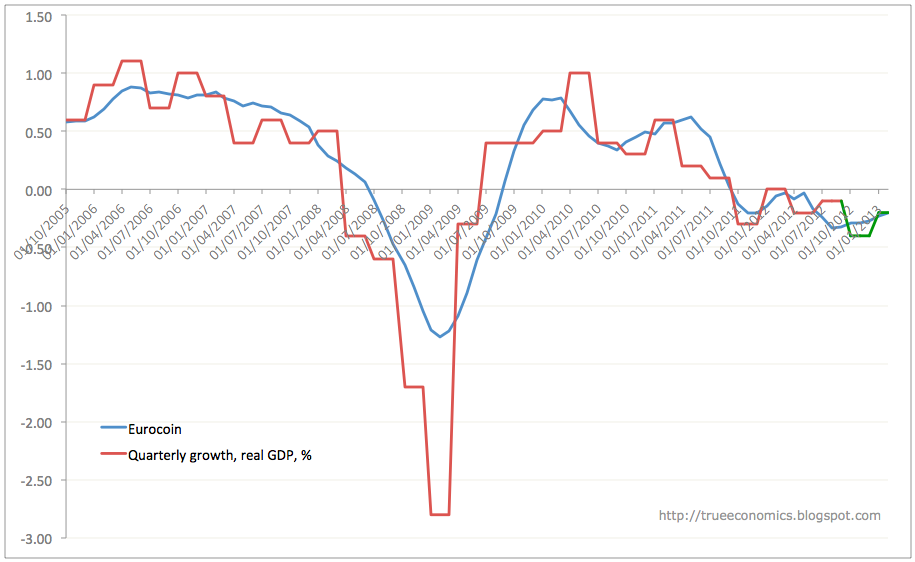
1/3/2013: Eurocoin February 2013 - 17 months-long recession?

February eurocoin leading growth indicator for the euro area, published by the Banca d'Italia and CEPR came in at another sub-zero reading of -0.20. This marks statistically insignificant improvement from -0.23 in January 2012.

More ominously, the reading posts 17th consecutive monthly below-zero reading. Put differently, on monthly average basis, eurocoin has been posting sub-zero readings since March 2011.

Y/y comparatives are even worse. Back in February 2012 the indicator stood at -0.06, and in February 2011 it was running at a blistering pace of +0.57, while in February 2010 we had a reading of +0.77. In fact, this is the lowest reading for any February since the depths of the Great Recession in February 2009.

Two charts to illustrate the eurocoin dynamics and associated implied growth forecasts:


  • 3mo MA is now at -0.233, while 6mo MA is at -0.267. 2008-2009 crisis-period average was -0.31. Draw your own conclusions (STDEV = 0.471 for historical record and 0.560 for the crisis period).

As I pointed out before, the last 12 months of economic performance in the euro area have shown very clearly that the ECB monetary policy stance is not working. Here are the same illustration (updated to February 2013 figures) once again:


Growth-consistent level of the ECB rates is zero. Meanwhile, with slowly moderating inflation still above the target, inflation-consistent rates are probably closer to 1.25-1.5%.


Inexistent fiscal policy at the euro area level is matched by the dysfunctional monetary policy. Next stop? Possibly political psychosis?

Thursday, February 28, 2013

28/2/2013: Boring, Boring Property Prices in January


When one is bored, truly deeply bored, it is hard to muster much strength to go through the twists and turns of the data. And I am bored, folks. Irish property prices data, released by CSO today, is simply equivalent to watching a fish flopping on hot asphalt - it is simply, clearly, obviously, patently... not going anywhere.

That is the story with the stats from Ireland nowadays - the flatline economy, punctuated by the occasional convulsion up or down.

Alas, to stay current we simply have to go through the numbers, don't we?

Let's first do a chart. Annual series for 2012 are finalised and were revised slightly down on the aggregate index compared to the previous release:


The chart clearly shows that despite all the talk about 'bottoming out' house prices, and 'buyers throwing deposits on unfinished homes' is a quasi-2006 frenzy, property prices in Ireland fell over the full year 2012.

Recall the prediction by some economists that property prices are likely to stabilise around -60% mark on peak? I made similar claim, but referencing in the medium term Dublin and larger urban areas, while stating that nationwide prices will be slower to react due to rural and smaller towns' property markets being effectively inactive. Guess what? Dublin prices were down 56.3% on peak in 2012. Not exactly that badly off the mark. Apartments prices - down 61.1% on peak. Exceeding the mark. Nationwide, properties were down 49.5% on peak, still some room to go, but in my view, we are still heading in the direction of 60% decline.

Now, onto monthly series.

Nationwide Property Prices: 

  • All properties RPPI declined from 65.8 in December 2012 to 65.4 in January 2013 (down 0.61% m/m) and is down 3.25% y/y. 
  • Despite all the 'stabilisation claims', overall RPPI has not posted a single month y/y increase since January 2008. 
  • The 'good news' is that RPPI rate of decline (in y/y terms) has slowed down for the 9th consecutive month in January 2013.
  • 3mo MA has been static now over the last 3 months at 65.77, which simply means that half of the gains that were made from the historical trough of 64.8 in June 2012 to the local peak of 66.1 attained in November 2012 were erased when the index fell to 65.8 in December. January rise is a tiny correction back up.
  • Let's put this differently. January 2012 index returned us back exactly to the level of prices recorded in April 2012 and then repeated in October 2012. 
  • The market is... lifeless. Irony has it: 3mo cumulated gains through December 2012 were exactly zero. 3mo cumulated change in the index through January 2012 is exactly zero.
  • 6mo cumulative gains are more 'impressive' at +0.77%.
  • But put this into perspective: this rate of 'growth' implies annualised rate of +0.878%. At this rate of annual expansion, the next time we shall see 2007 peak level prices for properties, expressed in nominal terms, will be 2092. 
Dublin:
  • Prices in Dublin corrected slightly up in January to 59.5 from 59.2 in December 2012. Latest reading is still below 60.0 local peak recorded in November 2012, so the correction is so far very much partial.
  • Y/y prices are now firmer at +2.06% in January, having posted -2.47% decline in December. January marked the first month that we had y/y increases in prices since November 2007.
  • The rate of price increase in January in y/y terms, however, is basically solely correcting for inflation, which means that for anyone with a mortgage payable today, property 'wealth' is continuing to drop in real terms. Obviously, that is too far advanced of an analysis for the Government and its cheerleaders who think 2.06% increase in just one month over 62 months is a firm sign of a 'turnaround' or worse, 'recovery'.
Instead of boring you with the discussion of detailed stats on dynamics, here are the main charts:


All of the above show basic reality of an L-shaped 'recovery' we have been having to-date. May be, one might hope or one might dread, the prices will move up from here in a more robust fashion. Reality is - so far, they are not... When that reality changes, I will let you know.


28/2/2013: Risk-free assets getting thin on the ground


Neat summary of the problem with the 'risk-free' asset class via ECR:


Excluding Germany and the US - both with Negative or Stable/Negative outlook, there isn't much of liquid AAA-rated bonds out there... And Canada and Australia are the only somewhat liquid issuers with Stable AAA ratings (for now). Which, of course, means we are in a zero-beta CAPM territory, implying indeterminate market equilibrium and strong propensity to shift market portfolio on foot of behavioural triggers... ouchy...

Tuesday, February 26, 2013

26/2/2013: 'Italy effect"


Mid-day 'Italy effect' or may be 'democracy effect' or 'No Goldie Sachs Boy in Rome effect'? CDS markets (via CMA) the EU has not banned... yet


Also, note that everyone in the periphery is being clubbed: Ireland and Portugal inclusive (we can safely assume that Tunisia, Sweden, Russia and Bulgaria have been coupled into the group on ad hoc bases).

26/2/2013: The Real Lesson from Italian Elections


The outcome of the Italian elections is the current core driver of the newsflow. Alas, so far, it is for a very wrong reason. The Italian voters have returned a divided Legislature, prompting the claims that Italy is now at a risk of becoming 'ungovernable'. In reality, such statements are confusing one of the symptoms for the entire disease because the original departing assumption of the analysts arguing such a scenario is that the brief period of technocratic governance under Mario Monti administration was:

  1. Effective in enacting / implementing reforms,
  2. Involved reforms needed to address the core problems faced by Italy, and
  3. A sustainable 'new normal' for Italy.

In fact, none of the above three assumptions are valid.

Firstly, the reforms enacted by Mario Monti administration were shallow, not structural and addressed the issue of deficits (which are not the core problem for Italy). These reforms were successfully resisted on the ground - with exception of few tax measures, which were all regressive to growth and were unlikely to survive intact into the future due to their unpopularity as much as due to the fact that Italians evolve very systemic tax evasion responses over time to virtually all attempts to claw tax out of the real economy. There is also a pesky problem that Italian tax burdens are already very high, creating disincentives to entrepreneurs and highly skilled.

Secondly, the reforms enacted by Monti were not addressing the main two problems faced by Italy: the gargantuan Government debt, and the decades-long period of economic stagnation. Structurally, Monti reforms were like a plaster applied to a shark wound, helping to lower the cost of funding the state, but changing little in terms of what is being funded, why it is being funded, and how it is being funded.

Thirdly, technocratic regime is simply incompatible with democratic institutions, and as such cannot be sustained. The result of the latest election actually show the deep disconnect between professional capability of the state / business managerial elites (Monti) and political leadership (ideas-light, and thus forced into rhetorical campaigns juxtapositions) that is emblematic of the proceduralist, bureaucratised European modus operandi since the 1960s. 

Europe's political elite - thin on ideas, experience of real management and knowledge - is incapable of defining leadership beyond populism. Meanwhile, Europe's professional elite - permanently shielded from reality of life by protectionism and bureaucratic licenses - is incapable of capturing hearts & minds of any electorate, let alone emotive electorate found in the periods of crises. Hence, popular leaders turn out to be incompetent managers, while competent managers turn out to be uninspiring as leaders.

This is not an Italian problem - it is a European problem. And the most likely 'European solution' to it will be that Italians will have to vote again, relatively soon, like the Greeks almost  a year ago, in a hope that forcing electorate to face 'explained' or rather 'better marketed' choices can yield the desired outcome, a la Ireland ca 12 June 2008 through 2 October 2009.

Monday, February 25, 2013

25/2/2013: Shifting centre of [economic growth] gravity


Interesting research from McKinsey Institute (link here) on the shifting geography of urban economies growth. Worth a read. And a neat summary of economic trends:

Again, a major theme on my list of big challenges and opportunities coming our way (see presentation on this here).

You can view interactive McKinsey maps and background info here.

25/2/2013: When 8 out of 10 economists agree?


Eurointelligence today published a neat summary of some of the prominent economists' opinions about the Euro area macroeconomic policies:


"Motivated by the recent controversy between Olli Rehn and economic analysists critical of austerity (including from the IMF), El Pais garners the opinions of 10 prominent economists on whether the European Commission is to blame for Europe's poor economic prospects. ... Some quotes:

  • Paul de Grauwe says: "the EU authorities are responsible for the recession … the Eurozone's macroeconomic policy is a disaster"
  • James Galbraith says: "the Commission's leadership seems to work in an alternate reality, indifferent to the consequences of its policies"
  • Luis Garicano says: "Brussels is incomprehensibly dogmatic [and] neglects the probability of a serious accident"
  • José Manuel González-Páramo says: "in a way we're all responsible for the recession … The Commission's proposals are advanced and forward-looking"
  • Paul Krugman blogged "these people have done terrible damage and stll have the power to continue"
  • Desmond Lachman says: "The Commission was very slow to draw the conclusion that the IMF did: excessive austerity with the Euro as straitjacket is counterproductive"
  • Jonathan Portes says: "The optimistic conclusion is that [Rehn] is admitting the justifications for austerity are crumbling"
  • Dani Rodrik says: "The Commission has been fooling itself with the illusion that the structural reforms it spouses can stimulate the economy in the middle of an activity plunge made worse by austerity measures"
  • Guntram Wolff says: "Considering all the constraints the Commission is subject to, it's adopted generally adequate policies, trying to strike a balance between fiscal consolidation and supporting the economy"
  • Charles Wyplosz says: "The Commission makes politically correct forecasts knowing full well they will have to appear surprised when they are not fulfilled."

Paul Krugman also labeled Olli Rehn “the face of denialism”. According to Kurgman, the recent declines in sovereign spreads was due to the LTRO and OMT, and "while unit labour costs have converged a little, they have only converged by a fraction of what needs to be done".

Kevin O’Rourke via the Irish economy blog: “You might have thought that the disastrous but wholly unsurprising eurozone GDP numbers indicate that the bloc is in a bad way, and will continue to be so until the current macroeconomic policy mix is jettisoned. Happily, Olli “Don’t mention the multiplier” Rehn has good news for us: The current situation can be summarised like this: we have disappointing hard data from the end of last year, some more encouraging soft data in the recent past and growing investor confidence in the future. Thank goodness for that.”

I find it very interesting that virtually not a single of the above quotes, save for Krugman's passing reference to labor costs, distinguishes between the necessary structural reforms and pure, brutish, line-across-the-sky cuts that have been adopted by the EU. And even Krugman's references is hardly sufficient - labor costs in and by themselves are not and should not be the target for structural reforms. Instead, market structure, institutional competitiveness, cartel-like structure of some protected sectors, legal systems, moral hazard and other aspects of the crisis should be.

Oh, and lets face it - the drive toward 'austerity' is not only the job of the EU Commission, but also of the EU Parliamentarians (link here), plus all the nation states that adopted the Fiscal Compact.

Olli is nothing more than a mouthpiece for the consensus policies that are continuing to transfer economic crisis burden from the elites to the real economy.

Sunday, February 24, 2013

24/2/2013: EU's Banking Union Plan Can Amplify Moral Hazard It Is Designed to Cure


In a recent note, Germany's Ifo Institute (Viewpoint No. 143 The eurozone’s banking union is deeply flawed February 15, 2013) thoroughly debunked the idea that the European Banking Union is a necessary or sufficient condition for addressing the problem of moral hazard, relating to the future bailouts.

Per note (emphasis is mine), "Largely ignored by public opinion, the European Commission has drafted a new directive on bank resolution which creates the legal basis for future bank bailouts in the EU. While paying lip service to the principle of shareholder liability and creditor burden-sharing, the current draft falls woefully short of protecting European taxpayers and might cost them hundreds of billions of euros."

Instead of directly tackling the mechanism for bailing-in equity and bondholders in future banking crises, "the new banking union plans may... turn out to be another large step towards the transfer of distressed private debt on to public balance sheets..."

Here's the state of play in the euro area banking sector per Ifo: ECB "has already provided extra refinancing credit to the tune of EUR 900 billion to commercial banks in countries worst hit during the crisis... These banks have in turn provided the ECB with low-quality collateral with arguably insufficient risk deductions. The ECB is now ...guaranteeing the survival of banks loaded with toxic real estate loans and government credit. So the tranquillity is artificial."

I wholly agree. And worse, by doing so, the ECB has distorted competition and permanently damaged the process of orderly winding down of insolvent business institutions, as well as disrupted the process of recovery in terms of banking customers' expectations of the future system performance. Per Ifo, "Ultimately, the ECB undermines the allocative function of the capital market by shifting the liability from market agents to governments."

The hope - all along during the crisis - was always that although the present measures are deeply regressive, once the current crisis abates and is reduced from systemic to idiosyncratic, "the European Stability Mechanism (the eurozone’s rescue fund – ESM) and the banking union plan [will impose] more [burden sharing of the costs of future crises on] private creditors".

The problem, according to Ifo is that neither plan goes "anywhere near far enough" to achieve this. "..the “bail-in” proposals suggested by the European Commission as part of a common bank resolution framework [per original claims] “should maximise the value of the creditors’ claims, improve market certainty and reassure counterparties”".

Nothing of the sorts. Per Ifo: "Senior creditor bail-ins are explicitly ruled out until 1 January 2018, “in order to reassure investors”. But if bank creditors are to be protected against the risk of a bail-in, somebody else has to bear the excess loss. This will be the European taxpayer, standing behind the ESM."

"The losses to be covered could be huge. The total debt of banks located in the six countries most damaged by the crisis amounts to EUR 9,400 billion. The combined government debt of these countries stands at EUR 3,500 billion. Even a relatively small fraction of this bank debt would be huge compared to the ESM’s loss-bearing capacity."

Ifo see this four core flaws in "institutional architecture" of the bail-in mechanism:

  • "First, the write-off losses imposed on taxpayers would destabilise the sound countries. The proposal for bank resolution is not a firewall but a “fire channel” that will enable the flames of the debt crisis to burn through to the rest of European government budgets." 
  • "Second, imposing further burdens on taxpayers will stoke existing resentments. Strife between creditors and debtors is usually resolved by civil law. The EU is now proposing to elevate private problems between creditors and debtors to a state level, making them part of a public debate between countries. This will undermine the European consensus and replicate the negative experiences the US had with its early debt mutualisation schemes." 
  • "Third, asset ownership in bank equity and bank debt tends to be extremely concentrated among the richest households in every country. Not bailing-in these households’ amounts to a gigantic negative wealth tax to the benefit of wealthy individuals worldwide, at the expense of Europe’s taxpayers, social transfer recipients and pensioners."
  • "Fourth, the public guarantees will artificially reduce the financing costs for banks. This not only maintains a bloated banking sector but also perpetuates the overly risky activities of these banks. Such a misallocation of capital will slow the recovery and long-run growth."
Note that per fourth point, the EU plans, while intended to address the problem of moral hazard caused by current bailouts, are actually likely to amplify the moral hazard. In brief, "...the proposal for European bank resolution exceeds our worst fears."


Note that the Ifo analysis also exposes the inadequacy of the centralisation-focused approach to regulation that is being put forward as another core pillar of crisis prevention. "A centralised supervision and resolution authority is necessary to address the European banking crisis. But that authority does not need money to carry out its functions. Instead bank resolution should be subject to binding rules for shareholder wipeout and creditor bail-ins if a decline in the market value of a bank’s assets consumes the equity capital or more. If the banking and creditor lobbies are allowed to prevail and the commission proposal passes the European parliament without substantial revision, Europe’s taxpayers and citizens will face an even bigger mountain of public debt – and a decade of economic decline."

I couldn't have said it better myself.

24/2/2013: Absurdity of Human Capital Politicisation in Europe


Much of economic policymaking in Europe is driven by the political objectives of the EU, not by economic rationality or efficiency considerations. Here is an interesting potential example of the same trend toward over-politicisation of decision making happening in another sphere - border controls and immigration:
http://blogs.lse.ac.uk/europpblog/2012/12/10/eu-asylum-balkans/

Most certainly worth a read and a robust discussion.

A note to flag some absurdity of the EU policies. Take a look at this map:


Note that Balkan countries, not members of the EU, all (with exception of Kosovo) have a visa-free travel arrangement with the Schengen area. This means that a resident (both citizen and non-citizen) of these countries has visa-free access to the entire Schengen despite paying not a single cent in taxes in the EU, having no residency in the EU, having no family member with an EU citizenship, maintaining no home in the EU nor any business within the EU.

In contrast, an EU taxpayer with full residency in the UK or Ireland but who is not the national of the EU state cannot freely travel to Schengen countries. Full stop. Only one restrictive exception to this is the case where such travel is undertaken by non-EU citizen accompanying their EU-citizen spouse.

Get the madness? Those non-EU citizens who live, work, maintain homes, have families (including with EU citizens in them), run businesses in EU member states (Ireland & UK) have less rights than non-EU citizens of the countries that are not a part of the EU.

Worse than that. Absurdity goes much deeper. A non-EU citizen who is a long-term resident of Ireland and the UK, with home ownership (1), employment (2), business (3) in these states, cannot gain a long-term multi-entry visa to Schengen countries simply because the issuing authorities (embassies of Schengen countries in the UK and Ireland) cannot coordinate the frequency of travel etc between themselves. Yet, a non-EU citizen with a vacation home in, say Spain or Montenegro, has full unrestricted access to the Schengen.

Saturday, February 23, 2013

23/2/2013: Irish Knowledge Economy: Sources of Funding


In previous two posts, I have covered the broader trends for R&D spending in Ireland over 2007-2012 and more specific trends in terms of R&D-related employment. In this, last, post I will illustrate some trends in relation to R&D spend and activity by nationality of the firm ownership.

First, two charts:


The charts above clearly show that for indigenous firms (Irish-owned):

  • Use of own company funds has declined in overall importance between 2009 and 2011, although the category still plays more important role in 2011 than it did in 2007 in funding R&D activities. This longer-term trend is most likely a result of a combination of factors at work: 1) reduced availability of credit and equity investment as the result of the crisis, 2) reduced emphasis in R&D on tangible IP that can be used to raise equity funding.
  • Meanwhile, public funding (despite the fiscal austerity) rose in overall importance in 2007-2011 period, although 2011 result is showing some moderation in overall reliance on public purse sources for R&D funding. This is also consistent with the points raised above.
  • All other sources funding share accruing to the Irish-owned enterprises is volatile (per second chart above), but overall these sources of funding are becoming less important to the Irish-owned firms (first chart above). It is unclear whether supply (bust financial system in Ireland and collapsed investment) or demand (firms struggling with already massive debt overhang and facing the prospect of multi-annual Government deleveraging) drives this. My gut feeling - both.

The contrast between the Irish-owned and non-Irish-owned enterprises is difficult to interpret outside the simple realisation that the latter are predominantly MNCs and as such have no difficulty in sourcing internal funds for R&D activities. Public funding for these types of enterprises is ca60 percent less important than for Irish-owned enterprises.

Table below summarises the data:


I guess the main lesson here is that we need to more aggressively stimulate the use of 'other' sources of funding for the Irish-owned enterprises. I have been speaking about the need for enhancing Ireland's tax system to increase use of employee equity shares as a major tool for raising funding for indigenous firms, especially medium-sized ones (see presentation here).

23/2/2013: Another 'Competitiveness' Indicator for Government to Cheer About


That price competitiveness thingy is clearly hitting Ireland:


Now, even Dublin 4 can have a competitively priced milk-over-saturated brew with little coffe taste on the side that passes for 'grande latte' in the Starbuck Universe.