Monday, October 13, 2014

13/10/2014: Germany: Too Old to Read Paul Krugman or Rescue Europe


You want to know WHY Germany ain't 'saving Europe' in a fashion favoured by Paul Krugman? Read this:

Key point, of course, is demographics. Germany already experiencing shrinking working age population pool. And this process is only going to accelerate.

Here are 2009 projections for worker/retired ratios in economies:
Source: http://www.ncpa.org/pdfs/st319.pdf

This shows Germany as second worst-off economy to Italy. And here (from the above source) estimates of pensions and health liabilities:

In 2012, Germany already had second lowest income replacement ratio for new entrants into workforce, meaning its capacity to fund future cost increases without hitting directly the retirees is now pretty much exhausted:

Source: http://www.oecd-ilibrary.org/finance-and-investment/oecd-pensions-at-a-glance_19991363

And here's a table of projections for public spending on pensions, showing Germany accelerating spending as share of GDP earlier than other comparable economies:


All of which means that Germany is not in a position to ramp up leveraged fiscal expenditure or investment. It has no fuel to move itself, let alone the Euro area. So stop calling on Germany 'to do the right thing'. It is too old to read Paul Krugman.

Saturday, October 11, 2014

11/10/2014: WLASze: Weekend Links on Arts, Sciences & zero economics


One of my by-now rather irregular WLASze posts: Weekend links of Arts, Sciences and zero economics. Enjoy!

In the week of Nobel prizes, it is worth taking a look at some awards.

Chemistry: a well-deserved award for empirical work on improving our ability to observe sub-cellular activities http://www.nytimes.com/2014/10/09/science/nobel-prize-chemistry.html?partner=rss&emc=rss&smid=tw-nytimes&_r=0 And a lovely story of a scientist leaving a big mark on his field and then leaving the field…

Meanwhile, in Physics, the Prize went for an invention that is rather more about engineering than science: the LED (and a sub-component of that, to boot): http://www.nytimes.com/2014/10/08/science/isamu-akasaki-hiroshi-amano-and-shuji-nakamura-awarded-the-nobel-prize-in-physics.html?rref=science&module=Ribbon&version=context&region=Header&action=click&contentCollection=Science&pgtype=article In my view, nothing earth-shattering as far as knowledge goes, but big item as far as practical applications are concerned.

Physiology (or popularisingly: Medicine): an exciting choice covering the discovery of the structure of the brain responsible for spatial positioning: http://www.nytimes.com/2014/10/07/science/nobel-prize-medicine.html?rref=science&module=Ribbon&version=origin&region=Header&action=click&contentCollection=Science&pgtype=article

And a priceless account by 2011 Nobel Physics Prize winner of his attempt at smuggling the Nobel medal to fargo, North Dakota… http://blogs.scientificamerican.com/observations/2014/10/10/nobel-prize-airport-security/

Stories are the stuff Literature is made of. And Modiano - this year's winner - is no stranger to them. http://www.theguardian.com/books/2014/oct/09/patrick-modiano-wins-nobel-prize-for-literature. Another take on same: http://moreintelligentlife.com/blog/simon-willis/my-first-patrick-modiano.
Let my literary professionals friends take this one over…

While you were on the pages of Scientific American, did you spot this gem? "Is Kindness Physically Attractive": http://blogs.scientificamerican.com/beautiful-minds/2014/10/09/is-kindness-physically-attractive/ . Clearly, there's no end to social 'sciences' experimentation… at which point it is probably worth shouting: "Stop! Leave at least something undiscovered, will you?" To break my own chain of thinking - here's a link I blogged on before, covering the Mathematics of Beauty: http://www.boston.com/ae/theater_arts/articles/2009/02/22/beauty/?page=full

But no, never, reply social 'scientists', deploying a total buzz-killer: the Social Machines to Tackle Twitter http://socialmachines.media.mit.edu/ At least, for now, the machines are chasing us… for now… Half-ironically, earlier today I tweeted:

which relates to the MIT Media Lab's latest Lab nicely and, of course, confirms the self-referential nature of social 'science'. At one point we will get fed up with all this trawling of the  www and start thinking once again.

Meanwhile, for those who still marvel at art and science and thought, a nice essay on one of my favourite artists of all times, Anselm Keifer: http://www.prospectmagazine.co.uk/arts-and-books/anselm-kiefer-inside-a-black-hole


Here are some of the links to his works:
http://www.saatchigallery.com/aipe/anselm_kiefer.htm


https://theartstack.com/artists/anselm-keifer
http://www.tate.org.uk/art/artists/anselm-kiefer-1406
Maybe it's German psyche exposed. Or human one. Or both... just kidding...

And to marvel at something entirely different, a wonderful essay on the Killogram: http://moreintelligentlife.com/content/ideas/tom-whipple/weight-almost-over via The Economist's Intelligent Life supplement.

Thursday, October 9, 2014

9/11/2014: New WP on Tsallis Entropy application to FTSE & AIM


Just got a new Working Paper over the line (submission ready over the weekend): "Tsallis Entropy: Do the Market Size and Liquidity Matter?" (October 2014). Available at SSRN: http://papers.ssrn.com/sol3/papers.cfm?abstract_id=2507977

9/10/2014: Where Did Ireland's Young Ones Go?..


ECB Monthly Bulletin for October: https://www.ecb.europa.eu/pub/pdf/other/art1_mb201410_pp49-68.en.pdf has a nifty chart, mapping proportion of younger people who are not in employment, education or training:


So guess what... Ireland has 3rd highest inactive population of younger people as proportion of total population - in other words, those who are neither unemployed, nor in education or training. And Ireland had the 3rd highest inactive population of the younger people back in 2007 too.

What on earth are these young people doing?! Working in the black economy?

9/10/2014: IMF Lagarde: We Are Out of Ideas, You Are Out of Convictions


In several recent posts, I have highlighted the fact that the IMF - that stalwart of global 'structural' reforms - has now effectively exhausted its toolkit of ideas as to how we can get global growth back on track. And the governments around the advanced economies world are now equally out of conviction to deploy the IMF's old toolkit.

This is evident across the board: from the Fund latest World Economic Outlook update which keeps endlessly banging on about the need for

  • Accommodative monetary policies and, simultaneously, de-risking of the financial economy (the two tasks that actually contradict each other, as IMF own GFSR report admits);
  • Structural markets reforms (which in the IMFspeak means preciously little more than more reforms of the labour markets, or in distilled terms: more 'activation' efforts to bring the unemployed to still inexistent jobs and push welfare recipients off the dole into still inexistent jobs);
  • Credit supply restoration in the economy amidst continued banks deleveraging (which basically means that the banks need to get rid of old - presumably bad risk - loans while increasing their stock of new - presumably better risk - loans);
  • Creation of better, more robust risk management frameworks in banking while increasing banking sector concentration (the outcome of the deleveraging process) and increasing risks concentrations by creating more centralised controls and supervision (e.g. the European Banking Union); and so on.

All of the above 'reforms' are clearly self-contradictory in so far as achieving one side of the objective implies undermining the other side.

And with today's release, we have a veritable Map to the Middle-Earth from the Fund's own Christine Lagarde. In today's "The Managing Director's Global Policy Agenda" Ms. Lagarde is navel gazing over 14 pages of text, charts and slides under the sub-heading of "Aiming Higher, Trying Harder". You get the sense of frustration of the Fund stuff with the intransigent Governments unwilling to deploy all of the medicines prescribed to them by the Fund, but you also get a feeling for the out-of-touch banality of the IMF's approach to the crisis.

Take the preamble. "Bold and resolutely executed policies are needed to prevent growth from settling into a “new mediocre,” with unacceptably low job creation and inclusion. Measures should emphasize":

  • "Lifting growth. Decisive structural reforms are needed to bolster confidence and lift today’s actual and tomorrow’s potential growth and break the pattern of persistent underperformance and insufficient job-creation. Accommodative monetary policies should continue to support demand and provide breathing space as these reforms are implemented. But it is essential that they are accompanied by macro-critical reforms that remove deep-seated distortions in labor and product markets; improve credit flows to productive sectors; strengthen growth-friendly fiscal frameworks; and eliminate infrastructure gaps." You get a sense that this has been said before, argued many times over and offers nothing new. In effect, the IMF is saying: spend more, cut spending more, re-spend more; and fund it all by printing presses, while making sure the rag-tag of the real economy (SMEs and households) don't get their hands on the printed cash.
  • "Building resilience. Easy money continues to increase market and liquidity risks, especially in the shadow banking sector, potentially compromising financial stability. Appropriate regulation and vigilant financial sector supervision, including developing and deploying macro-prudential tools, can help limit excessive financial risk-taking. Preparations for less benign financial conditions also need to be stepped-up. As monetary policy normalization approaches in some major economies, stronger policy frameworks, institutions, and economic fundamentals can mitigate potentially adverse spillovers." But, dear IMF, who creates this 'easy money'? And for who the money is 'easy'? The answer is in the first point above: printing presses do create 'easy money' and Governments and larger banks get 'easy money'. So de facto, IMF advice 1 and 2, taken together mean that creating growth + building resilience to risk = growing the share of Government and big banks in the economy. That should really keep troubles at bay, especially since the current crisis is caused by… yep, you've guessed it, rising role of Governments and big banks in the economy. Apparently, what can't kill you makes you stronger.
  • And then there is IMF advice that IMF should learn to follow itself: "Achieving coherence. International cooperation is needed to amplify the benefits from these bold policies and to avoid exacerbating existing distortions, particularly regarding financial stability and global imbalances. Dialogue and policy cooperation can help smoothly rebalance global demand; minimize adverse spillovers and spillbacks from asynchronous monetary unwinding; ensure consistent financial regulation; and maintain an adequate global financial safety net. Fresh momentum must be injected into the global trade dialogue." Where did we hear that? Ah, yes, right - we've heard in Greece (when the IMF quietly stood by as the EU rained chaos onto Greek and Cypriot financial systems and Exchequers by refusing to get Public Sector Participation - or restructuring - going); and we heard it in Ireland (where the IMF stood idly by as the Irish Governments and European partners loaded some EUR70 billion-plus worth of banks debts onto the real economy and then destroyed entire sectors of the economy in the name of Nama-lution); and in Italy (where IMF is still refusing to acknowledge the need for sovereign debt restructuring).


Do not forget that the IMF team has run out of Athens this week in a hissy - the most heavily 'repaired' economy in the world seems to be going off-the-rails again.

Here is the road map for advanced economies as traced by the IMF:


As we have it: in Euro Area the achievements were: 1) 'good progress' on monetary easing (the printing press) but more to be done; 2) 'some progress' on consolidating the banking system eggs in one regulatory basket (and more to be done); 3) basically no fiscal reforms; and 4) no reforms on taxation, no improvement in competition across both labour and product markets (not to mention decline in competition in financial economy).

Are we still talking, Ms Lagarde? Oh yes…

Let's take a look at the first pillar of IMF 'wisdom': the printing press. Here's Fund own assessments of the outcomes: "Despite massive and welcome monetary support in major advanced economies and slowing fiscal consolidation, the recovery remains uneven and sluggish. Growth, and hence policy advice, are increasingly divergent across countries. Inflation is still below target in many advanced economies and is a growing concern in the euro area, while unemployment has stayed high. … The envisaged acceleration in economic activity has again failed to materialize."

So just as with Krugmanomics, the IMFology calls for more printing, cause previous rounds weren't enough: "Growth prospects in advanced economies are expected to remain uneven across regions. The strongest growth rebound is expected in the United States, while growth in Japan will remain modest. The crisis legacy brakes (including high private and public debt) are expected to only gradually ease in the euro area, while inflation expectations continue to drift down and deflationary risks are rising. Growth elsewhere, including other Asian advanced economies, Canada, and the United Kingdom, is projected to be solid."

And with all of those 'structural reforms' - do we have an uplift in at least potential (if not actual) output? Nope: "Growth potential may be lower than earlier assumed… Increasing evidence suggests that potential growth started to decline in advanced economies even before the onset of the crisis—which may be affecting the current pace of recovery. The recent slowdown in EMEs also has a large structural component, raising questions about the sustainability of growth rates achieved prior to the crisis and during the 2010–11 rebound."


So here are two road maps side by side: one for Spring 2014 and another for Fall 2014… and, save for gentle re-phrasing of the same, the two are largely identical when it comes to the advanced economies.


So spend more on infrastructure as opposed to reduce debt overhang... and that will be funded by what? Pears and apples?

Out of new ideas. QED.

9/10/2014: Revisiting that Scariest Chart for the US...


With all the 'good news' on US unemployment out, time to update my Scariest Chart relating to the subject.

Take a look at average duration of unemployment through September 2104:


And now take a look the Scariest Chart plotting duration of unemployment within every historical episode of unemployment duration exceeding pre-recession average:


In other words, positive momentum is retained and average duration of unemployment in the current crisis is falling relative to pre-crisis average, but:
1) Average duration of unemployment remains well above its pre-crisis average during the current episode;
2) Average duration of unemployment over and above pre-crisis average in the current period is well higher than in any other crisis period;
3) The duration of the jobs crisis in the US, measured by the length of period over which average duration of unemployment is above its pre-crisis period is now just 2 months shy of overtaking the third longest crisis in history (although we should really exclude that episode as it covers short-lived sharp 2001 recession during which the duration went up and stayed permanently above pre-crisis period).

So things are significantly better, but they are still epically bad...

9/10/2014: A couple of new black eyes for our Corporate Tax regime


Oh dear... as if Apple news were not pretty bleak for Ireland Inc, Wall Street Journal is now covering Google's tax practices with Ireland featuring prominently: http://online.wsj.com/articles/googles-tax-setup-faces-french-challenge-1412790355 and related explanatory note on how Google tax schemes work: http://blogs.wsj.com/digits/2014/10/08/how-googles-french-tax-structure-works/.

With a handy graph:

And an ugly question: Presumably (per Irish Government and its 'analysts'), Google is in Ireland for the quality of our workforce and R&D capabilities. Which begs asking: is that quality Irish workforce and R&D in Bahama-ed 'Ireland' or in Irish Ireland?

But never mind, bad news keep rolling in. It now looks like the savings of EUR350m per annum on the IMF 'repayment' deal are going to come with some hefty price tags... http://www.independent.ie/business/irish/germans-want-irish-tax-reform-in-return-for-deal-on-imf-loans-30650496.html

Did someone say 'reputational capital' is illusory? How about reputational damage costs?..

Wednesday, October 8, 2014

8/10/2014: IMF GFSR: That Battleship Potemkin Moment...

In the previous post (http://trueeconomics.blogspot.ie/2014/10/8102014-imf-gfsr-oh-dear-its-headless.html) I covered some of the IMF's discoveries concerning the risks present in financial markets.

Irony aside, the Fund does provide a handy map to these risks. Here it is:

The closer things are to the centre of the spiderweb, the lower are the associated risks. Which is preciously funny, if you are into morbid sense of humour.

You see, here's the same map from October 2013:


First thing first: let's take a look at Risks:

  • Emerging Markets risks have scaled up in 12 months through April 2014 and then stayed where they were through October 2014. 
  • Credit Risks have gone down - undoubtedly the result of just one thing: write down and insolvencies waves that swept across primarily the US and UK and to a lesser extent (due to slower response) through the EU banking systems.
  • Market and Liquidity Risks - the wonder sparks of the Central Banks' attention - have grown, and by much. Now, recall that the entire first stage of the crisis was about providing liquidity. ECB is still forcing more and more liquidity into the system… and the risks are rising, not subsiding.
  • Macroeconomic Risks - the gold dust of the Governments and Central Bankers - is not budging. Not a notch decline in these risks for all the efforts over the last 18 months.


Now look at the underlying Conditions:

  • Monetary and Financial conditions have eased through April 2014 and then got stuck in the same spot.
  • Risk Appetite conditions have improved a little in 6 months through October 2013, then grounded to a halt through April 2014 and deteriorated since back to where they were in April 2013. 18 months of going nowhere policies.


This really does make you wonder - all the heroic efforts of the Central Bankers, Treasuries, Governments and international agencies, all the push for more cash, more 'reforms', more 'deleveraging'... and what? Swimming harder to stand still?..

Mommy, the pram is still rolling moment from Battleship Potemkin anyone?..


8/10/2014: IMF GFSR: Oh dear, financial markets are headless chickens...

Financial markets are headless chickens rampaging across the risks landscape, says IMF. This being hardly surprising, the IMF goes on to astonish us all by admitting that the beheadings were the job of the Central Bankers and international policy advisers... aka, the IMF...


IMF's Global Financial Stability Report published today offers some very uneasy reading on the topic of the global financial system risks, both in terms of the evolution of these risks over time and the sources of the risks.

Per IMF: "Easy money continues to increase global financial stability risks. Accommodative policies aimed at supporting the recovery and promoting economic risk taking have facilitated greater financial risk taking."

In other words, instead of reducing the overall level of risks accumulated in the financial system, monetary and regulatory policies deployed since the onset of the Global Financial Crisis (GFC) have resulted in an increase in these risks. Why? Because the entire response since the start of the GFC was focused on priming the debt pump. This manifested itself in record low rates charged by Central Banks on funding they supply into the banking system; in massive waves of liquidity injected by the Central Banks into the sovereign and private debt markets; in incessant pressure to accumulate credit placed on the economies from the policymakers irrespective of the debt levels already present; in wilful reduction of the debt repayment capacity of the households via increased taxation by the insolvent states and so on. All of this has meant that while economic fundamentals (the Great Recession and debt overhang) should have led to a reduction in credit supplied into the global financial system, the opposite took place.

Asset bases of the banks grew, on the aggregate, Central Banks balance sheets swell and asset markets boomed. As IMF notes: "This has resulted in asset price appreciation, spread compression, and record low volatility, in many areas reaching levels that indicate divergence from fundamentals." In other words: as companies managed no significant gains in their productive capacity, their capital valuation exploded. Solely because the hurdle rate on investment (the cost of investment) collapsed. Never mind there is no new demand for companies' output. When money is cheap, it pays to borrow. So asset prices appreciated. Meanwhile, the risk spreads between various quality borrowers have become much tighter. During the crisis, we saw massive widening of risk premia that lower quality (higher risk) borrowers (sovereign, corporate and household) had to pay to secure credit. Now, with money being given away at negative real prices, no one gives a damn is one borrower is less likely to repay than the other: risks are misplaced once again. You don't have to look any further for the evidence of this than the Euro area sovereign yields. When Italy borrows in the markets at negative rates, you know the jig is up. Surprisingly, all of this: irrationally easy credit and outright bubbly assets valuations, coincided with a decline in markets volatility. In other words, markets are now acting as if their participants are 100% (or close) certain the trend is only up for asset prices. And worse, this applies to all asset classes: from housing to bonds to VCs to Private Equity.

IMF notes that "What is unusual about these developments is their synchronicity: they have occurred simultaneously across broad asset classes and across countries in a way that is unprecedented." The word *unprecedented* should ring the alarm bells. We are deep into the monetary policy corner (zero rates, massive liquidity pumping programmes) and fiscal policy corner (debt levels carried by the sovereigns are now breaking all-time records). Should the *unprecedented* start unwinding, what stands between here and a full blow disaster?

Nothing. Worse than nothing.

Most certainly not the fabled 'reformed' banking systems with all the layers of new supervisors and rules mounted on top of their crumbling strategies is no solution, despite all the European chatter about Banking Union and joint supervision and macro prudential risks oversights and so on… All of this is pure blabber. For as the IMF states: "Capital markets have become more significant providers of credit since the crisis, shifting the locus of risks to the shadow banking system. The share of credit instruments held in mutual fund portfolios has been growing, doubling since 2007, and now amounts to 27 percent of global high-yield debt." So risks have: (1) risen, and (2) migrated into the less manageable, more poorly monitored and understood sub-system.

"At the same time, the fund management industry has become more concentrated. The top 10 global asset management firms now account for more than $19 trillion in assets under management." So risks have: (3) concentrated behind fewer black boxes of management strategies.

With (1)-(3) above you have: "The combination of asset concentration, extended portfolio positions and valuations, flight-prone investors, and vulnerable liquidity structures have increased the sensitivity of key credit markets, increasing market and liquidity risks."

That's IMF-speak for 'sh*t about to hit the fan'. In more academic terms, Nassim Taleb - in 2011 article in Foreign Affairs said: "Complex systems that have artificially suppressed volatility tend to become extremely fragile, while at the same time exhibiting no visible risks. Such environments eventually experience massive blowups, catching everyone off-guard and undoing years of stability or, in some cases, ending up far worse than they were in their initial volatile state. Indeed, the longer it takes for the blowup to occur, the worse the resulting harm in both economic and political systems."


In 2008-2011 GFC, global economy had a buffer: the Emerging Markets. These fared better than advanced economies precisely because regionalisation has enabled them to offset the risk transmission channels that globalisation has created. But what about now? This time around, the buffer is no longer there. Quoting IMF: "Emerging markets are more vulnerable to shocks from advanced economies, as they now absorb a much larger share of the outward portfolio investment from
advanced economies. A consequence of these stronger links is the increased synchronization of asset price movements and volatilities." Translation: if sh*t does hit the fan, there won't be an umbrella big enough to cover everyone… nay, anyone…


But IMF does another useful thing in its GFSR report. It evaluates the impact of the credit risks present. "To illustrate these potential risks to credit markets, this report examines the impact of a rapid market adjustment that causes term premiums in bond markets to revert to historic norms (increasing by 100
basis points) and credit risk premiums to normalize (a repricing of credit risks by 100 basis points)." Now, note - they are not suggesting any risk-run on the markets, nor change in sentiment of any variety. They are just measuring what will happen if *historical norms* were to prevail (for comparison, however, that norm in the euro area implies credit risks and term premia repricing by more like 200 basis points).

"Such a shock could reduce the market value of global bond portfolios by more than 8 percent, or in excess of $3.8 trillion. If losses on this scale were to materialize over a short time horizon, the ensuing portfolio adjustments and market turmoil could trigger significant disruption in global markets." You don't say… sure they will. Remember that the ECB is hoping to deliver roughly USD1 trillion addition to its balance sheet through extraordinary measures, such as TLTROs and ABS purchases. And the shock is almost 4 times that of the ECB extraordinary efforts. What happens, then, with the euro area banks that are so stuffed with Government bonds and corporate debt they are making even thick-necked ECB squirm? Oh, right, they will need to either absorb these losses (which can be of the size of the GFC-induced write downs) or pretend that their bonds holdings are not subject to risks, just as the entire world will see them as being subject to huge risks. Take your pick - either we have an insolvent banking system or we have a dishonest banking system… or may be both… or may be we already have instead of *will have*…


The IMF is always keen on suggesting what needs to be done. But, alas, the Fund has now been devoid of any new ideas on all policy fronts for some time. Ditto on the topic of global financial stability. IMF says: "Managing risks from an ongoing overhaul in bank business models to better support economic risk taking. The policy challenge is to remove impediments to economic risk taking and strengthen the transmission of credit to the real economy." Wait, what? Superficial risk taking stimulation that the IMF said above is the cause of the imbalances is now also the solution to the built up imbalances? Yep, you've heard it right: hair of the dog to the power of 10. "Cure the hangover from 10 pints by downing 10 bottles of vodka…", says Doc. IMF.

But more on the banks in the next post…

8/10/2014: BRIC Services PMIs: Barely Afloat but Not Recessionary...


After today's release of Markit Services PMI for China, time to update September PMIs series for BRIC countries.

Note: link to my analysis of Russian PMIs (services and manufacturing) is here: http://trueeconomics.blogspot.ie/2014/10/3102014-russian-services-composite-pmis.html

Detailed analysis of BRIC Manufacturing PMIs is here: http://trueeconomics.blogspot.ie/2014/10/2102014-bric-manufacturing-pmis-things.html

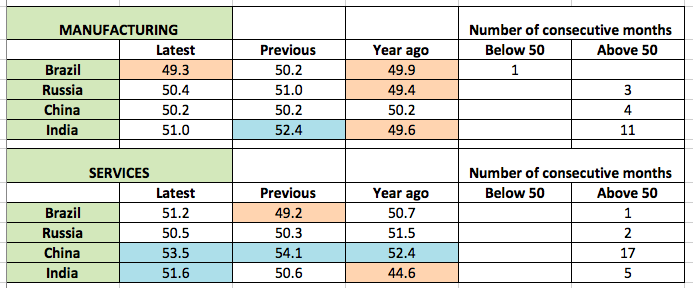
Table below summarises PMIs for BRIC economies:


Overall, all Services PMIs for BRIC economies managed to stay above 50.0 line in September. Brazil Services PMI returned back to above 50.0 territory after one month dip to 49.2 in August. China was the only economy amongst BRIC that posted slowdown in PMIs-signalled growth in Services.


Combined Manufacturing and Services PMIs for BRICs ex-Russia and Russia are shown below:


Overall dynamics are not great, however. Although BRICs are staying above the 'recessionary' levels, activity is weak. Weak enough to post no statistically significant reading above 50.0 in Manufacturing and only one statistically significant reading (China) in Services. All reinforcing the IMF concerns about the direction of global growth (see: http://trueeconomics.blogspot.ie/2014/10/7102014-imf-on-global-euro-area-growth.html

Tuesday, October 7, 2014

7/10/2014: Subsidies Rained on Irish Agriculture: 2013


Recently, CSO published accounts for Irish Agricultural sector for 2013. And what a reading these make.

"In 2013, net subsidies accounted for 66.8% of agricultural income (operating surplus) at state level." In other words, say 'thanks EU' for paying 2/3rds of our farmers' income (or whatever you might call it)...

"In the Border, Midland and Western region, net subsidies accounted for 108.8% of agricultural income, while in the Southern and Eastern region net subsidies accounted for 51.0% of agricultural income." Net subsidies accounted for 176.7% of operating surplus in the Midlands.

A table breaking down the above:


Net Subsidies fell from EUR1.801 billion (73.6% of income) in 2011 to EUR1.63 billion (73.4% of income) in 2012 to EUR1.505 billion (68.8% of income) in 2013. So over 2011-2013, net subsidies shrunk by 16.4%. Meanwhile, operating surplus (income) fell from EUR2.447 billion in 2011 to EUR2.221 billion in 2012 before rising slightly to EUR2.254 billion in 2013 - a net loss over 2 years of 7.9%.

Chart to illustrate net subsidies share of income:

Good thing we have EU taxpayers to sustain these levels of productivity in our indigenous champions of traditional life...

7/10/2014: IMF on Global & Euro Area Growth: Cloudy with 40% chance of a storm

My analysis of the IMF 2014-2015 forecasts for the global economy and euro area are now available on Learn Signal Blog: http://blog.learnsignal.com/?p=62 

Monday, October 6, 2014

6/10/2014: BlackRock Institute Survey: EMEA, September 2014


BlackRock Investment Institute released the latest Economic Cycle Survey results for North America and Western Europe (covered here: http://trueeconomics.blogspot.ie/2014/10/6102014-blackrock-institute-survey-n.html). Here are the survey results for EMEA:

"The consensus of respondents describe South Africa, Croatia, Slovenia, Russia and the Ukraine in a recessionary state, with an even split of economists gauging Romania to be in a recessionary or contraction phase. Over the next two quarters, the consensus shifts toward expansion for Russia and South Africa. At the 12 month horizon, the consensus expecting all EMEA countries to strengthen or remain the same with the exception of Turkey, Slovenia, Hungary and the Ukraine."

Global: "respondents remain positive on the global growth cycle with a net 50% of 36 respondents expecting a strengthening world economy over the next 12 months – an 9% decrease from the net 59% figure last month. [There was also a net decrease from 85% two months ago]. The consensus of economists project mid-cycle expansion over the next 6 months for the global economy."


Two charts to illustrate:


Previous month results are here: http://trueeconomics.blogspot.ie/2014/08/2382014-blackrock-institute-survey-emea.html

Note: these views reflect opinions of survey respondents, not that of the BlackRock Investment Institute. Also note: cover of countries is relatively uneven, with some countries being assessed by a relatively small number of experts.

6/10/2014: BlackRock Institute Survey: N. America & W. Europe, September 2014


BlackRock Investment Institute released the latest Economic Cycle Survey results for North America and Western Europe. Here are the main points (emphasis and comments are mine):

"This month’s North America and Western Europe Economic Cycle Survey presented a positive outlook on global growth, with a net of 55% of 98 economists expecting the world economy will get stronger over the next year, compared to net 59% figure in last month’s report [and 81% in July survey]."

Global outlook: "The consensus of economists project mid-cycle expansion over the next 6 months for the global economy. At the 12 month horizon, the positive theme continued with the consensus expecting all economies spanned  by the survey to strengthen or stay the same except France, Finland and Belgium.

Regional outlook: Euro Area: "Eurozone is described to be in an expansionary phase of the cycle and expected to remain so over the next 2 quarters. Within the bloc, most respondents described Greece, Italy and France to be in a recessionary state [same outcome was recorded back in August survey], with the even split between contraction or recession for Belgium and Finland [in August survey, this applied to Portugal and Finland]. Over the next 6 months, the consensus shifts toward expansion for Greece and Italy [with Italy being a new addition to this list compared to August survey]."

US and North America: "Over the Atlantic, the consensus view is firmly that North America as a whole is in mid-cycle expansion and is to remain so over the next 6 months." [Same result as in August survey].


Two charts to illustrate:


Previous month results are here: http://trueeconomics.blogspot.ie/2014/08/2382014-blackrock-institute-survey-n.html

Note: these views reflect opinions of survey respondents, not that of the BlackRock Investment Institute. Also note: cover of countries is relatively uneven, with some countries being assessed by a relatively small number of experts.

6/10/2014: Ifo Forecast for Euro Area Economy: Q4 2014 and Q1 2015


Germany's Ifo institute released its joint forecasts for Euro area economy through Q1 2015. Here are the details:

"In Q3 2014, economic activity is expected to increase again, but only moderately, as geopolitical concerns are still strong and seem to affect investors’ confidence. GDP is projected to increase by 0.2% in the Q3 and Q4 2014, and expand by 0.3% in Q1 2015."

But, the Ifo warns about "increased asymmetries across euro area economies. The recovery is expected
to be mainly driven by a gradual improvement in domestic demand conditions. Private investment is expected to restart over the forecast horizon triggered by improved liquidity conditions and lower cost of capital, after the sharp adjustment following the financial crisis. The rise in production activity and increasing demand for new production capacity will be the main factor underpinning the recovery. Consumption prospects remain positive, albeit subdued, as the recovery in the labor market is projected to be gradual. Under the assumptions that the oil price stabilises at USD 97 per barrel and that the dollar/euro exchange rate fluctuates around 1.28, the headline inflation is expected to increase only marginally over the next two quarters, remaining significantly below the threshold of 2%."

On the risks side: "Key downside risks to this scenario comprise the effective recovery of investment and the increases in the savings rate of private households owing to deleveraging. A weaker external demand from emerging economies, especially from Asia and Latin America, as well as a greater impact of international tensions in Eastern Europe and the Middle East, might also be a drag on the exports and investment."

Summary of forecasts:

All of which acts a nice prelude to tomorrow's release of the IMF WEO update for October. I'd say expect (given World Bank previously released forecasts) some downgrades to growth expectations...

Sunday, October 5, 2014

5/10/2014: US Removes Russia from GSP Access as Biden Admits US 'Leadership' over Europe


This week, amidst generally holding ceasefire in Ukraine and with Russia continuing to constructively engage in the multilateral process of normalisation of Eastern Ukrainian crisis, the US leadership once again shown its hand on the issue of Russian relations with the West. Instead of pausing pressure or starting to return trade and diplomatic relations toward some sort of normalisation, the US actually continued to raise pressure on Russia.

First, earlier in the week, the US issued a decision to terminate Russia's designation as a beneficiary developing country in its Globalised System of Preferences (GSP) - a system that allows developing economies' exporters somewhat 'preferential' access to the US markets at reduced tariffs. This decision was notified on May 7th and officially published by the White House on Friday when it came into force.

The US GSP is a program designed to aid economic growth in developing economies (more than 100 countries and territories) by allowing duty-free entry for up to 5,000 products.

According to the White House statement, President Obama "…determined that Russia is sufficiently advanced in economic development and improved in trade competitiveness that it is appropriate to terminate the designation of Russia as a beneficiary developing country effective October 3, 2014."

The likely outcome of this is, however, uncertain. Russian exports to the US in the categories covered by the GSP programme are primarily in the areas of strategically important materials, including rare-earth metals and other key inputs into production for US MNCs. The same MNCs can purchase these inputs indirectly from outside the US. So, if anything, the White House decision is harming its own companies more than the Russia producers by de facto raising the cost of goods with low degree of substitution.

While, personally, I do not think Russia is a developing country - it is a middle income economy - in my opinion, the best course of diplomacy (in relation to trade) is opening up trade markets and reducing (not raising) trade barriers. This is best targeted by lowering tariffs first and foremost in the areas where private (not state) companies supply exports. GSP is a scheme that should be expanded to include all economies, not just developing ones and the US and Europe should pursue more open trade with Russia and the rest of the CIS. Sadly, the Obama Administration is using trade as a weapon to achieve geopolitical objectives (notably of questionable value, but that is secondary to the fact that trade should not be used as a weapon in the first place, but as a tool for helping achieve longer term objectives closer economic and social cooperation).


In a related matter, the US VP, Joe Biden, openly confirmed this week that the US has directly pressured its European allies to impose sanctions against Russia. On October 3rd, speaking at Harvard University, Joe Biden said that: “It is true - they [European countries] did not want to do that [impose sanctions against Russia] but again it was America’s leadership and the President of the United States insisting, oftentimes almost having to embarrass Europe to stand up and take economic hits to impose cost,” the vice president said.

So, apparently, there was quite a bit of discord in the Western 'unity' camp over the actions against Russia. Which makes you wonder: was that resistance based solely on the European countries concern for the economic impact of sanctions on their own economies, or was it a function of their scepticism over the actual events in Ukraine (the nature of the latest Ukrainian 'revolution'? the role of the Western powers in stirring the conflict? the role of Russian in the conflict? etc)? Or may be all of the above?..


One way or the other, the US is driving a dangerous game. It is pursuing extremely aggressive course of actions against Russia with no concrete road map for de-escalation, no specific targets for policy and no back up strategy for addressing the adverse effects of isolating Russia in other geopolitical issues, such as ISIS, Middle East, Iran, North Korea and so on.

Saturday, October 4, 2014

4/10/2014: IMF on Russia: What Never Hurts Repeating...


As predicted (see here: http://trueeconomics.blogspot.ie/2014/09/2992014-russian-economy-briefing-for.html) IMF came in weighing heavily on the doom for its outlook for Russian economy this week.

In its "Russian Federation: Concluding Statement for the September 2014 Staff Visit" report from  October 1, 2014, the Fund notices (quite a sharp eyesight there) that: "Geopolitical tensions are slowing the economy already weakened by structural bottlenecks."

According to the IMF, the solution is for the Central Bank of Russia (CBR) to "tighten policy rates further to reduce inflation and continue its path towards inflation targeting underpinned by a fully-flexible exchange rate." Investment is falling down, capital flight de-accelerated but remains a problem, deposits are desperately needed for the banks to stay liquid (absent foreign funding sources and coming bonds maturities), so has to kill the economy to keep economy alive dilemma...

On fiscal side, things are ok-ish: "While the projected overall fiscal stance is appropriately neutral in 2015, the needed fiscal consolidation should resume in the following years… The proposed federal budget, which is consistent with the fiscal rule, envisions a loosening in 2015. However, this is offset by a tightening at the sub-federal levels. This strikes an appropriate balance between the need to consolidate in the medium term, with the non-oil deficit remaining near historical high, and the need for supportive fiscal policy in the face of the current downturn." And as I noted in the note linked above: "The use of the National Wealth Fund for domestic infrastructure projects may be appropriate to consider if done in the context of the budget process and subject to appropriate safeguards. The diversion of contributions from the fully-funded pillar weakens the viability of the pension system, creates disincentives to save, and dilutes the credibility of the fiscal rule."

On growth: "The economic outlook appears bleak. GDP is expected to grow by only 0.2 percent in 2014 and 0.5 percent in 2015." Not as gloomy as the World Bank but uuuuugly…
Drivers, predictably are:

  • "Consumption is expected to weaken as real wages and consumer credit growth moderate." No… wait… they are already weak and moderated… 
  • "Geopolitical tensions—including sanctions, counter-sanctions, and fear of their further escalation—are amplifying uncertainty, depressing confidence and investment. Capital outflows are expected to reach USD 100 billion in 2014 and moderate somewhat but remain high in 2015." Again, no surprises here.
  • "Inflation is projected to remain over 8 percent by the end of 2014 mostly due to an increase in food prices, caused by import restrictions, and depreciation of the ruble. In the absence of further policy actions, inflation is expected to stay above target in 2015." That we know too. No surprises here. 

On banks, pretty much same as I have been saying: "Increased oversight and heightened financial stability remain a priority. Banks and the corporate sector are facing a challenging environment due to the weak economy, limited access to external financing, and higher financing costs. Existing financial buffers together with appropriate policy responses by the CBR have limited financial instability thus far. Nonetheless, the current uncertain environment could create difficulties in individual banks and businesses, even in the near term. In case of acute liquidity pressures, emergency facilities should be temporarily offered to eligible counterparties, against appropriate collateral, priced to be solely attractive during stress periods."

On structural side, I would have expected more clarity. Instead, we have more generalities: "Despite the slowdown, the economy is expected to have limited excess capacity owing to structural impediments to growth… Even if [geopolitical] uncertainty dissipates next year, domestic demand and potential growth are projected to remain weak in the medium term due to insufficient investment and deterioration in productivity. Potential growth is projected to be about 1.2 percent in 2015, reaching 1.8 percent in 2019, with downside risks. Structural reforms are needed to provide appropriate incentives to expand investment and allocate resources to enhance efficiency. Protecting investors, reducing trade barriers, fighting corruption, reinvigorating the privatization agenda, improving competition and the business climate, and continuing efforts at global integration remain crucial to revive growth."

Then again, all this you could have heard at our briefing breakfast for IRBA… to stay ahead of the IMF analysis… 

3/10/2014: East Asian Crisis, European Disaster: Tale of Two Recoveries


My post for Learning Signal blog on IMF report covering East Asian Crisis of the 1990s comparatives to the Euro area crisis 2007-present is available here: http://blog.learnsignal.com/?p=55 

Friday, October 3, 2014

3/10/2014: Ireland: Quarterly PMIs and Composite Activity Index: Q3 2014


As promised in the previous post, covering monthly Services PMI (http://trueeconomics.blogspot.ie/2014/10/3102014-services-pmi-for-ireland.html), here is my analysis of quarterly data and my own Composite Activity Index across manufacturing and services sectors, as well as construction sector.

All data reported is based on my calculations using Markit/Investec PMIs.

In Q3 2014, Manufacturing PMI averaged 56.1 which is up on 55.5 average for Q2 2014 and is up on Q3 2013 average of 51.9. Q3 2014 marks the 5th consecutive quarter of expansion in the series.

Services PMI stood at 62.1 in Q3 2014, unchanged from 62.1 in Q2 2014 and up on 58.7 Q3 2013 reading. This quarter marked 15th consecutive quarter of above 50 readings in PMI.

Construction PMI (data through August so far only) is at 62 in Q3 2014, up on 61.2 in Q2 2014 and 51.0 in Q3 2013. This marks 5th consecutive quarter of expansion in the sector.

Composite Activity Index is now at 60.35 in Q3 2014 ex-Construction, up on 60.16 in Q2 2014 and on 59.95 in Q3 2013. This is 18th consecutive quarter of composite indicator above 50.0. Including construction, Composite Activity Index is at 60.38, up on Q2 2014 reading of 60.18 and up on Q3 2013 reading of 56.81.

Chart to illustrate:

On a note of caution: showing just how weak the PMI indices are in predicting Irish growth, here are two charts plotting log changes in PMIs against log changes in GDP and GNP. In all cases, explanatory power of changes in PMIs is weak when it comes to matching the outcomes in growth in the real economy. The same qualitative results hold for levels of PMIs against log changes in GDP and GNP and to levels of PMIs against actual GDP and GNP levels.


3/10/2014: Services PMI for Ireland: September 2014


Markit/Investec released their Services PMI for Ireland today. I covered Manufacturing PMI release here: http://trueeconomics.blogspot.ie/2014/10/1102014-irish-manufacturing-pmi.html

On Services side:

  • MNCs-driven activity in the sector expanded once again, with PMI for September rising to 62.5 from 62.4 in August and almost matching 62.6 reading in June.
  • 12mo MA is now at 60.9 - which is simply unbelievable, given the overall economy performance over the last 12 months. Predictably, of course, there is somewhat little connection between the survey - weighted heavily on MNCs side, such as ICT Services giants we house in Ireland - and the real economy.
  • 3mo average (Q3 2014 average) is at 62.1 which is identical to Q2 2014 average and is ahead of Q3 2013 average of 58.7. In other words, judging by the figures coming out of PMIs, Irish services economy is growing roughly at 7-8 percent per annum. Good luck spotting that on the ground.

Still, the above chart clearly shows that whether connected to real lives or not, Services economy is now averaging growth rates (post-crisis) that are above those recorded in pre-crisis period. This suggests two things:
  1. There has been a significant switch in economic activity in favour of services (dominated by the dynamics in ICT Services); and
  2. There has been a larger gap opening up between the real economy and tax optimisation-based economy.
I will blog on composite performance on quarterly basis, pooling together both Manufacturing and Services PMIs next, so stay tuned.

3/10/2014: Russian Services & Composite PMIs: September 2014


Russia Services and Composite PMIs were released today by Markit/HSBC for September.

I covered relatively poor performance of the Manufacturing PMI here: http://trueeconomics.blogspot.ie/2014/10/1102014-russian-manufacturing-pmi.html and comparatives between BRICs for Manufacturing were discussed here: http://trueeconomics.blogspot.ie/2014/10/2102014-bric-manufacturing-pmis-things.html

On Services PMI side:

  • September PMI came in at 50.5 which is basically unchanged on 50.3 in August and signals weak growth (statistically, this reading is not significantly different from 50.0).
  • 3mo MA is now at 50.2 (barely above 50.0) although that is an improvement on Q2 2014 reading of 47.6, yet poorer than Q3 2013 reading of 50.7.
On Composite PMI side:
  • Composite PMI declined marginally from 51.1 in August to 50.9 in September, still staying ahead of 50.0. Both readings were, however, statistically not significantly different from 50.0, implying weak expansion in output.
  • Q3 average is at 51.1, which is a lot better than 48.3 average for Q2 2014 and is ahead of 50.4 average in Q3 2013.
Chart below shows three PMIs together and identifies October-November 2012 are the period of trend shift toward falling PMIs.


Overall, activity remains subdued across all sectors of the Russian economy and growth signals from PMIs suggest that this year growth is likely to be in the range of around 0.4-0.5%.

Comparatives with BRICs are coming up later today, so stay tuned.

Thursday, October 2, 2014

2/10/2014: That Oil Price Shock: Russia


In a recent Russian Economy briefing (http://trueeconomics.blogspot.ie/2014/09/2992014-russian-economy-briefing-for.html) I highlighted the risk of oil price changes on Russian economy. Here is a chart showing dramatic elevation of these risks:

via @MacrobondF

2/10/2014: IMF Report: Risk Taking Behaviour in Banks


As some of you might have noticed, I started to contribute regularly to Learn Signal Blog last week. This week, my post there covers IMF Global Financial Stability Report update released this week, dealing with the drivers for risk taking behaviour of the banks prior to and since the Global Financial Crisis: http://blog.learnsignal.com/?p=46

2/10/2014: BRIC Manufacturing PMIs: Things are getting slower...


Yesterday, I covered Manufacturing PMIs for Russia (http://trueeconomics.blogspot.ie/2014/10/1102014-russian-manufacturing-pmi.html) so today time to update all BRICs chart:


And from the above, things that were ugly in the merging markets continue to be ugly and get worse.

In September, according to Markit (and all its marketing partners paying for the releases of its data):

  • Manufacturing PMIs posted rather significant slowdown in growth in Russia: from 51.0 in July and August to 50.4 in September. However, on a 3mo MA basis, the index is performing better: 3mo average through September (Q3 average) stood at 50.8 (anaemic, but growth) compared to 3mo average through June (Q2 average) of 48.7 and 3mo average through September 2013 of 49.3. M/M slowdown in growth was 0.6 points, which is the second best performance in the BRIC group and September level of index signals second fastest growth in BRIC group.
  • In China, Manufacturing PMI posted zero change in September (50.2) on August (52.4). 3mo average through Q3 2014 was 50.7, which is better than 3mo average for Q2 2014 (49.1) and 3mo average for Q3 2013 (49.3). With zero change in growth in PMI m/m, China is the best performer in the group, but its level of PMI is only third best.
  • India Manufacturing PMI posted the largest drop in PMIs in September (51.0) on August (52.4) in the group. 3mo average through Q3 2014 was 52.1, which is better than 3mo average for Q2 2014 (51.4) and 3mo average for Q3 2013 (49.4). With PMI falling 1.4 points m/m, India is the worst performer in the group in terms of m/m dynamics, but its level of PMI is still the highest in the group, which is not surprising, given there appears to be a strong upward bias in India PMI readings across data history (see chart).
  • Brazil Manufacturing PMI fell from 50.2 in August to 49.3 in September, switching from growth to contraction - the only country posting contractionary PMI reading in the group. Q3 2014 average reading is at 49.5 which is almost identical to the Q2 2014 reading of 49.4 and to Q3 2013 reading of 49.3. M/m Brazil posted the second worst level of decline in PMI and level-wise it is the worst performer in the group.
Notably, there appears to be little level difference across China and Russia in Q3 2013 Manufacturing activity, despite the fact that Russia is under sanctions pressure relating to Ukraine crisis. Both China and Russia outperformed Brazil, but under-performed India in this sector. Adjusting for Indian data apparent bias upwards, there is also little difference between India and China and Russia.

Summary table of changes and levels:


Wednesday, October 1, 2014

1/10/2014: IMF's out of Ideas, but still full of Analysis: WEO Chapter 4

IMF WEO October update is steadily creeping toward its main denouement, the release of the database update at the very end of the process that normally starts with releases of analytical chapters of the WEO - bigger thematic pieces dealing with the core topics relating to the global economy.

This week, IMF released its Chapter 4, covering the issue of current accounts imbalances across the world.

Per IMF, "Global current account (“flow”) imbalances have narrowed significantly since their peak in 2006, and their configuration has changed markedly in the process. The imbalances that used to be the main concern—the large deficit in the United States and surpluses in China and Japan—have more than halved. But some surpluses, especially those in some European economies and oil exporters, remain large, and those in some advanced commodity exporters and major emerging market economies have since moved to deficit."

You don't need to say. Just see this post from earlier today: http://trueeconomics.blogspot.ie/2014/10/1102014-that-exports-led-recovery-in.html

But IMF shows some pretty interesting data on composition and levels of imbalances across the globe. Chart below details these:


The IMF argues that "the reduction of large flow imbalances has diminished systemic risks to the global economy." Sounds happy-all-around.

But as usual, there is a kicker, or rather two:
"First, the nature of the flow adjustment—mostly driven by demand compression in deficit economies or growth differentials related to the faster recovery of emerging market economies and commodity exporters after the Great Recession—has meant that in many economies, narrower external imbalances have come at the cost of increased internal imbalances (high unemployment and large output gaps).

This straight into the teeth of the EU, where 'internal devaluations' (beggar thy own consumers and households) policies are all the rage. But it is also a warning to the emerging markets, where the latest stage of economic growth is translating into falling commodities prices, threatening to unravel their own economic 'recoveries' based on beggar-thy-trading-partners economic environment of elevated commodities prices in the past.

"The contraction in these external imbalances is expected to last as the decrease in output due to lowered demand has likely been matched by a decrease in potential output." Which means a Big Boom! Potential output is the stuff economies supposed to produce once the effects of the business cycle (recession-to-expansion) is netted out. In other words, the stuff that is somewhat long-term 'sustainable'. And the above statement says it is down.

"However, there is some uncertainty about the latter, and there is the risk that flow imbalances will
widen again." Which means 'choose your poison' - either risks are materialising in structural growth slowdown or risk will be materialising in current account imbalances returning once again. Rock. Hard place. The world stuck in-between.

"Second, since flow imbalances have shrunk but not reversed, net creditor and debtor positions (“stock imbalances”) have widened further. In addition, weak growth has contributed to increases in the ratio of net external liabilities to GDP in some debtor economies.These two factors make some of these economies more vulnerable to changes in market sentiment. To mitigate these risks, debtor economies
will ultimately need to improve their current account balances and strengthen growth performance."

And here we have the usual bangers-n-mash dish from the IMF. What it says is that debt overhang is not getting better, but might be getting worse. And with that, the IMF runs out of any solutions other than go back to 'internal devaluations'. Which, of course, gets us back to the first kick in teeth. Bigger rock. And an even harder place. And Euro area is now wedged in-between.

"Stronger external demand and more expenditure switching (from foreign to domestic goods and services) would help on both accounts," says IMF. And this is the statement of surrender. Basically IMF says that if more people were to buy stuff from the countries with weak external balances and loads of debt, things will improve. No sh*t Sherlocks. And if money was growing on trees in Sahara Desert, things would improve even more.

IMF's out of idea. But IMF is still full of analysis. QED.

1/10/2014: That Exports-Led Recovery... in Germany


And a Scary Chart of the Day prize goes to @IanTalley who produced this gem:

That's right, Germany is now officially producing more stuff that its people can't afford than China...

But its a good thing, for it means that people in countries like Italy, Spain, Greece, Portugal, Cyprus etc who owe Germany money can buy more stuff from Germany they can't quite afford either, except for the credit supplied from Germany funded by the credit they take from Germany... Confused? Try confused.edu for some academic analysis... or just look at KfW bank latest foray into Ireland (apparently it took months of planning to get us to this absurdity http://www.independent.ie/business/irish/kfw-deal-to-fund-irish-firms-was-months-in-the-planning-29896868.html).

1/10/2014: Russian Manufacturing PMI: September


Markit and HSBC released Manufacturing PMI for September for Russia. Here are the headline numbers:

  • Manufacturing PMI declined from 51.0 (signaling already weak expansion) in August to 50.4 in September. 
  • This marks 8th consecutive month of index falling within the range that is statistically indifferent from 50.0. Over the last 3 months, the index was trending just above 50.0 line (not statistically significant difference to 50.0). 
  • 3mo MA for the index is at 50.8. 3mo MA through June 2014 is at 48.8. 3mo MA through September 2013 was at 49.3. This really does illustrate structural slowdown in the Russian economy setting on at around Q4 2012, well before the onset of Kiev protests in November 2013 and much before the onset of the Ukrainian crisis in February 2014.

Today's reading puts into question the hopes of a nascent recovery we could have expected from PMI readings in August. Recall that in July Russian GDP fell estimated 0.2% and in August it posted zero growth. My most recent update on Russian economic situation (from Monday) is here: http://trueeconomics.blogspot.ie/2014/09/2992014-russian-economy-briefing-for.html

1/10/2014: Irish Manufacturing PMI: September


Irish Manufacturing PMI released by Investec/Markit today signalled de-acceleration of growth in September.

  • Headline Manufacturing PMI declined from 57.3 in August to 55.7 in September. The reading is still ahead of July 55.4 and remains statistically significant above 50.

September correction does not represent a shift in the trend, which remains solidly up:

  • 12mo MA is at 54.7 and September reading is ahead of that. Current 3mo MA is at 56.1 and well ahed of previous 3mo MA of 55.5. 3mo MA through September is solidly ahead of the same period readings in 2010-2013.
Investec release provides some comments on the underlying series sub-trends, but I am not inclined to entertain what is not backed by reported numbers.

On the balance, it appears that Manufacturing sector retain core strengths and that expansion continues. This marks thirteenth consecutive month of PMI readings above 50 (statistically significant) and 16th consecutive month of PMI reading above 50 (notional).

Tuesday, September 30, 2014

30/9/2014: Have Irish Retail Sales 'regained growth momentum' in August?


Yesterday, CSO released latest data on Retail Sales in Ireland for August 2014, prompting some media reports that the data is showing the "retail recovery gaining momentum".

Here is the actual data for core retail sales (ex-motors):

  • Value of retail sales rose 0.1% m/m in August, down from 0.2% growth in July. This implies loss of the momentum in value of sales, not a gain.
  • Volume of retail sales rose 0.29% m/m in August, up on -0.1 loss in July, implying regaining of the momentum m/m in volume of sales.
  • Value of retail sales rose 2.22% y/y in August after posting 1.22% gain in July, implying some improved momentum y/y.
  • Volume of retail sales rose 3.64% y/y in August after posting a rise of 3.21% in July, again implying some improved momentum y/y.
  • 3mo average through August 2014 rose 1.9% for value of sales compared to the same period a year ago and 3.6% for volume of sales. Both rates of growth were lower than those recorded for the 3mo period through May 2014, representing a slowdown in the momentum, not a gain.
All of the above evidence suggests that retail sales are bouncing along the established trend and are not consistent with a claim that there has been sustained gains in retail recovery in August. Charts below illustrate this conclusion:


Chart above shows that Volume of retail sales index is trending along with established long-term trend. A gain in momentum would imply the index pushing steeper up relative to trend. Value of sales index is now running at a flatter upward momentum than long term trend implies. This supports the view that retail sales recovery has lost recovery momentum (but did not lose recovery overall) in Value terms and is running at zero change to the momentum (which is still positive) in Volume terms.


The conclusion above is confirmed by looking at /y/y growth rates in both series: since April 2014 jump in retail sales, both Volume and Value growth rates have fallen. Value growth has continued to trend down after May and Volume growth trended down from June.

Once again, we have positive growth in the series, but the momentum in this growth is either zero or negative, certainly not positive.