Friday, July 18, 2014

18/7/2014: IMF Approves Ukrainian Funding... & Pushes the Country into Deeper Austerity


IMF Announced agreement with Ukraine on First Review under the Stand-By Arrangement. Comments in italics are mine.

Mr. Nikolay Gueorguiev, mission chief for Ukraine, made the following statement today in Kyiv: “The mission has reached understandings with the Ukrainian authorities on the policies necessary for the completion of the first review under the SBA… the authorities have committed to take a number of policy actions prior to the completion of the review. …The completion of the review would enable the disbursement of ...about US$1.4 billion. The mission found that policies have generally been implemented as planned and that all but one of the performance criteria for end-May have been met. All structural benchmarks for the first review have been met as well, although some of them with a delay. This is a notable achievement as the intensification of the conflict in the East means that the program has been implemented in an environment that is considerably more difficult than anticipated when it was launched."

It is worth noting that IMF generally does not lend to countries in a state of civil war or major insurgency. Presumably, when it does lend to such countries, the conditions for lending allow for the risk of acceleration of the conflict. It appears IMF is taken by the surprise by the continuation of the conflict and by amplification in both the Ukrainian Government offensive and the rebels' defensive stances:

“The conflict is putting increasing strain on the program [after just a MONTH of the programme existence?!] and a number of key elements of the macroeconomic framework have had to be revised: (i) economic prospects have deteriorated notably, and GDP is now expected to contract by 6.5 percent this year, compared to 5 percent when the program was adopted; (ii) a shortfall in revenue collections in the East, higher security spending, and lower-than-expected debt collection by Naftogaz will cause fiscal and quasi-fiscal deficits and financing needs to rise above the programmed path; and (iii) higher-than-expected capital outflows and monetization of fiscal deficits are causing pressures on net international reserves."

Ok, one can excuse IMF for missing the forecast, but points (ii) and (iii) risks were predictable and material even BEFORE the programme started. One has to wonder, did IMF extend funds under the assumptions that 

  1. The conflict will somehow go away without major costs on the ground?
  2. The Government will be able to engage in revenue collection in rebel-controlled areas?
  3. Naftogaz will be able to do more successfully that which the Government is failing to do?
  4. Capital outflows will be benign and monetization of fiscal deficits will not be aggressive to compensate for (1)-(3)?


Things get worse. “Notwithstanding the authorities' continued commitment to the program and good record of implementation so far, the authorities have decided to take a number of compensatory measures to limit the negative impact of the conflict in the short run, and ensure that key program objectives are achieved over the period of the two-year program".

This sounds actually fine, except when you start reading into what exactly the IMF prescribed for the authorities and what they did in the wake of this prescription:

  • Point 1: "On fiscal policy, the authorities have decided to implement a package of revenue and expenditure measures, amounting to 1 percent of GDP in 2014, offsetting the effect of increased security spending by other expenditure cuts. They have also committed to limiting wage and pension increases to the level of inflation in 2015, continuing reform-based reduction in public sector employment, and exercising tight control over discretionary spending." Set aside the issue of 2015. Look at NOW. The country is in a civil war, it is facing into the prospect of medium-term rebuilding and peace-building. Government response: cut spending, increase allocation to defense. The latter is necessary, no doubt. But the former is simply inconsistent with the need to build peace and rebuild infrastructure and businesses and peoples' lives. De facto, IMF is pushing Ukraine into austerity just at the time as the country is going through a civil war! As a fiscal hawk, I have to ask if this is simply mad?
  • Point 2: "In the energy sector, the authorities are taking additional actions to strengthen payment discipline and compliance, such as pursuing payments from collectible accounts and seizing assets if repayment is not forthcoming. They are also preparing to restructure Naftogaz with a view to improve the transparency of its operations and reduce costs." Should second take place before the first? Should Naftogaz be reformed to increase its legitimacy and democratic acceptance and only AFTER that should it pursue more aggressive collection? Remember, again, this is not a society with comfortable margins of income and security!
  • Point 3: "The authorities are taking steps toward strengthening governance and improving the business climate. A recent diagnostic study has identified major areas for reforms. Based on the study’s recommendations the authorities plan to implement a wide range of anti-corruption measures, including establishment of an independent anti-corruption agency with broad investigative powers and adoption of legislative amendments to support the anti-corruption effort." This is an area where progress is necessary and vital. And it is good to see Ukrainian Government taking serious reps here, if only academic ones for now.

I will skip monetary policy points identified by the IMF - these are technical and, for now, theoretically supportive of the economy.

So two sets of 'compensatory' policies are de facto a road to disaster, one is the road toward potentially better future and one is technically supportive of the present. 

Still, the Fund is pleased: “On the strength of these compensatory measures and continued implementation of other policies agreed when the program was approved, staff is confident that the program can achieve its fundamental objectives of restoring internal and external macroeconomic equilibrium, generating sound and sustainable economic growth, and strengthening economic governance and transparency. In particular, while the combined fiscal and quasi fiscal deficits are projected to amount to 10.1 and 5.8 percent of GDP in 2014 and 2015, respectively—compared to previous targets of 8.5 and 6.1 percent—the structural adjustment is stronger by ½ percent of GDP over 2014-16 and the headline deficit will be below the originally programmed path by 2016. Similarly, gross reserves will be only some US$3.4 billion lower than programmed by end-2015. While external debt to GDP will peak 7 percentage points higher than programmed at end-2015, it will be on a steady downward slope by the end of the program, suggesting that external viability is not at risk." This is a bag full of estimates, assertions and forecasts. We know how these play out in reality even in countries not undergoing a civil war conflict.

But it gets better: “The program hinges crucially on the assumption that the conflict will begin to subside in the coming months." How many months? No idea. What happens in the post-conflict process? No idea. How much destruction will be brought about in resolving the conflict? No projections. Hope, hope and more IMF money… while Ukrainian people and State are doing all the heavy lifting.

I noted months ago that Ukraine will need a Marshall Plan, not an 'emergency liquidity support'. It still does - more than ever. This is not even being discussed.

Thursday, July 17, 2014

17/7/2014: Irish Bilateral Trade in Goods with Russia & Ukraine


A journalist just requested from me some trade stats on Russian and Ukrainian trade with Ireland, so here is a summary table and a chart:


The table above shows irish exports to Russia by category. For comparison, Ukraine:


And totals for 2012-2013 full year:


Russia dwarfs Ukraine as trading partner for Ireland by:

  • Exports - 2012-2013 average levels of goods exports to Russia is at EUR620 million against those to Ukraine at EUR62.2 million.
  • Trade balance: average 2012-2013 goods trade balance wit Russia is at +EUR151.5 million surplus against deficit of -EUR16 million for Ukraine.
  • In trade flows for the first four months of 2014
  • Indigenous exports component of our trade: approximately 40-42% of our trade with Russia related to indigenous sectors of the economy, as opposed to near zero for our exports to Ukraine.

17/7/2014: More Russia Sanctions, Same Pains, Same Strategies


Another set of sanctions and another tumble in Russian shares. This time around, sanctions have impacted major Russian companies with significant ties to the global economy. However, no broad sectoral sanctions were introduced.

The following companies are hit:

  • Rosneft - largest oil producer in Russia
  • Gazprombank - largest bank in Russia outside retail sector
  • VEB - Vnesheconombank 
  • Novatek - largest independent natural gas producer
  • Federal State Unitary Enterprise State Research And Production Enterprise Bazalt, 
  • Feodosia Oil Products Supply Company (in Crimea)
  • Radio-Electronic Technologies Concern KRET 
  • Concern Sozvezdie
  • Military-Industrial Corporation NPO Mashinostroyenia  
  • Defense Consortium Almaz-Antey
  • Kalashnikov Concern
  • KBP Instrument Design Bureau
  • Research and Production Corporation Uralvagonzavod 

Full list here: http://www.treasury.gov/ofac/downloads/ssinew14.pdf

The U.S. Treasury Department said that under new sanctions, the U.S. companies are only prohibited from dealing in "new debt of longer than 90 days maturity or new equity" with the listed non-defence firms. There are no asset freezes, no prohibitions or restrictions on export/import transactions. The sanctions do not impact U.S. and other multinationals' work in Russia, unless Moscow retaliates with such measures (which is unlikely).

This contrasts with previous sanctions under which sanctioned companies were prevented from conducting any transactions, including export/import and clearing with the U.S. firms.

So we are having a clear attempt to undercut some Russian companies' access to the U.S. debt and equity markets, while preserving their ability to trade.

VEB will unlikely feel the pinch. The bank converted the National Wealth Fund deposits into capital recently, so it can offset the shortfall on foreign funding.

Gazprombank is a different issue. Last month, Gazprombank raised EUR1 billion at 4% pa in the foreign markets via a bond sale on the Irish Stock Exchange. Gazprombank has one of the largest exposures to international funding markets of all other Russian financial institutions - it has 78 outstanding eurobond issues demented in a number of currencies. So the real problem with the sanctions is that they may open the way for EU to follow, which can shut Gazprombank from the Euro-denominated debt markets too.

When it comes to Rosneft, sanctions are weak. The U.S. simply cannot afford shutting flows of Russian gas and oil to global markets. Reason? Imagine what oil price will be at, if Rosneft was restricted from trading. The company is responsible for roughly 40% of the total Russian oil production which runs at around 10.5-10.9 million barrels per day. Get Rosneft supply access cut and you have an equivalent of entire Iraq's 2013 output (that's right - total output of Iraq is lower than that of Rosneft alone) drained from the global production. Rosneft pumps more oil than Canada and more than double the output of Norway.

You can read on geopolitics of Russian oil & gas here: http://trueeconomics.blogspot.ie/2014/07/1772014-geopolitics-of-russian-gas-oil.html

The real target of the sanctions are pre-paid contracts that Rosneft and Novatek have on future supplies of oil and gas. These are de facto forward loans, repayable with future oil and gas supplies. Rosneft exposure to these currently sits at around USD15 billion. Another target: long term funding for energy companies. Rosneft raised USD30 billion in two loans in 2012 and 2013, in part to co-fund buyout of TNK-BP which cost Rosneft USD55 billion in 2013.

In reality, while short- and medium-term borrowing costs for two Russian energy companies is likely to rise, the effect in the longer term will be to push more and more trade and finance away from the U.S. dollar and U.S. markets. Plenty of potential substitutes are open: Hong Kong and Singapore being the most obvious ones. London is a less likely target. For example, in June partially state-owned UK Lloyds Bank cancelled a USD2 billion prepayment facility with Rosneft. The loser is, of course, Lloyds as it foregoes substantial revenues, while Rosneft can secure (albeit also at a price) similar funding from any number of larger trading companies it deals with, e.g. Glencore, Vitol or Trafigura.

Bloomberg covers some of the immediate reactions in corporate debt markets here: http://www.bloomberg.com/news/2014-07-17/rosneft-bonds-sink-most-on-record-as-sanctions-shut-debt-markets.html

All in, there is still ca USD60 billion worth of maturing corporate debt that Russian companies need to roll over before the end of 2014. This is a bit of a tight spot for Russian economy going forward, but it can be offset by releasing some of the liquidity accumulated on Russian banks balance sheets in 2013.


There is a bit of a silver lining for Russia from the U.S. sanctions too. To-date, higher oil prices worldwide (primarily driven by the Middle East mess, but now also with a support from the latest Russia sanctions) pushed up Federal Budget surplus to 1.4% of GDP (see latest arithmetic here: http://trueeconomics.blogspot.ie/2014/07/1772014-geopolitics-of-russian-gas-oil.html) over January-May 2014. This means Moscow can afford a bit more of a stimulus this year, offsetting any sanctions-related adverse effects on its economy in the short run.

On another positive side, sanctions have triggered renewed interest in Moscow in developing domestic enterprises with a view of creating a buffer for imports risks (http://en.itar-tass.com/world/741073). Imports substitution is a norm for Russian economy during strong devaluations of the ruble. This time around, we can expect a push toward more domestic investment and enterprise development to drive imports substitution growth to compensate not for Forex changes, but for the risks of deeper and broader sanctions in the future.


So I would re-iterate my previously made call: 

  1. Russian economy is in a short- medium-term decline in terms of growth
  2. Growth slowdown is compounded by rising borrowing costs and adverse news flow
  3. With correct course of actions (monetary & fiscal policies and potentially some regulatory changes), Moscow can steer the economy into recovery in 2015
  4. Ukraine crisis abating during the rest of 2014 is likely to support (3) above

All of the above suggest the markets will be oversold by the time Russian equities corrections hit 8-10% mark, assuming, of course, no further escalation in Ukraine (both with and without Russian influence, Ukraine's internal problems have now been firmly pushed by the EU into Russian domain).

There has been no cardinal change in the Western strategy with respect to Ukraine (support at any cost of Poroshenko push East) and with respect to Russia (blame at any opportunity for anything happening in Ukraine). The latest sanctions are simply a replay of the previous ones, which means that the U.S. is relatively satisfied with the progress in Ukraine, while the EU has moved to the back seat, having finalised the association agreement and unwilling to expand on this.


As a side note: there are implications building up for Western companies, relating to the U.S. and EU sanctions:


On political front, here is an interesting report on President Putin approval ratings: http://en.itar-tass.com/russia/740817. I have not seen the original study cited in the report, yet.

Wednesday, July 16, 2014

16/7/2014: Gross FDI stocks per destination: BRICS


Natixis research published this handy chart summarising stocks of FDI by origin for BRICS countries:

H/T to @FGoria

Note: this is in absolute levels and aggregated over different time horizons, also note that figures date to 2012, while 2013 was a major year for reduced investment activities in the Emerging Markets and saw the beginnings of the onset of capital outflows from Russia. So lots of caveats on the above data.

16/7/2014: BlackRock Institute Survey: N. America & W. Europe, July 2014


In an earlier post I covered EMEA results from the BlackRock Investment Institute latest Economic Cycle Survey. Here, a quick snapshot of results for North America and Western Europe.

"This month’s North America and Western Europe Economic Cycle Survey presented a positive outlook on global growth, with a net of 81% of 97 economists expecting the world economy will get stronger over the next year, compared to net 67% figure in last month’s report."

"The consensus of economists project mid-cycle expansion over the next 6 months for the global economy."

"Eurozone is described to be in an expansionary phase of the cycle and expected to remain so over the next 2 quarters. Within the bloc, most respondents described Greece and France to be in a recessionary state, with the even split between contraction or recession for Belgium. Over the next 6 months, the consensus shifts toward expansion for Greece and France. Over the Atlantic, the consensus view is firmly that North America as a whole is in mid-cycle expansion and is to remain so over the next 6 months."


"At the 12 month horizon, the positive theme continued with the consensus expecting all economies spanned by the survey to strengthen or stay the same with the exception of Finland which is expected to stay the same."


See June data for comparatives here: http://trueeconomics.blogspot.ie/2014/06/1462014-blackrock-institute-survey-n.html - very interesting changes in the first chart above can be traced.

Ireland top question analysis:


Note: these views reflect opinions of survey respondents, not that of the BlackRock Investment Institute. Also note: cover of countries is relatively uneven, with some countries being assessed by a relatively small number of experts.

16/7/2014: What Exactly does JobBridge Public Sector Record Tells Us?


We are all familiar with the JobBridge scheme run by the Irish State:

  • Young people are 'incentivised' into 'apprenticeships' where they are paid social benefits plus EUR50/week by the State to work on 'enhancing their skills'. 
  • In many cases (majority?) there are no real skills training components to the scheme and instead people are used as cheap labour.
  • In theory, upon completion of the scheme they are prioritised into hiring, since (in theory again) they have acquired new skills (of importance to their employer) and have established a proven track record of work.
So there can be two reasons why a JobBridge participation may result in not employing the intern:
  1. Intern proves herself/himself to be unsuited for the job (bad skills or bad aptitude etc); or
  2. JobBridge internship was set up not to lead to employment (in other words, from the start it was used as a vehicle for obtaining cheap temporary help).
Now, take this fact
"The Department of Social Protection has confirmed that 261 interns have worked at departments since the back-to-work scheme began, of whom 233 finished their internships. None were offered permanent jobs because there is a moratorium on recruitment in the public sector, which only allows staff to be hired in exceptional circumstances." 

So, let's ask: 
  • Was the reason that all 233 interns were not good enough for the job (remember, the article cites some instances where hiring was done, for the positions interns held, but not of interns themselves)? How can this be true if we have 'the best educated workforce in the world'? And if JobBridge is a 'competitive hiring scheme' where there is pre-screening of the candidates for suitability going on? or
  • May be JobBridge was set up - in the case of these 233 internships - to extract cheap labour? Surely the Government would not do such a dubious (ethically) thing as deceive young unemployed into a promise of a reasonable chance of gaining a job at the end, while knowing that "there is a moratorium on recruitment in the public sector, which only allows staff to be hired in exceptional circumstances"? Surely not!
So which one is true, then (because there is no other, 'third' truth possible)? Our education system produces bad crops of candidates unsuited for employment in our excellence-focused public sector? Or our State Training Programmes are run with ex ante expectation of not hiring people completing them?

17/7/2014: Geopolitics of Russian Gas & Oil: BRICS, US, EU and more


Let's put together three areas on the geopolitical and economic map:
- Ukraine
- Latin America
- Central Asia

What do we have?

A conflict theatre that pitches against each other: Russia, Europe, China and the US. This conflict is drawn across both geopolitical and economic spheres and is, largely, fought via PR and finance. It is, however, a conflict that continues to shift the global balance of power East and South, away from its traditional focus on the West and North.

Let's take a look at all three theatres of the conflict. Keep in mind that in 2013, Russian total energy output grew by 1.5% y/y to rise to 15% of the global output. This represents the largest combined oil & gas output in the world. In natural gas, Russia supplies 22% of the world total. But… and there is a proverbial 'but'… US gas output is growing and US exports of LNG are growing too.


Ukraine: Europe's Push Point

Ukraine is a clear battlefield relating to the energy supply security for EU and gas (less so oil) exports for Russia. We have been here before: most recently in 2006 and 2009, but back then Ukraine was much more independent of the EU and thus Russian-Ukrainian gas price conflict at the time did threaten to disrupt supplies of gas to Europe. This time around, Ukraine has no teeth and Russia needs gas flows, so no one West of the Uzhgorod is losing much of sleep. This sense of security is reinforced by the fact that Moscow needs sales, as Russian economy is running in the red, as opposed to 2006. 2009 was, of course, different in this sense. Another footnote to this is that in the medium term, Europe has plentiful stored reserves of gas: some 65% of its gas storage capacity into early summer is full. This is a record high, allowing EU to do some sabre-rattling vis-a-vis Russia.

In addition, EU currently holds the trump cards when it comes to completion of the South Stream pipeline. This point is very significant. South Stream can provide meaningful diversification for transit of gas into Southern European markets, currently being serviced via Ukraine. South Stream capacity is set at 63 billion cubic meters (bcm) per annum, in excess of 55 bcm capacity of Nord Stream 1 & 2 which is up and running. There are problems with capacity utilisation on Nord Stream which are down to EU regulations. The same is threatening the South Stream plans (although the EU has exempted from the said regulations the Turkish pipeline, while it is unwilling to grant an exemption to Russians).


Source: Expert.ru

EU gas imports from Russia currently run at around 1/3 of total european demand, and cost ca USD53 billion per annum. Total volume of gas sales to EU from Russia was 138 bcm in 2013 at an average price of USD387 per thousand cubic meters (mcm) or USD10.50 per million British thermal units (therm). Currently, around 15% of Russia's Federal budget comes from gas exports and Europe is by far the largest market for Russian gas. This underpins medium-term Russian dependency on Europe. But it also underpins medium-term dependency of Europe on Russia: replacing Russian gas in any meaningful quantities will be costly. According to Bloomberg report (here) from earlier this year, "Benchmark U.K. prices would need to rise 127 percent to attract liquefied natural gas if Europe had to replace all its Russian fuel for two summer months". That is only for summer months. Furthermore, "The EU would need to pay as much as 50 percent more to replace that with a combination of LNG, Norwegian gas and coal, according to Bruegel, a research group in Brussels."


Source: Bank of Finland, 2014.

So with power to block South Stream (primarily by pressuring EU member states through which it will pass), the EU holds some serious tramp cards against Russia. These states are: Bulgaria (which was the first signatory to South Stream construction project back in January 2008, just 5 months after South Stream MoU was signed between Eni and Gazprom; Hungary (which signed an inter-governmental agreement on South Stream at the end of February 2008), Slovenia (in South Stream partnership since November 2009) and Croatia (since March 2010). Interestingly, Austria signed a legally binding agreement to build South Stream section (50km) via its territory on June 30th (Russian version here). The EU Commission has engaged in very heavy-handed 'diplomacy' bordering on bullying when it comes to those countries (namely Hungary, Austria, Bulgaria and Slovenia) which have been at the forefront of progressing the South Stream project. But their position is reinforced by both necessity and expedience. Neither the South Stream countries, nor Germany and Italy want to see continued EU dependence on Ukraine as transit route. Despite all the Ukrainian claims to the contrary, this transit has been less than reliable both due to Russian position vis-a-vis Ukraine and Ukraine's position vis-a-vis Russia. On expedience side, transit fees for Russian gas are lucrative to many Balkan countries and South Stream involves partnership with Italian Eni and French EDF - both of which have massive political and economic clout.

Still, Ukraine is clearly attempting to drive a wedge between EU and Russia when it comes to gas transit. Kyev has offered to construct own pipelines to transport Russian gas, in a JV with European countries (who, presumably, will fund this programme). See a report on this idea here. And Russia considered (albeit did not follow through with it) responding in-kind: South Stream economics would significantly improve if it were to go sea-route from Crimean land mass. However, to-date Russia has not indicated officially it is interested in this re-routing).

Russia has another, albeit more limited alternative. In April 2013, Gazprom was instructed to restart the Yamal-Europe-2 gas pipeline bypassing Ukraine, via Belarusian border to Poland and Slovakia. This was scheduled to be completed by 2019, but we can expect some acceleration in the project later this year. This will add only 15 bcm to Yamal-Europe-1 pipe that currently has capacity of 33 bcm. Beefing shipments via Belarus in the future is an alternative. It involves added costs and uncertainty for Russia too. On costs side, Belarus is heavily dependent on Russian energy subsidies and this dependency can be amplified if it serves as a more important gas transit conduit. Russia, weary of its Ukrainian experience - the never ending double-play by transit countries of EU against Russia in gas politics - is not too keen on switching Ukrainian routes to Belorussian. And on risks side, there is Poland with staunchly Russo-sceptic politics and insistence on ownership of transit infrastructure that potentially makes Russian gas hostage to Warsaw.


Source: American Enterprise Institute, 2013

On to Central Asia

All of which means that Russia is looking for diversification away from the European markets for its gas. Earlier this year, China provided a convenient outlet. China accounts for 22.4% of world's energy consumption and it signed a Chinese-Russian 30 year, USD400 billion (plus options) gas deal this May (I covered the deal here). China is also engaged in Bazhenov super-field exploration development (see my earlier note on this here). Both are mega-deals, beyond any doubt. But China will be buying (in first stages) only 38 bcm of gas from Russia.

The reason for this is that China has been also gradually diversifying its sources of supply. This year, China will purchase over 45% of its imports of natural gas directly from Central Asia, according to BP. Turkmenistan ships around 25 bcm of gas to China, Kazakhstan and Uzbekistan ship 2.9 bcm and 0.1 bcm. The latter has capacity to increase these shipments by 50 fold by 2015-2016. Turkmenistan holds a 65 bcm supply deal (by 2020) with China. And China is completing two pipelines linking it to Central Asia this year (see here). Combined Central Asian pipeline capacity by 2015 will be running at 55 bcm - same as South Stream. And in December, China will launch construction of line D which is expected to be in full operation by 2020.

On the surface, this looks like China is aggressively shifting toward increasing its share of imports from Central Asia, but even with line D fully running, the target is for Central Asia to ship about 40% of China's overall imports demand for natural gas - a small decline on current share of Chinese imports. Still, China's aggressive move into Central Asia puts a bit of a chill into Russia's regional power base there. And it happened over the last 7-8 years, just at the time as Russia has been focusing increasing attention on its European border. In fact, Russian global position can be described as being under double-pressure: in the West by the EU and Nato and in the East by China - all actively moving into Russian 'near-abroad' and both actively pushing Russia into defensive position with respect to its traditional or historical economic and political allies.

This is best exemplified by Turkmenistan which used to depend almost entirely on Russian gas infrastructure and sales capacity to export its gas. The country has the sixth largest proven natural gas reserves in the world (at 7.5 trillion cubic meters) and is the second largest dry natural gas producer in Eurasia. Turkmenistan is continuously increasing its proven reserves: between 2009 and 2011 these rose 2.8 times. Since 2006, the Government has focused on diversifying its exports outside the markets supplied by Russian infrastructure. Turkmenistan exported some 42.48 bcm of natural gas in 2012, of which 52% went to China, 24% to Russia and 22% to Iran.

Crucially, from China's point of view, Beijing owns the Turkmen infrastructure: it has effectively full ownership of the pipelines and it built the USD600 million gas processing facility at the Bagtyyarlyk gas field (plant capacity is 8.7 bcm per annum). China also built the first plant at the field back in December 2009 and Chinese investment in the field runs around USD4 billion and rising. In June, the Government launched construction of another processing plant at the super-giant Galkynysh field (world's second largest gas field). Turkmenistan is also heavily pushing for a Trans-Caspian pipeline with a link to Trans-Anatolian pipe which would give it access to European markets. The EU has indicated already that the pipeline will be exempt from the European regulations relating to the Third Energy package, the same regulations that are effectively cutting Russia's Nord Stream capacity by a half and are threatening the derailment of the South Stream.

Russia's response to the Central Asian challenge is to push for more business on its Western and Eastern flanks. Azerbaijan is currently in negotiations with Moscow to join the Eurasian Economic Union. Based on economic analysis (see here) the EEU offers significant trade and trade diversification opportunities for Azerbaijan, but it will also harmonise energy policy, reducing Azerbaijan's clout in terms of accessing the EU markets. The major sticking point, however, is Azerbaijan's ongoing 'cold' war with Armenia in which Russia backs Yerevan and Turkey backs Baku. However, there are rumours that Russia is trying to bypass this issue by negotiating simultaneous accession of Armenia and Azerbaijan into EEU. Although these are just rumours. Officially, Azerbaijan was not (yet) invited to join. For now, Azerbaijan is playing both sides of the Russia-West divide but how long this game can go on is a huge question. The country is pivotal for transit routes for Trans-Caspian gas to Europe and it is a major player in Central Asian developing links to Turkey. Europe is keen on incentivising (or de facto geopolitically bribing) Azerbaijan to shift toward its orbit and Turkey is keen to play the leadership role in this game. Georgia - the dealing of the West in the region - is also keen on drawing Azerbaijan into Western orbit, as it hopes to act as a bridge between oil and gas rich Caspian and cash rich Europe via the Black Sea routes.

In recent months, EU and US both stressed the importance of Azerbaijan to energy security in Europe. In April, US Secretary of State, John Kerry, declared Azerbaijan to be "the future of European energy" despite the obvious fact that even if Azerbaijan gains access to European markets via TANAP and TAP pipes linking it (via Turkey) to Austria and Italy the combined pipelines capacity will be around 30 bcm per annum. EU consumes roughly 460 bcm of natural gas annually. The 'future of European energy' is a source of no more than just 6% of the European demand. Not that absurdity of exaggerated claims ever stopped Mr. Kerry from making them in the past. Incidentally, the EU and US both have brushed aside significant security concerns relating to putting two major gas pipes through the region that is ripe with risks of terrorist threats.


Source: http://www.tagesschau.de/wirtschaft/nabucco-aus100~magnifier_pos-1.html

From Central Asia to Broader Asia

So Russia is forced into a defensive position in Central Asia, just as it is being forced into a defensive position o its Western borders. Russian response to-date has been two-pronged:

  1. Engage China into broader cooperative inter-links via BRICS; and
  2. Find new geopolitically strategic markets.


In terms of new geopolitically and economically lucrative markets, Russia has been looking both at the BRICS and elsewhere.

On the latter front, recent move (April 2014) to cancel 90% of the Soviet-era North Korean debt and engagement with the country in trying to open transit routes to Korea show Moscow's interest in driving gas and oil exports out to the wealthier Southern Korean markets, currently reliant on excruciatingly expensive LNG shipments (97% of total energy needs of the country are imported). Russia is planning to invest some USD1 billion in North Korea, amongst other things, building a gas pipeline to South Korea.

Beyond this, there is Japan. Per Bloomberg report a group of 33 Japanese lawmakers have backed a 1,350 kilometer USD5.9 billion (estimated cost) pipeline connecting Russia’s Sakhalin Island and Japan’s Ibaraki prefecture. Pipe capacity: 20 bcm or just over half the Chinese deal Russia signed. This pipeline, if completed, would supply up to 17% of Japan’s imports, but more importantly, open up Sakhalin fields access to a huge market. Cost savings for Japan and Korea can be sizeable. Russia-China deal was priced at around USD10.50-11 per therm, as opposed to the LNG priced at USD13.3 at around end of May (down from USD19.7 back in the winter 2014).

And then there is India, the 3rd-largest oil importer in the world after the US and China, with forecasts showing the country becoming world's largest importer by 2020. Worse, with prices sky-high and its economic growth heavily dependent on energy-intensive services sectors, India is now facing an energy crunch.

Russia has been negotiating with India the most expensive pipeline deal in history: a USD30 billion oil pipe linking Russia’s Altai Mountains to the Xinjiang province of China and northern India. Oil is a different equation for Russia (the country exports 70% of oil output against 30% of gas output and Federal revenues are more dependent on oil than on gas.

In 2012, 52% of Federal revenues came from exports of energy carriers, with gas supplying around 1/3rd of this. Still, pressure is rising. Russia's 2014 budget is balanced at around USD115-117 per barrel, which more than 5-times higher than 2006 when its budget balanced at around USD21-22 per barrel. In its revised Budget plan for 2014, based on performance over January-April 2014, Russia expects federal budget revenue of 14.238 trillion rubles (an increase of 668.3 billion rubles compared to the previously published budgetary estimates). This includes additional oil and gas revenue of 1.567 trillion rubles, up 952.1 billion rubles on previous. Moscow expects a federal budget surplus of 278.6 billion rubles in 2014. On the other hand, Russian Government actual revenues rose 10 % y/y in Q1 2014, primarily due to foreign exchange effects of ruble devaluation (dollar up, dollar revenues from exports translate into more ruble revenues). Which means that, assuming the price of Urals-grade crude stays at USD104 per barrel and if ruble/dollar exchange rate stays at around 35.5 rubles to the dollar (ca 10 % devaluation on 2013), then Russian federal budget is likely to show a forecast surplus despite lower economic activity.

Back in October 2013, India and Russia reiterated that they will continue collaborating on developing direct ground links for oil and gas transports. Indications are, the issue was mentioned at the latest BRICS summit. India imports ca 35% of its gas consumption. Interestingly, in this area, Russia can squeeze out Turkmenistan. The proposal for a USD9 billion Turkmenistan-Afghanistan-Pakistan-India gas pipeline is currently finding it difficult to raise funding and sign a consortium lead. The project ran pitches in London, Singapore and New York but failed to attract an international major to join. India is now looking to Russia for developing a gas pipeline, similar to the oil pipeline, via China. India is already linked into Russian oil and gas industry. Back in 2011, Indian FDI into Russian energy sector totalled USD6.5 billion, with USD2.8 billion invested in Sakhalin-1 and is seeking a stake in Sakhalin-3. India is also looking to invest some USD1.5 billion in the Russian Yamal peninsula. Yamal holds one-fifth of global natural gas reserves. Last, but not least, India is trying to get off the ground gas liquefaction offshore projects in Russia for shipments to Indian market.

Source: http://www.dailykos.com/story/2009/10/29/798609/-Building-A-Pipeline-Energy-Politics-In-Afghanistan

Here is a far-reaching possibility: India, Russia and China creating a joint/shared infrastructure system that links Russian and Central Asian oil and gas to India and China. The net losers in such a scenario will be the US (due to lower cost of LNG in Asia-Pacific), Australia (major supplier of LNG to Korea and China) and Europe. Azerbaijan, on the other hand, is likely to link up with the BRICS-led transport network, although it might require the country to sign up to the EEU.


BRICS: The Flavour of the Month

Which, naturally brings us to BRICS. This week, we had a BRICS summit and Vladimir Putin's visit to Latin America. Both played a central role in shaping the evolving Russian geopolitical strategy. Firstly, the trip and the summit shows that Russia is not a regional power (as President Obama claims), but a global player (as Russia claims). Via twin track approach: BRICS + disenfranchised states provide exactly this platform. Hence we saw Cuban visit and cancelation of 90% of the (completely un-recoverable) Cuban debts. We also saw Argentina talks, which yielded major nuclear power contract: Rosatom will build two new power generation units. There were also talks about development of Argentinian shale gas deposits.

Secondly, BRICS summit is now set to remain neutral on the issue of Ukraine. With BRIC leaders abstaining from criticising Russian position, President Putin achieves two goals:
  1. puts Russia into a major international decision making arena without having to deal with the issue of Ukraine; and 
  2. shows to the West that US and EU cannot automatically count on emerging economies falling into their orbit on geopolitical issues.
Thirdly, Putin's initiative for creating a BRICS-based development bank strengthens the BRICS cooperation and moves it toward a tangible financial and policy commitment. The same goes for a reserve fund.

On geopolitical side of things, Russia, India and China are already facing common security considerations (as well as some growing economic interests) in Afghanistan. The countries have raised a possibility of setting up a trilateral framework of cooperation there and this is also likely to feature in their discussions in Brazil, although don't expect to see it in the official reports. And BRICS are getting more active in the Latin American neighbourhood. BRICS held a meeting with Unasur organisation and leaders of a number of Lat AM countries.

On trade side, President Putin and Brazil president Dilma Rousseff have confirmed their objective of doubling the bilateral trade between the two countries to USD10 billion dollars per annum from current (2013) USD5.56 billion. The original target was set three years ago.

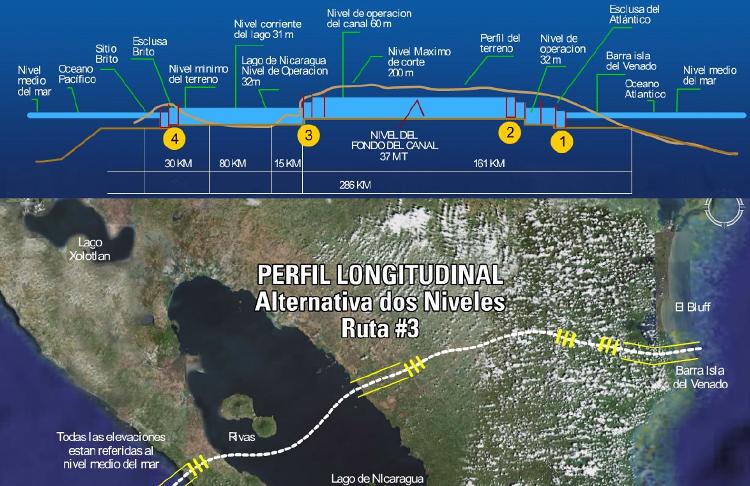
Elsewhere, in June, Russia and Nicaragua confirmed Russian engagement with the Chinese-led plan for Interoceanic Grand Canal. Construction is expected to start by the end of 2014. The IGC will be 286 km long (Panama Canal is 81.5 km), have width of 83 meters and depth of 27.5 meters. This will make it suitable for long-range ships with a deadweight of up to 270,000 tons. The cost of which is estimated at USD30-40 billion.


Source: http://www.qcostarica.com/wp-content/uploads/2014/02/Canal-Nicaragua.jpg


Conclusions:

The last point ties in the BRICS dynamics with Russia's economic push East. China is becoming a major partner in a number of Russia-linked initiatives, including those that are of greater benefit to Beijing than to Moscow (e.g. the IGC). In effect, Russia is gradually building up mutual inter-dependency with China in Latin America, Central Asia and, via the Northern Passage (the sea route to Europe via Russia's Arctic waters) in Europe. This process is in its early stages, but it is a part of the emerging long-term strategy that can lead to significant re-orientation of global politics and, to a lesser extent, economics. Further ahead, beyond the bilateral agreements, Russia, India and China are sitting at the centre of the vast and rapidly growing infrastructure-light markets for energy and transport. Joint co-development of this infrastructure, especially pairing transport of energy with transport of goods and other commodities, suits all regional powers well. This is similar in nature to, but more massive in scale than the ongoing emerging cooperation between China and Russia in Central and Latin America. It does not suit the West.

So Ukraine is a flashing point of the old battlefields. It is still 'hot' but it no longer matters as much as Kiev and Brussels want it to matter. From here on, keep an eye on Latin America, Central Asia and Asia-Pacific for the places where Russian strategy is going to play out next, this time around with BRICS most likely alongside Moscow. The core driver for this change is not Russian 'nationalist revival' or Kremlin's 'aggressive aspirations'. Instead it is the force of the pince-nez squeeze of Western geopolitical pressures on Russia on its Western flank and Chinese demand for natural resources on the Eastern flank that is driving Russia to a reactive, not pro-active strategy. That this strategy is defensive is clear from its reactive and lagged nature. That this strategy is getting now active is clear from the geographic reach it assumed in recent months.

Tuesday, July 15, 2014

15/7/2014: Construction Sector PMI: Q2 2014


June PMI for Construction industry were out this week. Good discussion of some monthly data on this topic here.

Here are quarterly averages through Q2 2014:

  • Total Activity index is up 3.6 points to 61.2 in Q2 2014 compared to Q1 2014. The index is up significantly - by +18.8 points - on Q2 2013.
  • On average we have fourth consecutive quarter of growth in the sector activity and in three of these quarters, the index was statistically significantly above 50.0 expansion mark.
  • Based on these figures we are in a confirmed recovery in the sector and in Q2 2014 this accelerated substantially. Which is good news.
  • Housing Activity sub-index rose to 61.9 - marking rapid growth - and is now up 2.8 points on Q1 2014 and 17.1 points on Q2 2014. Again, we are into fourth consecutive quarter of above 50 readings and, as above, this is the third consecutive quarter of statistically significant readings above 50.0.
  • Commercial Activity sub-index rose to 61.5, up 2.8 points on Q1 2014 and 20 points on Q2 2013. Same dynamics over the last four quarters as in the case of the Total Activity index and Housing Activity sub-index.
  • Civil Engineering index is a drag on overall growth picture, averaging 44.9 over the Q2 2014, up 4.2 points on Q1 2014 and up 12.1 points on Q2 2013, but still below the 50.0 line. This is expected, as the Government continues to destroy public investment at an alarming rate.
Chart to illustrate:


15/7/2014: Mispriced Investment and Risk: Ireland & Euro Area


Whenever Irish Government and media talk about the fabled hordes of investors wondering around Ireland looking for anything to put their money into, all this talk makes me wonder: why are the actual numbers coming out of capital formation side of the National Accounts showing only weak, leafless 'improvements'? Even with reclassifications of R&D costs as 'investment', and with the FDI (some of which does count as 'domestic') and retained profits (some of which, if reinvested, also count as 'domestic').

Well, I bet the IMF should be wondering too. Because in its latest Euro Area analytical paper, the Fund shows that Irish Gross Fixed Capital Formation in Q1 2014 was the second lowest (relative to 2007 levels) after that of another 'recovering' miracle: Greece.


Meanwhile, Ireland is benefiting from low interest rates (compared to its 'peripheral' counterparts) despite having the largest net debt pile of all euro area economies (although Irish rates are rising):


Run by me again that point where, in theory, higher risks are priced via higher cost of capital?


Or that point where equity valuations should be reflective of debt exposures?

15/7/2014: Covenant-lite Debt Mountain & the Great Unwinding...


Recently, I wrote about IMF findings that the corporate and household debt mountains in the euro area remain unaddressed. Here is the World Gold Council chart on issuance of new covenant-lite corporate debt in the US:

The new age of complacency is emerging, defined by the ease of debt raising and low volatility:

Which, of course, can mean only two things:

  1. There will be reversals out of status quo.
  2. Low volatility implies reduced returns on investment and capital. This, in turn, implies lower investment and capital, which means lower growth and higher inflation into the future
With a caveat that we do not know the timing of the above changes, one has to keep in mind that the longer the status quo pre-1&2 remains in place, the worse 1&2 will be.

So there it is, a set up for gradual, painfully stagnant and prolonged unwinding of the extraordinarily accommodative monetary policies of the recent past...

Monday, July 14, 2014

14/7/2014: Some Facts on Web-Enabled Russian Consumers


Some interesting data from Google on internet-enabled consumers in Russia:


14/7/2014: As Far As Debtor Nations Go… All That FDI


There are more interesting revelations in the IMF survey of the Euro Area when it comes to Ireland. Let's imagine what we think of the Emerald Isle… no, not Guinness and not music or the Temple Bar… let's think of FDI. 
  • It is huge, right? Right. 
  • It is a marker of huge source of our success, right? Right-ish. 
  • It is making us richer as a nation, right? Err…

Ok, IMF provides a neat table summarising euro area economies as net creditors (the ones for which Net Foreign Assets held in the economy - private and public - are positive, so the world 'owes' them and associated with this, they have a positive, with exception of Malta, current account, averaging over 1999-2013) and debtors (the ones for which Net Foreign Assets are negative and so they owe, net, to the world, with their current account balances being negative on average over long period of time).

So Ireland is FDI-rich - we have lots of foreign assets that we can call upon as ours, right? Hmm… judge by the table:


And now notice two things:
  1. Our Net Foreign Assets position is a whooping -105% of GDP, less disastrous than that of only two other countries: hugely indebted Greece and heavily indebted and less open Portugal;
  2. Our current account averages at a deficit, of -0.6% of GDP which is benign compared to all other debtor economies, but that said, even at the best performance (maximum) we have generated a current account surplus of just 3.1% of GDP which is… no, not spectacular… it is ranked tenth in the euro area.

Do tell me if this consistent somehow with the evidence that Ireland's external balances are strong indicators of our economy's structural successes, as Irish and Brussels analysts are keen claiming?

But IMF soldiers on. In the following table in the same report it shows us the Average Real Return Difference between Foreign Assets and Liabilities Euro Area Economies. Now, what should we expect from our successes with FDI? That returns to assets inside Ireland should be in excess of returns on Irish assets held abroad. We are, after all, more successful in using investment (FDI) than other countries. What do we get? Exactly the opposite:


Note per above, our real return difference is a whooping 2.8 percentage points - largest after Greece and Slovak Republic. We know what is happening in Greece's case, but what on earth is happening with Slovak Republic case? Why, the same thing that is happening with Ireland: exports of returns via FDI.

So the above simply means we pay more on our liabilities than we get from our assets. In household finances sense... we are going broke...

Is this a problem? Why yes, it is. Here's IMF: "On average, many creditor economies saw negative real return differences between their foreign assets and liabilities, acting as a drag on their net foreign asset positions and also suggesting possible gains from portfolio rebalancing, either by shifting away from foreign towards domestic assets, or by changing the composition of their foreign assets and liabilities, away from euro area debtor economies. At the same time, many debtor economies had large negative real return differences on average, reinforcing their large net foreign liability positions and making adjustment more of an uphill climb."

That said, things are improving - our current account is now in stronger position than in the 2002-2007, but that is largely because of our consumption of imported goods dropping. Still, things are improving...

14/7/2014: Irish Banks are Open for Lending... when no one is looking?


Remember all the Irish banks advertorials in the media about the lending easing they engaged in when it comes to SMEs? The story, as it is being told by the banks, is that our banking system is approving credit to SMEs and that the SMEs just don't apply or don't draw down the loans approved.

Here is IMF chart from today's Euro area survey on the reasons for adverse outcomes of loans applications:


So we have: Irish banks are refusing loans to SMEs at rates second only to Greece. And applications fall short of business expectations at a rate that exceeds that of Greece, so overall, tightness of credit supply to SMEs in Ireland is just as abad as it is in Greece, and worse than in any other 'peripheral' economy.

But never mind, real cost of capital is now back rising in Ireland, so we can expect some additions of grey bars to the above chart too...

All with the blessing of our policymakers who keep talking about higher and higher margins for the banks...

Sunday, July 13, 2014

13/7/2014: Up, Down the Current Account Ladder


For quite some years now, Irish Governments have been keen promoting Ireland's 'unique' external balances performance that, allegedly, made us so distinct from other 'peripheral' countries. Our external balances were booming, we were told by the Government. Ireland's external surpluses are its unique strength, said the boffins at the Brussels think tanks. We are not like Portugal or Greece or Spain when it comes to the 'real' 'competitive' economy.

The hiccup of course, is that this rhetoric was ignoring few little pesky facts, such as the source of our external trade 'competitiveness' or the shifting composition of our trade. Nonetheless, it had some teeth: we started with a much higher base of exports in the economy and stronger external balances than other 'peripheral' states.

Still, in the world of crisis-related 'adjustments', the rate of change matters as much as the starting levels. And judging by IMF data, our rate of improvement in external balances is not that unique:


Per chart above, trade-attributed current account adjustments (the pink bar) for Ireland are higher than for any other peripheral economy. But net adjustments (accounting for income and transfers) are only third highest. This, in part, is due to the fact that vast majority of our exports are supplied by companies that increasingly ship more profits out of Ireland (and this is even worse if we are to account for profits temporarily retained in Ireland by the MNCs).

Still, good news: our trade balance is doing well. Better than any other 'peripheral' in the sample...

13/7/2014: Household Debt Mountains


In the earlier post (here) I covered IMF data on Non-Financial Corporations debt, comparing Spain and other 'peripherals' with Ireland. And here is one other comparative: for household debt


I know, I know... it doesn't matter, really, that households are being tasked with funding Government debt first, their own debt later. All is sustainable...

One caveat: per my understanding, the above does not include household debts transferred to investment funds, as data for Ireland comes from ECB, which does not include data not covered by the CBofI, which does not include household mortgages and other debt sold to institutions not covered by the banking licenses in Ireland. So there, keep raising taxes and reporting higher revenues as a 'success' or 'recovery'... because household debt does not matter... until it matters...

13/7/2014: Ireland v Spain: Property Markets Signal Fundamentals-Linked Growth Potential


Two charts showing why Ireland can expect more robust correction in the property prices post-crisis trough:

First, investment in new construction:


The above shows that Irish construction investment dropped more significantly than in the case of (relatively comparable) Spain. This implies that we have been facing longer and deeper reductions in new stock additions than Spain, implying greater pressures on new supply.

Second, House Price to Income ratios (ignore caption):


Irish property prices have fallen more relative to income than Spanish prices. Which implies that penned up demand is greater in Ireland.

So there you have it, two (not all, of course) fundamentals driving prices recovery up in Ireland and both have little to do with the potential bubble dynamics.


Note: above charts are from IMF's Article IV Consultation Paper for Spain.

13/7/2014: Deflating That Corporate Debt Deflation Myth


This week, the IMF sketched out priorities for getting Spanish economy back onto some sort of a growth path. These, as in previous documents addressed to Irish and Portuguese policymakers, included dealing with restructuring of the corporate debts. IMF, to their credit, have been at the forefront of recognising that the Government debt is not the only crisis we are facing and that household debt and corporate debt also matter. As a reminder, Irish Government did diddly-nothing on both of these until IMF waltzed into Dublin.

But just how severe is the crisis we face (alongside with Spanish and Portuguese economies) when it comes to the size of the pre-crisis non-financial corporate debt pile, and how much of this debt pile has been deflated since the bottom of the crisis?

A handy chart from the IMF:
The right hand side of the chart compares current crisis to previous historical crises: Japan 1989-97; UK 1990-96; Austria 1988-96; Finland 1993-96; Norway 1999-05; Sweden 1991-1994.

So:

  • Irish corporate debt crisis is off-the-scale compared to other 'peripherals' in the current crisis and compared to all recent historical debt crises;
  • Irish deflation of debt through Q3 2013 is far from remarkable (although more dramatic than in Spain and Portugal) despite Nama taking a lion's share of the development & property investment debts off the banks.
Now, remember the popular tosh about 'debt doesn't matter for growth' that floated around the media last year in the wake of the Reinhart-Rogoff errors controversy? Sure, it does not... yes... except... IMF shows growth experience in two of the above historical episodes:

First the 'bad' case of Japan:
 So no, Japan has not recovered...

And then the 'good' case of Sweden:
Err... ok, neither did Sweden fully recover... for a while... for over a decade.

13/7/2014: A Miracle of Reformed Banks Operating Costs Performance


We are all familiar with the fact that Irish banks are aggressively deleveraging and beefing up their profit margins. This much has been set out in regulatory and policy provisions (e.g. PCARs) and lauded by the Irish policymakers as a sign of improvements in the banking sector. Alas, the same cannot be said about operating costs in Irish banks. This metric, in fact, has not been given much attention in Irish media and by Irish politicians. So in their place, here's the latest from the IMF (special note on Spain published this week):

Wait... what?! Irish banks cost-to-income ratio is hanging around 80%, well ahead of all other 'peripherals'. Is the Irish economy (borrowers) sustaining excessive costs and employment levels in Irish banks? Why, yes, it appears so... 

Friday, July 11, 2014

11/7/2014: BlackRock Institute Survey: EMEA, July 2014


BlackRock Investment Institute released its latest Economic Cycle Survey for EMEA region.

Per BII: "With caveat on the depth of country-level responses, which can differ widely, this month’s EMEA Economic Cycle Survey presented a mixed outlook for the region.

The consensus of respondents describe Russia, the Ukraine and Croatia be in a recessionary state, with an even  split of economists gauging Kazakhstan and South Africa to be a in a recessionary or contraction. Over the next two quarters, the consensus shifts toward expansion for Kazakhstan and South Africa.


Note: Red dot represents Czech Republic, Hungary, Romania, Israel, Slovenia, Poland and Slovakia

At the 12 month horizon, the consensus expecting all EMEA countries to strengthen or remain the same with the exception of Russia, Kazakhstan, Turkey, Hungary and the Ukraine.


Globally, respondents remain positive on the global growth cycle with a net 85% of 34 respondents expecting a  strengthening world economy over the next 12 months – an 14% increase from the net 71% figure last month. The consensus of economists project mid-cycle expansion over the next 6 months for the global economy."

Note: these views reflect opinions of survey respondents, not that of the BlackRock Investment Institute. Also note: cover of countries is relatively uneven, with some countries being assessed by a relatively small number of experts.

11/7/2014: Notes on German ESM vote

Here are some of my briefing notes on last night's programme on TV3 covering the latest 'seismic' news on retroactive banks recapitalisations and ESM.


Eurogroup meeting on 20th June 2013 agreed on the main features of the European Stability Mechanism's (ESM) Direct Recapitalisation Instrument (DRI).  I covered the fallout from that meeting here  and here  and here.

Note in the first post above, there is a link to Irish Government-set target of 17% of GDP for retroactive recapitalisation.
  • The objective of the ESM's DRI will be to preserve the financial stability of the euro area as a whole and of its Member States in line with Article 3 of the ESM Treaty, and to help remove the risk of contagion from the financial sector to the sovereign by allowing the recapitalisation of institutions directly.
  • This does not decouple banking sector from the sovereign, but weakens the links.
  • There is a specific provision included in the main features of the DRI, which states: "The potential retroactive application of the instrument should be decided on a case-by-case basis and by mutual agreement."
So do note: it is 'potential' (not assured access) and it is to be decided on case-by-case basis (so no 'symmetric' or 'equal' treatment) and it is 'mutual agreement' (allowing states to block any potential case-by-case deal). There is so much conditionality around this statement, one has to view it as being aspiration rather than prescriptive.

But, on a positive side, June 2013 agreement kept open the possibility to apply to the ESM for a retrospective direct recapitalisation of the Irish banks. I covered this here and the fallout from the second round deal here. The last link covers persistent opposition from Germany to retroactive recapitalisations. And if you thought this has gone away, here's the latest on that.

On June 10, 2014 the euro area member states reached a preliminary agreement on the operational framework for the ESM's direct recapitalisation instrument, DRI.
  • This framework does not guarantee that we will get our case approved.
  • It does not stipulate how retrospective recapitalization can take place (crucial detail).
  • It requires unanimous vote of ESM board of governors (which is basically Council of Ministers).
All of this was forthcoming. See my article from March 2014 on this here.

The above is also confirmed by Minister Noonan on July 3 in the Dail. Minister further stated that: "However, it will not be possible to make a formal application to the ESM for retrospective recapitalisation before the instrument is in place. It would, therefore, be premature to make any submission, be it a technical paper or otherwise, in advance of the instrument being in place."

Incidentally, Minister Noonan's pronouncements on the topic have by now converged to repeating the same statement on every occasion. compare this and this.

So a reminder: After June 2012 summit, Minister Noonan went onto "Today with Seán O'Rourke", and said he expected the retrospective recapitalization agreement to be concluded by November 2012. Now, we are looking at the earliest possible application date or application consideration date of November 2014. But even this application date is uncertain. Methodology for valuation or even structuring recapitalisations is uncertain. In the mean time, we are getting less and less certain if it makes any sense for us to even apply for this measure.

Minister Noonan on the topic again: "When one thinks through the recapitalisation retroactive option, it was always envisaged that there would be some form of exchange of shares in the banks for capital upfront, and that this capital would be used to reduce the debt. While the technical work has been done on it, there is a question of value, price and judgment in all these matters. I certainly do not wish to talk ourselves into a position where just as the banks are becoming valuable, we give them away for the second time." This was stated on July 3 this year in the Dail.

Meanwhile, Bank of Ireland shares we hold have already yielded returns that are EUR1 billion in excess of original recapitalization, excluding the cost of the Bank of Ireland-related measures to the Exchequer via higher borrowing costs in 2009-2013 period.

Value of AIB currently is around EUR11 billion, value of PTSB is virtually nil, which is less than ca EUR23.5 billion we put into the bank and PTSB.

Our borrowing costs are low, and are lower than those of other peripheral states - why would they approve a recapitalization for Ireland? See, for example, most recent pressure points on borrowing costs here.

Another pesky issue: ESM is EUR500 billion fund. But only EUR60 billion is set aside to cover all future and any potential retrospective recapitalisations of banks. Eurostat estimates Irish Government banks stake at EUR16 billion in terms of its future potential value, which means that Ireland's retroactive recapitalization will either have to be so small as to make no difference to us, or so large as to swallow some 20% or so of the entire DRI fund.

Do we seriously expect to get anything substantial from the ESM?

Let us remember that until June 2013, Germany resisted not only retroactive recapitalisations, but even forward recapitalisations. The reason German leadership changed its mind is that EU has substantially reduced any potential exposure of ESM to such recaps in the future and loaded more, not less, burden onto national banks and sovereigns. These are covered here and here.

In short, the latest news from Berlin are not a 'step forward toward retroactive recapitalisations of the Irish banks' - at the very best these are simply re-affirmations of the already taken steps and the muddle they left behind.

Meanwhile, there are 3 major points of pressure relating to Irish banks:

  1. Recaps we put in are weighing on our debt levels: 25.3 billion against 13-14bn value. There is little we can hope to get from the ESM in this context.
  2. Government bonds from Promo Notes conversion: 25 billion against nothing. There is nothing in the ESM that allows us to swap these bonds for anything that is cheaper. Instead, the real impact can be achieved by significantly delaying sales of these bonds to private markets, which is not related to the ESM but is rather an ECB action.
  3. State of banks balance sheets - arrears and tracker mortgages (EUR36 billion in AIB and PTSB). Professor Karl Whelan has an excellent note on trackers here.

11/7/2014: My comment on Greek and Portuguese bonds pressures


Portugal's Expresso on Greek and Portuguese bond yields with my comment: here.

My full comment in English:

In my view, we are seeing a strong reaction by the markets to adverse news relating to some peripheral euro area countries. 

In the Greek case, much of the rise in bond yields can be attributed first to the persistent uncertainty over the deficit adjustments and the progression of the reforms. The most recent suggestions by some analysts that Greece may require additional EUR2-3 billion over 2015-2016 relating to the news that the country pension fund is now facing an annual EUR2 billion funding gap have triggered some pressure on the country sovereign debt. This was compounded by thin and nervous markets for today's issuance of EUR1.5 billion bond which originally attracted just over 2.0x cover, but saw final demand slump somewhat on generally negative sentiment in the markets. Today's bond was priced at a yield of 3.5% with guidance between 3.5% and 3.625% issued two days ago on Tuesday. This is below the April 2014 5-year bond issue - the issue that attracted EUR20 billion worth of bids and was priced at 4.95%. However, shortly after the issue, secondary markets yields on April bond shot up to 5.10%.

In Portugal's case, the core risk trigger so far has been building up of pressures in the banking sector, and in particular in relation to Espirito Santo International announcement on Tuesday. This pushed Portuguese yields above 4% for 10 year bonds in today's trading. 

Portuguese risks have also put a stop to Banco Popular Espanol contingent convertible bond issue, as well as Spanish construction company ACS plans for an issue.

All in, Greek 10 year bonds closed at 502.0 spread to 10 year German bund up 20.4 bps on yesterday, Portugal's at 276.2 up 22.3 bps, Spanish at 161.8 up 9.2 bps, Italian at 174.1 up 9.3 bps, and Irish at 112.7, up 4.4 bps.

Spreads on 10 year German Bund:


The markets instability is a reminder that while current monetary and investment climates remain supportive of lower yields, markets are starting to show increasing propensity to react strongly to negative newsflows. Investors' view of the 'peripheral' states as being strongly correlated in their performance remains in place, especially for Spanish, Portuguese and Greek sovereigns and corporate issuers. 

The markets are jittery and are getting trigger-happy on sell signals as strong rises in bond prices in recent months have resulted in sovereign and corporate debt being over-bought by the investors. These investors are now staring into the prospect of gradual uplift in US and UK interest rates, weakening of the euro and thus rising cost of carry trades into the European sovereign bonds. At some point in time, these pressures are likely to translate into earlier investors in 'peripheral' bonds starting to exit their positions. 

We are not there yet, but market nervousness suggests that we are getting close to that inflection point.