Friday, September 28, 2012

28/9/2012: Thou Shalt Not Read Into the ECB PRs Too Much


You'll read a load about the Spanish Banks 'stress' tests (which they largely passed with just minor blemishes) in days ahead, but one thing worth remembering is that all the congratulatory patting on the back the Spanish authorities about to receive means diddly-nothing.

Here's what the ECB had to say about the most farcical of all 'stress' tests ever conducted anywhere this side of the Zimbabwean border - the stress tests of July 2010 which even the Irish banks passed with flying colors:

"The stress-testing exercise is comprehensive and rigorous. It confirms the resilience of EU and euro area banking systems to major economic and financial shocks. The exercise, therefore, represents an important step forward in supporting the stability of the EU and euro area banking sectors."

The farcical bit was of course that the 'comprehensive and rigorous' tests of 2010 found all euro area banks needing just €3.5bn of capital...

And here's what the ECB had to say about July 2011 stress tests that failed to find much at fault with the Spanish banking system (italics are mine):

"The European Central Bank (ECB) welcomes the publication today of the results of the EU-wide stress-testing exercise, which was prepared and conducted by the European Banking Authority (EBA) and the national supervisory authorities. The EU-wide stress test in the banking sector has proved to be an important tool to enhance transparency in the EU banking system. It provides for the disclosure of all the information that is relevant for the market to assess the resilience of the institutions in the context of an adverse scenario."

So let's not exercise too much about today's ECB 'welcoming' of the Spanish stress tests (link here)...

28/9/2012: 2012 Emigration hits record levels


Latest data from the CSO on Migration and Population changes estimates for the 12 months period April 2011-April 2012 shows that during the period of so-called 'economic turnaround' marked by the officially 'EU-average growth' attained in Ireland, Irish emigration has hit new post-1990 record levels.

Top line numbers are:

  • In April 2011-April 2012 Ireland registered 74,000 new births - a number representing the fourth highest number of births in any year since 1987.
  • Over the same period, the number of deaths stood at 29,200, implying the natural rate of increase in Irish population of 44,900 - also the fourth highest rate in history of the series, tied with the identical rate achieved in 2008.
  • In April 2011 - April 2012 52,700 people migrated into Ireland well below 69,900 average for 200-2006 period.
  • Over the said period 87,100 people left Ireland - a historical record level, beating 80,600 record set in April 2010 - April 2011 period and more than tripple the average rate of outward emigration (28,500) for 2000-2006 period. Overall rate of emigration is now 23% above that attained in the peak pre-crisis year of 1989.
  • Net emigration reached 34,400 in April 2011 - April 2012, marking the third highest rate of net emigration in history of the series. In 2000-2006 we averaged 41,400 net immigration per annum, implying a downward swing of 75,800 per annum. Net emigration hit the post-1990 record in the 12 months through April 2012.
  • As the result, Irish population expanded by only 10,500 in April 2011 - April 2012 period - the slowest rate of growth since 1990. In 2000-2006 period, Irish population grew on average at the rate of 71,200 per annum.
Charts to illustrate these trends:


Breakdown of net emigration by nationalities shows that the principal driver of emigration from Ireland is outflow of Irish nationals from the country, confirming the trend established in 2011.


Referencing the trends in migration that existed prior to the crisis, the current crisis period is associated with potential net loss of 219,300 persons in the period of 2008-2012. In gross numbers terms, 358,100 people actually emigrated from Ireland in 2008-2012.


If there is such a thing as 'demographic dividend' Ireland today is running at a massive demographic 'loss'.

Thursday, September 27, 2012

27/9/2012: Planning Permissions, Ireland, Q2 2012


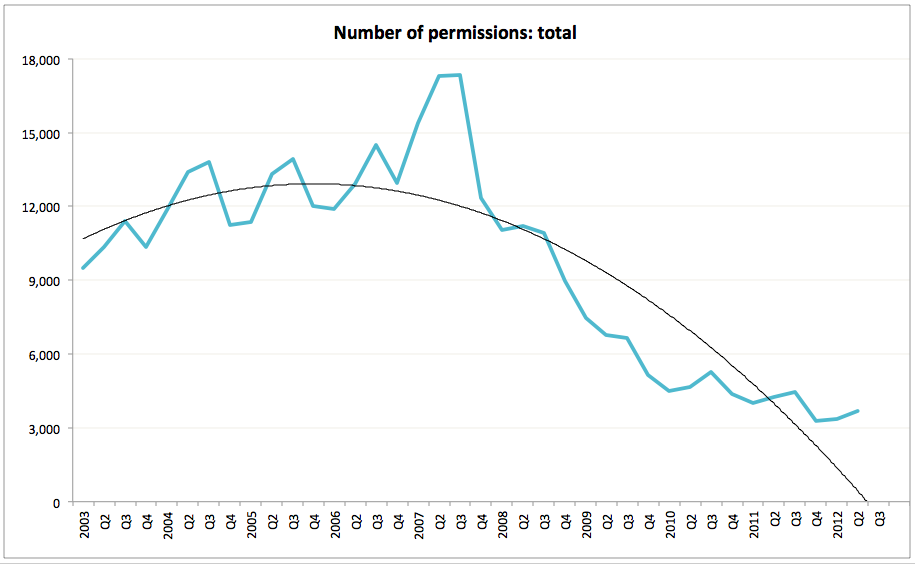
Planning Permissions for Q2 2012 were published today for Ireland, offering basically continuation of the trend established the end of 2010 which marks slower rate of decline in overall planning permissions. Chart below illustrates:


Total number of planning permissions rose 9.03% q/q in Q2 2012 to 3,672 (still 13.48% down on Q2 2011 and 78.8% down on peak).

In Q2 2012, overall number of planning permissions in Ireland for new dwellings dropped to 942 from 957 in Q1 2012 (-1.57% q/q), which is down 25.47% y/y and down 87.5% on peak. In contrast with new dwellings, other new construction permissions rose from 695 in Q1 2012 to 828 in Q2 2012 (up 19.14% q/q and up 14.84% y/y), which is still down 86.7% on peak.


Annual rates of change clearly show that the slowdown in the rate of decline is now persistent over two quarters for total number of planning permissions, while there is an acceleration in the rate of decline in the planning permissions for new dwellings.


Average square footage relating to new permissions granted is now moving sideways since Q3 2011, suggesting there is really no life in the market for new construction, even in the potential pipeline of work planned.

Sorry to say this, but no good news here.

Wednesday, September 26, 2012

26/9/2012: Nama valuations & August property prices


As promised - in the last post on today's data release for Irish Residential Property Price Index (RPPI) here's the summary of impact of latest price index movements on Nama valuations.

Note: the figures referenced are approximate and relate to averages of valuations, so these should be treated as a guide. Keep in mind that property prices reaching Nama valuations levels (adjusted for risk-sharing cushion and long-term economic value premium) still imply a loss on Nama books, in my view, due to costs associated with operations, plus the discounts on disposals of properties in volume and over time. Inflation adjustment further increases real loss.

Summary table:

In other words, we need 60%+ uplift on current price levels to achieve a break even on Nama average valuations.

26/9/2012: 2012 forecast for property prices in Ireland


In the previous post I covered main data for August Residential Property Price Index for Ireland. Now, annual forecasts based on data through August:


These imply a cumulated decline of ca3.2% on August 2012 through December 2012, a decline of 2.4-2.5% for Houses, a decline of 3.4-3.5% for Apartments, and a rise of 0-0.25% for Dublin. Obviously, these are not precise figures, so treat with caution.

I currently foresee decline of 51.5% for all properties in 2012 relative to the peak with range of forecasts of 55-61% decline through 2013 relative to peak for all properties index.

I have not updated these figures for some time now - over 6 months so there you go...


26/9/2012: Residential Property Price Index for Ireland, August 2012


Residential Property Price Index for Ireland (RPPI) for August 2012 is out today, triggering a torrent of usual commentary - some optimistic, some more bleak, depending on the focus of the analysis reported. Here are the facts:

Overall RPPI:

  • Index for all properties nationwide has risen marginally to 65.2 in August against July reading of 64.9 and this represents second consecutive monthly rise. M/m index rose 0.46% in August after posting a 0.15% rise in July. 
  • However, index reading remains below May when it stood at 65.5 and marks the third lowest reading in history of the series. 
  • 3mo MA for the overall index is now 64.97 in August and that is below 3mo MA ever recorded in the history of the series.
  • Y/y index fell 11.77% in August, which is an improvement on the fall of 13.58% in July and the shallowest annual rate of decline in any month since February 2011.
  • Overall residential properties prices are now 50.04% below their peak which is an improvement on the absolute bottom level of -50.34% on the peak, albeit statistically-speaking there is no discernable difference.
  • YTD average monthly change in the index is -0.68% and 12mo MA change is -1.03%. In other words, however you spin annual or monthly date, from September 2011 through August 2012 prices have fallen on average at a monthly rate of 1.03%.
Chart to illustrate:

Note, not a factual, but 'interpretative observation, we are seeing some attempts in the market to 'bottom out'. This does not mean that the market will bottom out here, but it does represent a first such instance of an attempt in the market.

Houses prices:

  • Safe as houses stuff prices rose to 68 in August from 67.8 in July marking second consecutive month of increases (in July prices rose 0.296% m/m and in August the rise was 0.295% - both statistically indistinguishable from zero).
  • However, as with overall residential prices, house prices through August failed to regain levels registered in May (68.2).
  • Y/y house prices are down 11.69% in August - slowest rate of annual drop since March 2011.
  • Relative to peak house prices are now down 48.48%
  • YTD average monthly drop is at 0.66% and 12mo MA monthly drop is at 1.03% so the same analysis for dynamics stands as for the overall RPPI above.
Chart on this below (after Apartments analysis).

Apartments prices:
  • Apartments prices firmed up to 46.9 in August from 45.8 in July and are still below the levels attained in June (47.6), implying the index is at the second lowest point in its history.
  • M/m prices rose 2.40% posting the first rise since April 2012. Y/y apartments prices are down 14.57% - the slowest rate of annual decline since February 2011.
  • Relative to peak, shoe boxes (err.. apartments) are now trading at a discount of 62.15%.
  • 12moMA of monthly deflation is at -1.53% and YTD average monthly price drop is -1.59%. Good luck if you are taking any solace from the one month blip.


Dublin prices:

  • Unlike the rest of the country (where I suspect prices changes are driven primarily by thin and selection-biased markets), Dublin property prices have continued steady decline dropping 0.52% m/m in August after 0.35% drop in July. 
  • August thus marks the second consecutive month since prices posted shallow increases in March-May 2012.
  • August also marks the month in which Dublin property prices have hit another record low at 57.3, with the previous record low attained in July (57.6) and in February 2012.
  • Dublin prices are now 57.40% below their peak.


I will be blogging later tonight on my forecasts for 2012 prices and on impact of these prices changes on Nama balancesheet, so stay tuned.

Tuesday, September 25, 2012

25/9/2012: Some questions on foot of latest ESM statement


From today's Joint Statement of the Ministers of Finance of Germany, the Netherlands and Finland (link here):
"Specifically, we discussed the governance, independence, decision making and accountability of the new Single Supervisory Mechanism involving the ECB. The new framework has to ensure that the ECB can continue to conduct effectively and independently its current tasks, and it has to take into account the concerns of non euro area Member States regarding governance of the new supervision. This requires appropriate governance structures and a clear division of responsibilities between a new ECB Supervisory Council, which may include representatives from all Members States, and the Governing Council of the ECB. To ensure the accountability of the new Supervisory Council, it should report on the stability situation and its decisions to European Finance Ministers (Ecofin Council or Eurogroup ) as well as provide reports to the European Parliament and national Parliaments."

Key points in my view are:

  • Core problem is the coordination of regulatory systems for euro area banks and non euro area banks is now further fractionalized into the space of 'supervised Euro area banks', 'non-supervised Euro area banks' (assuming the new Single Supervisory Mechanism (SSM) applies only to systemically important banks), 'non-Euro area banks in countries under mechanism', 'non-Euro area banks outside mechanism but inside the mechanism-covered countries', 'non-Euro area banks in countries outside the mechanism'.
  • The role of the Supervisory Council vis-a-vis the Governing Council of the ECB
  • The extent and nature of reporting by the Supervisory Council as well as the extent of the Ecofin / Eurogroup and EU Parliament oversight (if any) over the Supervisory Council activities.

"Regarding longer term issues, we discussed basic principles for enabling direct ESM bank recapitalisation, which can only take place once the single supervisory mechanism is established and its effectiveness has been determined. Principles that should be incorporated in design of the instrument for direct recapitalization include: 
1) direct recapitalisation decisions need to be taken by a regular decision of the ESM to be accompanied with a MoU; 
2) the ESM can take direct responsibility of problems that occur under the new supervision, but legacy assets should be under the responsibility of national authorities; 
3) the recapitalisation should always occur using estimated real economic values; 
4) direct bank recapitalisation by the ESM should take place based on an approach that adheres to the basic order of first using private capital, then national public capital and only as a last resort the ESM."

Points of note here are:

  • ESM recapitalization of the banks can only take place after the SSM is both established and proven in its effectiveness. Time scale for this? Anyone's guess. While time scale for Spanish economic meltdown is pretty well in front of our eyes.
  • Full and formal MoU will be required - a political no-go territory for some countries, though in fact the EU can fudge this requirement by simply re-printing as an MoU already ongoing 'reforms' processes.
  • Legacy assets should remain under the responsibility of national authorities, which means there is no coverage under the ESM for crisis-related assets. One can interpret this, possibly, as a de facto no to any removal of the Irish banks assets off the hands of the Irish state. One can also read this as a potential for restructuring some of the Irish Government liabilities relating to banks, but only to the extent of altering the cost of funding these liabilities (e.g. ESM loan with no change in actual liability risk, so that Irish banks-related debts will remain Irish Government liability).
  • Point (3) implies no 'future economic value' in computing ESM-available funding. In other words, losses incurred will not be covered. Which opens the question - who will cover the losses?
  • Point (4) is clear with respect to equity holders (these take the hit first, then the state owned equity is wiped out, only after that - ESM), but what about lenders to the banks (private bondholders and official lenders, including ECB)?


25/9/2012: One hell of a mess...


A quick quote from the recent Citi report on euro area economics, relating to ESM (emphasis is mine):

"Of the €500bn, €100bn is earmarked for future Spanish bank recapitalisation. If Ireland retroactively gets full mutualisation of sovereign debt issued to recapitalise its banks, that would require another €64bn. Equivalent treatment for Greece would cost €45bn and for Portugal €8.5bn. That would leave €282.5bn, a pittance compared with the likely future funding needs of Spain and Italy, unless the ECB
does most of the heavy lifting through the OMT."

Puts matters into perspective: Irish banking mess would cost EZ more funds than Greece and Portugal combined. Put alternatively, Irish taxpayers have done more to underwrite risks within the EZ banking system than Greek and Portuguese taxpayers combined. Take your pick of the option for interpreting...

To wet your appetite for explicatives further, here's another quote:

"We are still likely to see multiple sovereign debt restructurings of EA periphery sovereigns, starting possibly with Greece and probably lasting into 2015.

  • We expect Portugal will likely require sovereign debt restructuring, possibly in 2014-15, but could happen even earlier, both through OSI and through PSI (Private sector involvement). 
  • Unless Ireland benefits from major OSI, say in the form of a mutualisation through the ESM of up to €64bn worth of sovereign debt – the counterpart of the capital injection into its banking system provided by the Irish authorities between 2008 and 2010 – we believe it too is likely to see sovereign debt restructuring.
  • The Spanish sovereign and banking sector taken together are most likely insolvent. The relevant question then becomes what combination of mutualisation, bank debt restructuring and sovereign debt restructuring will occur...
  • Italy should never suffer a sovereign default due to inability to pay in our view. It is a rich country with massive private wealth and, by the standards of the periphery, is in a relatively good economic shape, although massive structural reforms are required to get out of the swamp the country now finds itself in."

25/9/2012: Some thoughts on US Government debt


There's much of a debate going on about which US President has added most to the US Government debt stockpile. The question is far from trivial.

Here's the chart plotting overall evolution of the US debt since 1980 with presidential tenures super-imposed onto it:

So far, it appears the contest is between Ronald Reagan, George W. Bush and Barack Obama. The tables below summarizes the presidential administrations' performance in terms of the US debt first in terms of absolute current US dollars and then in terms of debt to GDP ratios:


The problem is, of course, two-fold:

  1. Presidential tenure starts in year 1, for which some of the budgetary dimensions are already Pre-set by the previous administration, and the tenure ends in year 4, when the outgoing President sets out some of the legacy measures for the incoming one;
  2. Presidential tenures range between 4 and 8 years in the above period.
Controlling for the (1) is hard, so let's assume that the incoming President shares the burden of fiscal regime setting in year 1 with his predecessor. Tables below show this analysis:


The last two columns in the above summarize overall rates of change per year in office and this makes it clear:
  • Current administration leads in terms of overall rate of increasing the US Government debt by a factor of 5 times that of the Reagan administration;
  • The above does not account for inflation, as figures stated are in current US Dollars, but to match Barack Obama's rate of increasing public debt in real terms to that achieved by the Reagan administration we need annual inflation in excess of 6.5% pa. Meanwhile, over the period GDP deflator averaged 3.56%pa, while CPI averaged between 2.95% and 2.96% (depending on annual metric chosen);
  • Obama administration also leads, by a massive margin, every other administration in the rates of debt increases relative to GDP.


Monday, September 24, 2012

24/9/2012: Irish Building & Construction decline v EU27


Last post on Irish Building & Construction sector data for Q2 2012. Here are the comparatives for EU member states based on current activity (through Q1-Q2 2012) compared to 2006-2007 peak levels:


No need to comment on the above...

24/9/2012: Irish Building & Construction Sector Activity Q2 2012


And in another post prompted by @stephenkinsella tweet, here's an update on CSO data for Irish Building & Construction sector activity:

Ex-Civil Engineering:

  • Value index fell to 17.6 in Q2 2012 from 18.7 in Q1 2012, marking 5.88% decline q/q and down 15% y/y.
  • H1 2012 Value index is down 12.11% on H2 2011 and down 13.78% on H1 2011.
  • Value index fell to 15.5% relative to the peak and volume index declined to 14.66% of the peak level
  • Volume index dropped to 15.6 in Q2 2012 down on 16.7 in Q1 2012, marking a 6.59% decline q/q and 16.6% decline y/y. 
  • H1 2012 volume index was down 13.17% on H2 2011 and down 14.55% on H1 2011.
  • Both Value and Volume indices are now down on an annual basis for 22 consecutive quarters.


Civil Engineering:
  • Value of Civil Engineering activity rose from 58.4 in Q1 2012 to 62.7 in Q2 2012 (+7.36% q/q) and advanced 11/4% y/y, registering the first annual rate of increase after 15 quarters of contraction.
  • H1 2012 value index rose +1.68% on H2 2011 and is up 5.21% on H1 2011.
  • Volume of activity also grew from 52.3 in Q1 2012 to 55.8 in Q2 2012 (+6.69% q/q and +9.8% y/y) also breaking for the first time annualized contraction period of 18 quarters.
  • H1 2012 volume index rose 0.93% on H2 2011 and is up 4.75% on H1 2011.


Residential and non-residential:

  • Residential construction value index fell from 9.1 in Q1 2012 to 8.6 in Q2 2012 (-15.7% y/y and -5.49% q/q). H1 2012 index was down 9.69% on H2 2011 and down 16.51% on H1 2011. Relative to peak, the index is now down 92.45%.
  • Residential construction volume index fell to 7.7 in Q2 2012 from 8.3 in Q1 2012 (decline of 7.23% q/q and down 17.2% y/y). The index is now down 92.53% on peak.
  • Non-residential construction value index fell from 55.4 in Q1 2012 to 51.5 in Q2 2012 (-14.7% y/y and -7.04% q/q). H1 2012 index was down 14.41% on H2 2011 and down 12.23% on H1 2011. Relative to peak, the index is now down 58.23%.
  • Non-residential construction volume index fell from 49.4 in Q1 2012 to 46.0 in Q2 2012 (-15.8% y/y and -6.88% q/q). H1 2012 index was down 15.12% on H2 2011 and down 12.48% on H1 2011. Relative to peak, the index is now down 58.89%.


To sum up: rates of decline are (annually) in double digits and/or accelerating in Q2 2012 in Residential (value and volume), Non-residential (value and volume) and ex-Civil Engineering (value and volume). Residential construction is now at 8.6% of 2005 levels in value terms and 7.7% of 2005 levels in volume terms. Non-residential construction is now at 51.5% of 2005 levels in value terms and 46% in volume terms. Civil Engineering activity is now at 62.7% of 2005 levels in value terms and at 55.8% in volume terms. All activity ex-civil engineering is now down to 17.6% of 2005 levels in value terms and 15.6% in volume terms.

24/9/2012: Euro peripherals Building & Construction activity


Here's a chart updating to latest data index of Building & Construction sector activity in the peripheral euro area states:


As inspired by @StephenKinsella: "Ouch!"