Showing posts with label S&P500. Show all posts

Friday, September 6, 2019

6/9/19: Small Cap Stocks EPS: racing to the bottom of the MAGA barrel


Everything is going just plain swimmingly in the Land of MAGA, where American companies are now expected to do their duty by President Trump's agenda for investment in the U.S. because, you know, this:

As 'share' part of the EPS ratio has shrunk (thanks to buybacks and M&As tsunami of recent vintage), earnings per share should have gone up... and up... and up. Instead, small cap stocks' EPS has collapsed. To the lowest levels since the 2007-2008 crisis.

But never mind, more money printing by the Fed will surely cure it all.

Source for the above chart: @soberlook and WSJ.

Wednesday, July 31, 2019

31/7/19: Fed rate cut won't move the needle on 'Losing Globally' Trade Wars impacts


Dear investors, welcome to the Trump Trade Wars, where 'winning bigly' is really about 'losing globally':

As the chart above, via FactSet, indicates, companies in the S&P500 with global trading exposures are carrying the hefty cost of the Trump wars. In 2Q 2019, expected earnings for those S&P500 firms with more than 50% revenues exposure to global (ex-US markets) are expected to fall a massive 13.6 percent. Revenue declines for these companies are forecast at 2.4%.

This is hardly surprising. U.S. companies trading abroad are facing the following headwinds:

  1. Trump tariffs on inputs into production are resulting in slower deflation in imports costs by the U.S. producers than for other economies (as indicated by this evidence: https://trueeconomics.blogspot.com/2019/07/22719-what-import-price-indices-do-not.html).
  2. At the same time, countries' retaliatory measures against the U.S. exporters are hurting U.S. exports (U.S. exports are down 2.7 percent in June).
  3. U.S. dollar is up against major currencies, further reducing exporters' room for price adjustments.
Three sectors are driving S&P500 earnings and revenues divergence for globally-trading companies:
  • Industrials,
  • Information Technology,
  • Materials, and 
  • Energy.
What is harder to price in, yet is probably material to these trends, is the adverse reputational / demand effects of the Trump Administration policies on the ability of American companies to market their goods and services abroad. The Fed rate cut today is a bit of plaster on the gaping wound inflicted onto U.S. internationally exporting companies by the Trump Trade Wars. If the likes of ECB, BoJ and PBOC counter this move with their own easing of monetary conditions, the trend toward continued concentration of the U.S. corporate earnings and revenues in the U.S. domestic markets will persist. 

Sunday, July 7, 2019

7/7/19: Investment for growth is at record lows for S&P500


Interesting chart via @DavidSchawel showing changes over time in corporate (S&P500 companies) distribution of earnings:

In simple terms:

  1. Much discussed shares buybacks are still the rage: running at 31% of all cash distributions, second highest level after 34% in 2007. On a cumulated basis, and taking into the account already reduced free float in S&P 500 over the years, this is a massive level of buybacks.
  2. 'Investment for growth' - as defined - is at 51% - the lowest on record.
  3. Meaningful investment for growth (often opportunistic M&As) is at 38%, tied for the lowest with 2007 figure.
S&P 500 firms are clearly not in investment mode. Despite 'Trump incentives' - under the TCJA 2017 tax cuts act - actual capex is running tied to the second lowest levels for 2018 and 2019, at 26% of all cash distributions.

Friday, June 14, 2019

14/6/19: Rising Concentration Risk in S&P500 Earnings and Revenues


S&P 500 companies earnings and revenues are heading for another round of de-diversification (increasing concentration of earnings and revenues toward the U.S. markets), per Factset latest data:


Tuesday, May 14, 2019

14/5/19: Trump's Trade Wars and Global Growth Slowdown Put Pressure on Corporate Earnings


The combined impacts of rising dollar strength, reduced growth momentum in the global economy and President Trump's trade wars are driving down earnings growth across S&P500 companies with double-digit drop in earnings of companies with more global (>50% of sales outside the U.S.) as opposed to domestic (<50 exposures.="" of="" p="" sales="" the="" u.s.="" within="">
Per Factset data, released May 13, "The blended (combines actual results for companies that have reported and estimated results for companies yet to report) earnings decline for the S&P 500 for Q1 2019 is -0.5%. For companies that generate more than 50% of sales inside the U.S., the blended earnings growth rate is 6.2%. For companies that generate less than 50% of sales inside the U.S., the blended earnings decline is -12.8%."


Tuesday, March 12, 2019

12/3/19: S&P500 Concentration Risk over 10 years


More on increasing concentration risks in the U.S. equity markets: Goldman Sachs estimates that almost 1/4 of total return to S&P500 over the last 10 years came from just 10 stocks:


Of these, Apple alone accounted for almost 1/5th of total return to S&P500. 22% of total return was accounted for by ICT sector.

Wednesday, March 6, 2019

6/3/19: Expectations Sand Castles and Investors


As raging buybacks of shares and M&As have dropped the free float available in the markets over the recent years, Earnings per Share (EPS) continued to tank. Yet, S&P 500 valuations kept climbing:
Source: Factset 

As noted by the Factset: 1Q 2019 "marked the largest percentage decline in the bottom-up EPS estimate over the first two months of a quarter since Q1 2016 (-8.4%). At the sector level, all 11 sectors recorded a decline in their bottom-up EPS estimate during the first two months of the quarter... Overall, nine sectors recorded a larger decrease in their bottom-up EPS estimate relative to their five-year average, eight sectors recorded a larger decrease in their bottom-up EPS estimate relative to their 10-year average, and seven sectors recorded a larger decrease in their bottom-up EPS estimate relative to their 15-year average."

Bad stuff. Yet, "as the bottom-up EPS estimate for the index declined during the first two months of the quarter, the value of the S&P 500 increased during this same period. From December 31 through February 28, the value of the index increased by 11.1% (to 2784.49 from 2506.85). The first quarter marked the 15th time in the past 20 quarters in which the bottom-up EPS estimate decreased while the value of the index increased during the first two months of the quarter."

The disconnect between investors' valuations and risk pricing, and the reality of tangible estimations for current conditions is getting progressively worse. The markets remain a spring, loaded with the deadweight of expectations sand castles.

Saturday, December 8, 2018

8/12/18: Shares Buybacks Hit Diminishing Marginal Returns


The S&P 500 Buyback Index Total Return data tracks the performance of the top 100 stocks with the highest buyback ratios in the S&P 500 in terms of total return. As the chart below shows, the Buyback Index has generally and significantly outperformed S&P500 returns since 2008:


with three discernible periods of outperformance highlighted in the second chart:


In simple terms, since December 2015, the Buyback Index Total Return performance relative to S&P500 returns has stagnated, despite accelerating buybacks by the S&P500 corporates. In part, this is driven by the increased buybacks activity in the less active companies (not constituents of the Buyback Index), but in part the data suggests that the returns to buybacks are generally tapering out.

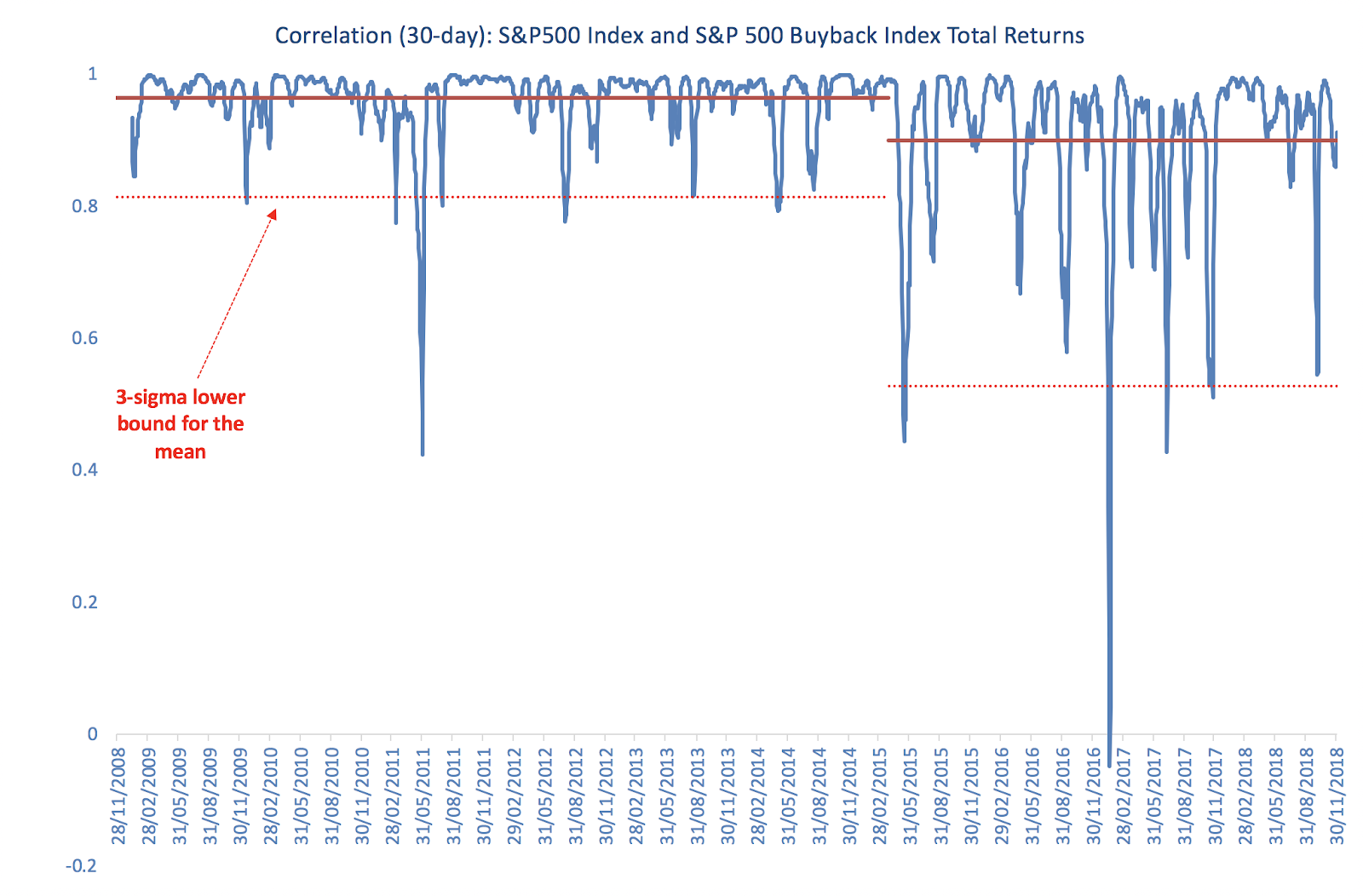
At the same time, correlation between S&P500 returns and Buyback Index returns has been weakening from around the same time:

All of the above indicates a breakdown in the traditional post-2008 pattern of returns, as buybacks role as the drivers for improved ROE performance for top S&P500 shares re-purchasers is starting to run into diminishing returns.

Tuesday, May 15, 2018

15/5/18: S&P500 Earnings Diversification: International Trading Pays


An intersting (and occasionally covered on this blog) chart via FactSet on earnings and revenue growth for S&P500 constituents based on their exposures to international markets:


As the above clearly shows, globally diversified (by source of activity) companies have stronger growth in earnings and aggregate earnings. Not surprising, in general, but given the relative strength of the U.S. growth, compared to other regions' dynamics, this shows the value of income diversification.

Friday, April 20, 2018

19/4/18: Geopolitical Risk: Who Cares?..


Geo-political risks, geo-shmalitical risks... who cares... not the markets...


None of the geopolitical risks registered on S&P 500 companies reporting radar according to Factset in 1Q 2018 https://insight.factset.com/more-than-half-of-sp-500-companies-citing-positive-impact-from-fx-on-q1-earnings-calls.  This is not very surprising as majority of earnings for 1Q accumulated before any spikes in these, and as "Tariffs" category probably absorbed the 'China' effect. Notably, however, earnings were impacted adversely by trade conflict and cyber risks (total of 3/25 companies impacted).

Monday, March 19, 2018

19/3/18: Bitcoin as a Hedge?..


The story of Bitcoin has been told, repeatedly, as a story of an asset that offers a hedge to stocks, a hedge against the fiat currencies and a hedge against the excesses of QE. That story is pure, unadulterated bullshit.


As the chart above shows, Bitcoin is more of a lead-indicator to S&P 500, than a hedge. With volatility well in excess of other comparable instruments. 

Sunday, October 22, 2017

22/10/17: Framing Effects and S&P500 Performance


A great post highlighting the impact of framing on our perception of reality: https://fat-pitch.blogspot.com/2017/10/using-time-scaling-and-inflation-to.html.

Take two charts of the stock market performance over 85 odd years:


The chart on the left shows nominal index reading for S&P500. The one on the right shows the same, adjusted for inflation and using log scale to control for long term duration of the time series. In other words, both charts, effectively, contain the same information, but presented in a different format (frame).

Spot the vast difference in the way we react to these two charts...

Wednesday, June 7, 2017

7/6/17: Equity Markets Continue to Mis-price Policy Risks


There has been some moderation in the overall levels of Economic Policy Uncertainty, globally, over the course of May. The decline was primarily driven by European Uncertainty index falling toward longer-term average (see later post) and brings overall Global EPU Index in line with longer term trend (upward sloping):


This meant that short-term correlation between VIX and Global EPUI remained in positive territory for the second month in a row, breaking negative correlations trend established from October 2015 on.

The trends in underlying volatility of both VIS and Global EPUI remained largely the same:


The key to the above data is that equity markets risk perceptions remain divorced from political risks and uncertainties reflected in the Global EPUI. This is even more apparent when we consider actual equity indices as done below:

Both, on longer-run trend comparative and on shorter term level analysis bases, both S&P 500 and NASDAQ Composite react in the exactly opposite direction to Global Economic Policy Uncertainty measure: rising uncertainty in the longer run is correlated with rising equities valuations.

7/6/17: Markets, Investors Exuberance and Fundamentals


Latest data from FactSet on S&P500 core metrics is an interesting read. Here are a couple of charts that caught my attention:

Look first at the last 6 months worth of EPS data through estimated 2Q 2017 (based on 99% of companies reporting). The trend continues: EPS is declining, while prices are rising. On a longer time scale, EPS have been virtually flat in 2014-2016, but are forecast to rise nicely in 2017 and 2018. Whatever the forecast might be for 2018, 2017 increase would do little to generate a meaningful reversion in EPS to price trend


However, the good news is, expectations on rising EPS are driven by rising sales for 2017, and to a lesser extent in 2018. This would be (if materialised) an improvement on the 2014-2016 core drivers, including shares repurchases (chart below).


Next, consider P/E ratios:

As the chart above indicates, P/E ratios are expected to continue rising in the next 12 months. In other words, the markets are going to get more expensive, relative to underlying earnings. Worse, on a 5-year average basis, all sectors, excluding Financials, are at above x14. Hardly a comfort zone for 'go long' investors. The overvalued nature of the market is clearly confirmed by both forward and trailing P/E ratios over the last 10 years:


Forward expectations are now literally a run-away train, relative to the past 10 years record (chart above), while trailing (lagged) P/Es are dangerously close to crisis-triggering levels of exuberance (chart below).


In summary, thus, latest data (through end-of-May) shows continued buildup of risks in the equity markets. At what point the dam will crack is not something I can attempt to answer, but the lake of investors' expectations is now breaching the top, and the spillways aren't doing the trick on abating them.

Monday, May 1, 2017

30/4/17: The Scariest Chart in the World


The scariest chart in the world this week, indeed this month, comes from the U.S. and plots U.S. real GDP growth with 1Q 2017 print at just 0.7% y/y.

Yes, the print ranks 13th from the bottom for any positive growth quarter since 2Q 1947. And yes, the rate of growth is (a) preliminary (subject to revisions) and (b) seeming one-off (driven by fall-off in consumer demand, despite strong indicators on consumer confidence side). There are reason and heaps of arguments why this print should not be treated as huge concern and that things might improve in 2Q and on.

But... the really scary stuff is longer-term trend in U.S. growth. And that is illustrated in the chart below:

Look at the grey bars: these take periods of expansion in the U.S. economy and average rates of growth over these periods. Notice the patter? Why, yes, the average expansion-consistent rates of growth have fallen, steadily, since 1975 through today. Worse, controlling for volatile growth (average rates) in pre-1975 period, an exponential trend for average expansion-consistent growth rates (the yellow line) is solidly trending down.

The latest period of economic expansion is underperforming even that abysmal trend. And 1Q 2017 is underperforming that worse than abysmal average.

Now, let me highlight that point: yellow line only considers periods of consistent growth (omitting official recessions, and one unofficial recession of  2001). So, no: the depth of the Great Recession has nothing to do with the yellow line direction. If anything, given the depth of the 2008-2009 crisis, the most current grey bar should have been at around 4%, almost double where it sits today.

That is what makes the chart above the scariest chart of April. And will probably make it the scariest chart of May too.

Tuesday, April 18, 2017

18/4/17: S&P500 Concentration Risk Impact


Recently I posted on FactSet data relating earnings within S&P500 across U.S. vs global markets, commenting on the inherent risk of low degree sales/revenues base diversification present across a range of S&P500 companies and industries. The original post is provided here.

Now, FactSet have provided another illustration of the 'concentration risk' within the S&P500 by mapping earnings and revenues growth across two sets of S&P500 companies: those with more than 50% of earnings coming from outside the U.S. and those with less than 50% of earnings coming from the global markets.


The chart is pretty striking. More globally diversified S&P constituents (green bars) are posting vastly faster rates of growth in earnings and a notably faster growth in revenues than S&P500 constituents with less than 50% share of revenues from outside the U.S (light blue bars).

Impact of the concentration risk illustrated. Now, can we have an ETF for that?..

Tuesday, April 11, 2017

11/4/17: S&P 500 Concentration Risk


Concentration risk is a concept that comes from banking. In simple terms, concentration risk reflects the extent to which bank's assets (loans) are distributed across the borrowers. Take an example of a bank which has 10 large borrowers with equivalent size loans extended to them. In this case, each borrower accounts for 10 percent of the bank total assets and bank's concentration ratio is 10% or 0.1. Now, suppose that another bank has 5 borrowers with equivalent loans. For the second bank, the concentration ratio is 0.2 or 20%. Concentration risk (exposure to a limited number of borrowers) is obviously higher in the latter bank than in the former.

Despite coming from banking, the concept of concentration risk applies to other organisations and sectors. For example, take suppliers of components to large companies, like Apple. For many of these suppliers, Apple represents the source of much of their revenues and, thus, they are exposed to the concentration risk. See this recent article for examples.

For sectors, as opposed to individual organisations, concentration risk relates to the distribution of sector earnings. And the latest FactSet report from April 7, 2017 shows just how concentrated the geographical distributions of earnings for S&P 500 are:


In summary:

  • With exception of Information Technology, not a single sector in the S&P 500 has aggregate revenues exposure to the U.S. market that is below 50%;
  • Seven out of 11 sectors covered within S&P 500 have exposure concentration to the U.S. market in excess of 70%; and
  • On the aggregate, 70% of revenues for the entire S&P 500 arise from within the U.S. markets.
In simple terms, S&P 500 is extremely vulnerable to the fortunes of the U.S. economy. Or put differently, there is a woeful lack of economic / revenue sources diversification in the S&P 500 companies.

Wednesday, May 18, 2016

17/5/16: US Earnings Recession: Four Quarters Long... but How Much Longer?


Recently, I have been highlighting in my Risk & Resilience course for MBAs at MIIS and on this blog the perils of corporate earnings gaming, including the rather worrying trend toward companies posting negative net cash flows (basically using debt to fund shares repurchases).

Here are two of my lecture slides from two weeks ago:


And to add to the pile of evidence, as 1Q 16 earnings rolled in, the numbers were coming in at a frankly put brutal squeeze: we had the fourth consecutive quarter for the S&P 500 earnings running in the red, with 1Q 16 decline being the steepest since 2008-2009 at 6.3%:


However, some interesting insight on the matter of forward earnings guidance was recently published by the Deutsche Bank Research and here is a link to the article discussing it: http://www.valuewalk.com/2016/05/earnings-q1-marks-darkest-hour-just-dawn-says-db/.

Yes, DB's model for earnings for S&P500 is an interesting one. No, without seeing actual standard econometric tests, I can't tell if it makes any sense in reality or not (just because it has high R-sq means diddly nada without knowing how the residuals behave). And no, I am not sure I am buying the idea of 'all factors in favour' arguments presented by DB Research. I am, however, pretty certain that probabilistically a bet should be for more moderate earnings performance in 2Q compared to 1Q, which of course will prompt DB Research lads cheering confirmation of their own model. So I am skeptical, but... still, the article is worth a read.

Friday, April 15, 2016

15/4/16: Corporate Finance, S&P500 and Bubble Trouble...


Classical corporate finance tells us that companies should be valued on their earnings with past earnings being indicative of future earnings (predictive component). Which is tosh. In today's world that is.

Q4 2016 saw highest payouts to shareholders (combined cash dividends and share repurchases) in over 10 years (couple of slides from my course presentation):

And yet... yet... earnings have hit the brick wall back in Q3 2014 and have been trending down ever since:

You really can't call S&P500 anything but a sail-in-the-Fed-wind. There are no fundamentals sustaining it above 1600-1650 range. At least, not corporate fundamentals.

Unless, of course, one expects the recent extraordinary payout performance to remain indefinitely present in the future. Which only a sell-side analyst or a lunatic can...

Saturday, March 19, 2016

19/3/16: Shares Buy-Backs: The Horror Show of QE Cash Excesses is Back


Remember the meme of the ‘recovery’?

The story of years of rising shares buy-backs by corporate desperate to do something / anything with all the debt they could get their hands on from the lending banks, whilst having no interest in investing any of these loans in real activity.

Well, back at the end of 2011 and the start of 2014, pumped up on hopium  of the so-called imminent recovery in global demand, we witnessed two dips in shares buy-backs, with resulting volatility going the flat trend taking us through some 12 months before lifting off the whole circus to new highs.

Source: @soberlook

And as you can see, the same momentum is now back. Shares buy-backs are booming once again, almost reaching all time highs of 2007. Thus, the toxic scenario whereby companies use cheap credit (QE-funded) to leverage themselves only to fund shares buybacks and not to fund new investment - that vicious cycle of leverage risk and wealth destruction - is open us once again.

Note: I have been tracking the topic on this blog, covering few months back the link between buybacks and lack of corporate capex: http://trueeconomics.blogspot.com/2015/11/111115-take-buyback-pill-us-corporates.html.