Monday, January 22, 2018

21/1/18: Student Loans Debt Crisis: It Only Gets Worse


A new research from the Brookings Institution has shed some light on the exploding student debt crisis in the U.S. The numbers are horrifying (for details see https://www.brookings.edu/wp-content/uploads/2018/01/scott-clayton-report.pdf) (emphasis mine):

"Trends for the 1996 entry cohort show that cumulative default rates continue to rise between 12 and 20 years after initial entry. Applying these trends to the 2004 entry cohort suggests that nearly 40 percent may default on their student loans by 2023." In simple terms, even 12-20 years into the loan, default rates are rising, which means that after we take out those borrowers who are more likely to default (earlier defaulters within any given cohort), the remaining borrowers pool is not improving. This applies to the cohort of borrowers who entered the labour markets at the end/after the Recession of 2001 - a cohort that started their careers before the Global Financial Crisis and the Great Recession, and that joined the labor force at the time of rapid growth and declining unemployment.

"The new data show the importance of examining outcomes for all entrants, not just borrowers, since borrowing rates differ substantially across groups and over time. For example, for-profit borrowers default at twice the rate of public two-year borrowers (52 versus 26 percent after 12 years), but because for-profit students are more likely to borrow, the rate of default among all for-profit entrants is nearly four times that of public two-year entrants (47 percent versus 13 percent)." Which means that the ongoing process of deregulation of the for-profit education providers - a process heavily influenced by the Trump Administration close links to the for-profit education sector (see https://www.theatlantic.com/education/archive/2017/08/julian-schmoke-for-profit-colleges/538578/ and https://www.politico.com/story/2017/08/31/devos-trump-forprofit-college-education-242193)  - is only likely to make matters worse for younger cohorts of Americans.

On a related: "Trends over time are most alarming among for-profit colleges; out of 100 students who ever attended a for-profit, 23 defaulted within 12 years of starting college in the 1996 cohort compared to 43 in the 2004 cohort (compared to an increase from just 8 to 11 students among entrants who never attended a for-profit)." So not only things are getting worse over time on their own, but they will be even worse given the direction of deregulation drive.

"The new data underscore that default rates depend more on student and institutional factors than on average levels of debt. For example, only 4 percent of white graduates who never attended a for-profit defaulted within 12 years of entry, compared to 67 percent of black dropouts who ever attended a for-profit. And while average debt per student has risen over time, defaults are highest among those who borrow relatively small amounts." This highlights, amongst other things, the absurd nature of the U.S. legal frameworks governing the resolution of student debt insolvency: the easier/less costly cases to resolve (lower borrowings) in insolvency are effectively exacerbated by the lack of proper bankruptcy resolution regime applying to the student loans.

Some charts:

Data above clearly highlights the dramatic uplift in default rates for the more recent cohort of borrowers. At this point in time, borrowers from the 2003-2004 cohort already exhibit higher cumulative default rates than the previous cohort exhibited over 20 years horizon. Worse, the rate of increases in default rates is still higher for the later cohort than for the earlier one. Put differently, things are not only worse, but are getting worse faster.

And here is the breakdown by the type of institution:
For-profit institutions' loans default rates are now at over 50% and rising. In simple terms, this is a form of legislatively approved and supported debt slavery, folks.

Beyond the study, here is the latest data on student loans debt. Student loans - aggregate - transition into delinquency is highest of all household credit lines:

And the total volume of Student Loans debt is now second only to mortgages:


Friday, January 19, 2018

19/1/18: Tears over QE & U.S. Household Debt Problem


As (some) White House-linked (or favouring) economists lament the Fed's QE (and there are reasons to lament it), one thing is clear: the unprecedented monetary policies of the recent years have achieved two things:

  1. The Fed QE has fuelled an unprecedented boom in risky assets (bonds, equities, property, cryptos, you name it); and
  2. The Fed QE sustained a dangerous explosion of personal household debt
Which, taken together, means that the rich got richer, and the middle classes and the poor got poorer. Because debt is not wealth. Worse, the policies past have set the stage for a massive unraveling of the credit bubble to come, if the Fed were to attempt to seriously raise rates.

Note: the figures below are not reflective of a reportedly massive jump in consumer credit in 4Q 2017 (see: https://www.marketwatch.com/story/consumer-credit-growth-surges-in-november-by-most-in-16-years-2018-01-08?siteid=bnbh). 

Here is the latest data on personal household debt:

\And here is the aggregate data (also through 3Q 2017) from the NY Fed:

Year on year, 3Q 2015 growth in total household debt in the U.S. stood at 3.03%. This fell to 2.36% in 2016, before rising to 4.90% in 2017, the highest annual rate of growth for the third quarter period since Q3 2007.

Aggregate household debt in 3Q 2017, relative to 2005-2007 average was:
  • 11.8% higher in 3Q 2017 for Mortgages;
  • 23.4% lower for HE Revolving;
  • 51.9% higher for Auto Loans;
  • 6.6% higher for Credit Cards;
  • 201.2% higher for Student Loans;
  • 6.5% lower for Other forms of debt; and
  • 19.7% higher for Total household debt
In current environment, a 25 bps hike in Fed rate, if fully passed through to household credit markets, will increase the cost of household credit by USD32.4 billion per annum. The same shock five years ago would have cost the U.S. household USD 28.3 billion per annum. Now, put this into perspective: current markets expectations are for three Fed rate hikes (and increasingly, the markets are factoring a fourth surprise hike) in 2018. Assuming the range of 3-4 hikes moves to raise rates by 75-100 basis points, the impact on American households of the QE 'normalization' can be estimated in the region of USD98-130 billion per annum. Since much of this will take form of the non-deductible interest payments, the Fed 'unwinding' risks wiping out the entire benefit from the recent tax cuts for the lower-to-upper-middle class segments of population. 

Now, let's cry about the QE... 

Thursday, January 18, 2018

18/1/18: The Arctic: A New "Old Conflicts" Frontier


A must-read set of three in-depth articles/visualizations from Bloomberg, documenting evolution of key environmental issues relating to the Arctic over time.

The first part covers the issue of the ice cap: https://www.bloomberg.com/graphics/2017-arctic/. The second part details the scale of political and geopolitical issues: https://www.bloomberg.com/graphics/2017-arctic/the-political-arctic/. Finally, part 3 covers economics of the Arctic region https://www.bloomberg.com/graphics/2017-arctic/the-economic-arctic/.

A genuinely impressive material worth reading.


As an added resource, Reuters are running a dedicated page on the news and issues involving the Arctic https://www.reuters.com/places/arctic

17/1/18: Apple's Plans for Foreign Cash and the Need for Larger Reforms


There is a lot that can be criticized in the GOP/Trump tax reforms passed late last year, but some things do make sense. Back in November 2016, in my column for the Cayman Financial Review (see here: http://trueeconomics.blogspot.com/2016/11/31116-cfr-tax-cure-for-american.html), I argued that a comprehensive tax reform of the U.S. corporate tax system, alongside a generous repatriation scheme for off-shored profits of the U.S. MNCs can provide a significant boost to the U.S. economy.

Today, we got some news confirming my assertion. Apple is planning to bring some USD350 billion back to the U.S. with a large scale investment portfolio aligned to this repatriation: https://www.cnbc.com/2018/01/17/apple-announces-350-billion-investment-20k-jobs-over-5-years.html.

However, to really lock in the new investment, President Trump and the Congress need to significantly revamp the existent system of work permits, work and business visas, starting with the current H1B system. Returning financial capital back to the U.S. is but the first step on the road to increasing the U.S. economic potential.

The second step must be opening up U.S. labor and entrepreneurship markets to inflow of talent from abroad (these markets are currently extremely closed). This will require not only revising numerical quotas, but also the following:

  1. Shifting admissions away from contingent workforce employers (contractors) and in favor of direct employment and sustainable, skills-based self-employment;
  2. Increasing ability (and incentives) for integration into the American society for newcomers (including, but not limited to, improving bureaucratic barriers to access to permanent residency and naturalization, improving the culture and the climate of government bureaucracies vis-a-vis higher skilled newcomers, etc);
  3. Creating new, more open, programs for entry into the U.S. for highly skilled and entrepreneurial migrants; and
  4. Encouraging greater mobility across employers for foreign highly skilled workers.
The third step must involve regulatory reforms that remove markets, financial & contractual supports for incumbent monopolistic firms (the rent-seekers, like big telecoms, large banks, automakers, etc). Opening the sectors to genuine competition will be the only chance the U.S. has to compete with the likes of China, and increase its own potential GDP).

Finally, the fourth step (partially already targeted by the recent tax reforms) must involve reducing the burden of direct and indirect taxes on the American wage earners, especially those with higher skills levels. The key here is to focus on both, direct and indirect taxation, and the latter, in my opinion, includes the cost of healthcare and pensions. 

Apple's announcement is the good news. And President Trump does deserve credit on this.  But tax holiday alone won't fix the problem of economic sclerosis that has plagued the U.S. economy for a good part of two decades now.

Tuesday, January 16, 2018

15/1/18: Of Fraud and Whales: Bitcoin Price Manipulation


Recently, I wrote about the potential risks that concentration of Bitcoin in the hands of few holders ('whales') presents and the promising avenue for trading and investment fraud that this phenomena holds (see post here: http://trueeconomics.blogspot.com/2017/12/211217-of-taxes-and-whales-bitcoins-new.html).

Now, some serious evidence that these risks have played out in the past to superficially inflate the price of bitcoins: a popular version here https://techcrunch.com/2018/01/15/researchers-finds-that-one-person-likely-drove-bitcoin-from-150-to-1000/, and technical paper on which this is based here (ungated version) http://weis2017.econinfosec.org/wp-content/uploads/sites/3/2017/05/WEIS_2017_paper_21.pdf.

Key conclusion: "The suspicious trading activity of a single actor caused the massive spike in the USD-BTC exchange rate to rise from around $150 to over $1 000 in late 2013. The fall was even more dramatic and rapid, and it has taken more than three years for Bitcoin to match the rise prompted by fraudulent transactions."

Oops... so much for 'security' of Bitcoin...


Thursday, January 11, 2018

11/1/18: Physical Mobility and Liberal Values: The Causal Loop


One of the key arguments relating the decline in the Millennials' support for liberal democratic values to socio-economic trends, identified in our recent paper on the subject (see Corbet, Shaen and Gurdgiev, Constantin, Millennials’ Support for Liberal Democracy Is Failing: A Deep Uncertainty Perspective (August 7, 2017): https://ssrn.com/abstract=3033949is the argument that reduced socio-economic mobility for the younger generation Americans (and Europeans) is driving the younger voters away from favouring the liberal economic system of resources allocation.

In this context, here is an interesting piece of supporting evidence, showing how the rates of physical migration across the states of the U.S. have declined in recent years - a trend that pre-dates in its origins the Great Recession: http://www.latimes.com/business/la-fi-declining-domestic-migration-20171227-story.html.


In basic terms, two sets of factors are hypothesised to be behind the declining mobility in the U.S. and these can be related to the broader theses of secular stagnation:

  • On the demand side of the secular stagnation thesis, as the article linked above states, "social and demographic factors such as an aging population and declining birth rates; older people tend to stay put more and starting families often motivates people to go out on their own";
  • On the supply side of the secular stagnation thesis, "The decline in mobility is due partly to what has become a less-dynamic and fluid American labor market, some economists believe".
Note: I explain the two sides of secular stagnation theses here: http://trueeconomics.blogspot.com/2015/10/41015-secular-stagnation-and-promise-of.html.

On balance, these are troubling trends. Jobs churn has been reduced - by a combination of structural changes in the American economy (e,g. rise of corporatism that reduces rates of new enterprise formation, and lack of new business investment), as well as demographic changes (including preferences shifting in favour of lower mobility).  But there are also long-term cyclical factors at play, including rampant house price inflation in recent years in key urban locations, and the significant growth in debt exposures carried by the younger households (primarily due to student debt growth). There is also a structural demographic factor at work in altering the 'normal' dynamics of career advancement in the workplace: older workers are staying longer in their positions, reducing promotional opportunities available to younger workers. Finally, the rise of low-security, high-volatility types of employment (e.g. the GigEconomy) also contributes to reduced mobility.

In simple terms, lower mobility is a symptom of the disease, not the cause. The real disease has been ossification of the U.S. economy and the continued rise of the status quo promoting rent-seeking corporates. Lack of dynamism on the supply side translates into lack of dynamism on the demand side, and the loop closes with a feedback effect from demand to supply. 


22/1/18: For-Profit CSR: Bounds of Effectiveness?


Quite an interesting paper concerning the potential limitations to the structured CSR (Corporate Social Responsibility) programs impact.

From the abstract (emphasis mine):

Prosocial incentives and Corporate Social Responsibility (CSR) initiatives are seen by many firms as an effective way to motivate workers. … We argue that the benefits crucially depend on the perceived intention of the firm. Workers use prosocial incentives as a signal about the firm's type and if used instrumentally in order to profit the firm, they can backfire. We show in an experiment in collaboration with an Italian firm, that monetary and prosocial incentives work very differently. While monetary incentives used instrumentally increase effort, instrumental charitable incentives backfire compared to non-instrumental incentives. This is especially true for non-prosocially-motivated workers who do not care about the prosocial cause but use prosocial incentives only as a signal about the firm. The results contribute to the understanding of the limits of prosocial incentives by focusing on their signaling value to the agent about the principal's type.”

Which raises some questions:

Often, these days, we think of CSR-to-improve-bottom-line ideas for structuring CSR and broader Social Impact programs. In the light of this research, should we continue focusing on the bottom line-linked CSR? Traditional corporate view of CSR has been that ’we spend resources to do good’. This perception of CSR within corporations quite often results in CSR function becoming secondary to other profit-centric functions. As a response to this, academics and consultants working in the field of Social Impact have advocated for years that companies and organisations need to define CSR as an organic profit-related function. The latest research suggests that this can be counter-productive to other objectives of the CSR programs.

If we do continue to focus on CSR as profit-related function in our teaching and research, what are the limitations to its effectiveness? The paper findings are based on a very restricted data set, derived from a single firm. We do not know the key factors driving the limitations uncovered in the study and we do not know how these factors translate into other geographical, cultural, social and macroeconomic contexts.

Are mixed/hybrid enterprises (socially-mandated for profit enterprises) have to rely on a biased selection of employees to mitigate for this effect? In other words, are mixed/hybrid enterprises, that explicitly rely on conflating the notions of Social Impact and profitability, subject to lower productivity risks when employing ’non-prosocially-motivated’ workers? If so, are systemic biasing filters used in selecting best-fit employees for such enterprises to avoid such workers? Can these filters be identified and tested against other biases (or worse, potential discriminatory hiring practices)?

As educators, we might think about structuring these questions into our classroom discussions. As researchers, we can see this study as opening up the gates for further research. The questions the study prompts are big, important and poorly researched.

Full paper: NBER Working Paper No. w24109 http://www.nber.org/papers/w24109
Ungated version: https://ssrn.com/abstract=3092527

Saturday, January 6, 2018

6/1/18: Spent 'Putin's Call' Means Growing Pressure for Reforms


Some interesting new trends emerging in Russian public opinion as the next Presidential election approaches. State-linked Russian

Academy of Sciences publishes relatively regular polls of public opinion that look into voters' preferences, including preferences for either "significant changes" in policy course in Russia or "stability" of the present course.

Here is the latest data:


Some 'Russia analysts' in the Western media have been quick to interpret these numbers as a sign of rising anti-Putin sentiment. Things are more subtle than that.

There is, indeed, a rather remarkable shift in public preferences in favor of "significant changes". Which can be attributed to the younger demographic who are predominantly supportive of reforms over their preferences for "stability". This is good. However, we do not know which changes the voters would prefer. Another potential driver for this shift is the ongoing weak recovery in the Russian economy from the 2014-2016 crisis - a recovery that fades to the background voters' previous concerns with the Russian State's geopolitical standing in the international arena (key pillar of Putin's third presidency) and the movement to the forefront of economic concerns (key pillar of Medvedev's interim presidency and, so far, an apparent area of significant interest for Putin looking forward to his fourth term).

These gel well with other public opinion data.

Here is Pew data from earlier 2017 showing that Russian voters nascent sentiment in favor of reforms may not be incongruent with their simultaneously continued support for Putin's leadership:

When one looks at the same polls data on core areas of domestic policy that the Russians feel more concerned about, these are: corruption (#1 priority), economy (#2 priority) and civil society (#3 priority). In other words, more liberal issues are ranked toward lower priority than other reforms (economy and corruption, which are both seen by the majority of the Russians as the domain of State power, not liberal order reforms). Civil society is an outlier to this. And an interesting one. Perhaps, indicative of the aforementioned demographics shift. But, perhaps, also indicative of the dire lack of alternatives to Putin-centric political spectrum in Russia. Again, whether the voters actually see Putin as a barrier to achieving these reforms is the key unknown.


Worse, not a single one area of domestic policies has plurality disapproval rating.

Somewhat confusing, Putin's personal approval ratings - for specific areas of policy - have been deteriorating over time:

This is significant, because traditionally, Russians view Presidential office as distinct from the Government (the 'good Tzar, bad Boyars' heuristic) and the tendency to view domestic objectives as key priorities or targets for disapproval would normally be reflected in falling support for the Government, not the President. This time around, things appear to be different: Russian voters may not be blaming Putin's Presidency outright, but their confidence in the President's ability to manage the policy areas of their key concerns is deteriorating.

The 'Putin call' - past bet on forward growth to sustain power centralization - is now out of money:


Weakest points are: corruption and economy. And these are the toughest nuts to crack for Putin's regime because it rests strong Federalization drive of 1999-present on the foundations of balancing the interests of the rent-seekers surrounding it (aka, on corruption around it, a trade-off between loyalty to the Federal State and the President, in return for access to wealth and the ability to offshore this wealth to the likes of London, a world's capital for grey and black Russian money).  Ironically, Western sanctions and broader policies toward Russia are actively constraining the scope and the feasibility of all reforms - be it reforms of the economy or civil society, anti-corruption measures or political liberalization.

Note: an interesting read on the changes in the Kremlin-backing 'opposition' is also afoot, as exemplified by the new leadership emerging within the Russian Communist Party (read this well-researched and unbiased view, a rarity for WaPo, via David Filipov: https://t.co/8OfqCZzdOY).

Taken together, the above suggests that Putin needs some quick wins on the hardest-to-tackle issues: corruption and economy, if he were to address the pivot in voters' preferences for change. The 'if' bit in this statement reflects severe uncertainty and some ambiguity. But assuming Putin does opt to react to changes in the public opinion, we can expect two policy-related moves in months ahead:

  1. Corruption: we are likely to see public acceleration in prosecution of smaller/lower-end bureaucrats, deflecting attention from the top brass surrounding the centre. Alongside promotion of some fresh names to regional leadership posts (governors etc), already ongoing, we are also likely to see some additional consolidation of the oligarchic power in the economy. There will be no cardinal wide-spread change in power ministries and within the Deep State institutions. But, even the beginnings of such acceleration in cleaning up mid-tier of the top echelons of power will prompt hysterical comparatives to Stalin's purges in the Western media.              
  2. Economy: we are also likely to see a new 'Program for 2030' aiming to 'modernize' the economy, deepen capital investment, on-shore funds stashed away in Cyprus, Austria, Germany, the Baltics, the UK and elsewhere. Note, the list of Russian-preferred offshore havens - it is littered with the countries currently beating the Russophobic drums, which will make such on-shoring double-palatable for Kremlin, and more acceptable to the Russian power circles. The process of on-shoring has already began, even if only in the more public and more benign context (https://www.bloomberg.com/news/articles/2017-12-21/russia-to-issue-fx-bonds-to-help-repatriate-cash-putin-says). The Program is also likely to see some reforms of the tax code (potentially, raising 13% flat tax rate and tweaking capital gains tax regime). A deeper push can come on enforcement and compliance side, with Moscow finally attempting to shift tax enforcement away from its current, highly arbitrary and politicized, practices. Putin is acutely aware of the fact that Russian public investment sits too low, while ammortization and depreciation are accelerating. We can expect some announcements on this front before the election, and, assuming economic growth becomes a new priority of the fourth term, an acceleration in State funding for infrastructure projects. This time around, new funding will have to flow to key public services - health and education - and not into large-scale transport projects, .e.g Crimean and Vladivostok bridges. Russia is well-positioned to support these initiatives through some monetary policy accommodation, with current inflationary dynamics implying that the current 7.75% benchmark CBR rate can be lowered to around 6% mark (this process is also ongoing). beyond fiscal and monetary aspects of reforms, Russia can opt to move more aggressively with revamping its Byzantine system of standards and certification systems to align them more closely to the best practices (in particular, those prevalent in the EU). Such alignment can support, over time, diversification of Russian exports to Europe and to other regions, where european standards effectively goldplate local ones.
What we are not likely to see, in the short term, is unfortunately what is needed as much as the above reforms: changes in legal and enforcement regimes. Poor legal enforcement and outdated, politicized and often corrupt judicial system are stifling entrepreneurship, enterprise scaling, international and domestic investment and, equally importantly, development of the civil society. It also weakens the Federal State by presenting a bargain in which local loyalty to Moscow is secured by allocating local authorities power to shadow justice systems. This bargain undermines voters' trust and reduces efficiency of resources flowing across regions and from Moscow.

As a number of more astute observers, e.g. Leonid Bershidsky (@Bershidsky) and David Filipov (@davidfilipov) have implied/stated in the past, promising reforms after nearly two decades in power will be a hard sell proposition for Putin. Which means Programs alone won't cut it. Kremlin will need to deliver and deliver fast, in order to break away from the 'Putin 3' track:


Wednesday, January 3, 2018

1/3/18: BRIC Manufacturing Sector ends 2017 with an upside


Quarterly Manufacturing Sector PMIs for BRIC economies have once again underperformed global indicators in 4Q 2017.

Global Manufacturing PMI for 4Q 2017 stood at 54.0, up on 53.0 in 3Q 2017 and marking the fastest rate of quarterly expansion in the sector on record (since 2Q 2013*). In comparison, BRIC Manufacturing quarterly PMI-based indicator stood at 51.6 in 4Q 2017, up on 51.0 in 3Q 2017. This marks the highest reading for the BRIC Manufacturing PMIs (quarterly basis) since 1Q 2013.


For individual BRIC economies:

Brazil Manufacturing Quarterly PMI measure was up at 52.4 in 4Q 2017, rising from 50.6 in 3Q 2017 and marking the third consecutive quarter of above 50.0 (nominal) readings. In statistical terms, 4Q 2017 was the first quarter with statistically significant growth signal since 1Q 2013, and marked the second fastest pace of expansion since 1Q 2011. With three consecutive quarters of above 50.0 nominal indicator readings, it is reasonable to assume that the Manufacturing sector recession of 3Q 2013-1Q 2017 is now over and the economy is moving into a new period of expansion.

Russia Manufacturing q-PMI measure slipped from 52.1 in 3Q 2017 to 51.5 in 4Q 2017. Russian Manufacturing has been posting distinctly weaker PMI readings in 2Q 2017 - 4Q 2017, with sharper pace of expansion of 4Q 2016 - 1Q 2017 being replaced by rather anaemic rates of growth since the start of 2Q 2017. This stands contrasted by Services sector that currently drives Russian economic growth. 

China Manufacturing posted q-PMI reading of 51.1 in 4Q 2017, marginally unchanged on 51.2 in 3Q 2017. Since 3Q 2016, Chinese Manufacturing was held within the pattern of weak growth, with q-PMIs ranging from 50.1 though 51.3. In fact, last time Chinese Manufacturing q-PMI reached above 51.3 was in 1Q 2013. Judging by PMIs, Chinese manufacturing is barely growing. Which continuously puts a big question mark over both the headline GDP figures coming out of China and the PMIs.

India Manufacturing qPMI jumped from 50.1 in 3Q 2017 to 52.5 in 4Q 2017, the highest rate in 12 quarters. Both Services (48.0) and Manufacturing (50.1) were very soft in 3Q 2017, and the to-date (through November 2017) reading for qPMI for Services sector (50.1) is still weak, so 4Q reading for Manufacturing qPMI is a welcome sign that things might be firming up on the growth side.

All, in, BRIC Manufacturing sector remains a weak contributor to Global growth. This weakness appears to be structural and consistent across a range of years. Dynamically, both Global and Manufacturing qPMIs are closely correlated and have been running in tandem since 2Q 2014.


*Please, note: my data for this indicator - not reported by Markit, but based on market’s monthly reports - goes only to 2Q 2013. Markit have repeatedly ignored my requests for data going back before that period, despite their claim that they assist independent academic researchers in gaining access to their data.

2/1/18: Limits to Knowledge or Infinity of Complexity?


Occasionally, mass media produces journalism worth reading not to extract a momentary piece of information (the news) of relevance to our world, but to remind ourselves of the questions, quests, phenomena and thoughts worth carrying with us through our conscious lives (assuming we still have these lives left). 

With that intro, a link to just such a piece of journalism: https://www.theatlantic.com/science/archive/2017/12/limits-of-science/547649/. This piece, published in The Atlantic, is worth reading. For at least two reasons:

Reason 1: it posits the key question of finiteness of human capacity to know; and
Reason 2: it posits a perfect explanation as to why truly complex, non-finite (or non-discrete) phenomena are ultimately not knowable in perfect sense.

Non-discrete/non-finite phenomena belong human and social fields of inquiry (art, mathematics, philosophy, and, yes, economics, psychology, sociology etc). They are defined by the absence of the end-of-the-game rule. Chess, go, any and all games invented by us, humans, have a logical conclusion - a rule that defines the end of the game. They are discrete (in terms of ability to identify steps that sequentially lead to the end-rule realisation) and they are finite (because they always, by definition of each game, result in either a draw or a win/loss - they are bounded by the end-of-game rule). 

Knowledge is, well, we do not know what it is. And hence, we do not know if the end-of-game rule even exists, let alone what it might be. 


Worth a read, folks.

Tuesday, December 26, 2017

26/12/17: U.S. Wars Budgets: More Lessons Never Learned


An interesting report on the official accounts for war-related spending in the U.S. is available here: http://www.ibtimes.com/political-capital/defense-department-war-terror-has-cost-250-million-day-16-years-2608639. Which is, of course, a massive under-estimate of the full cost of 2001-2017 wars to the U.S. taxpayers.

It is worth remembering that war-related expenditures are outside discretionary budgetary allocations (follow links here: http://trueeconomics.blogspot.com/2017/12/231217-bloomberg-view-on-asymmetric.html). And you can read more here: http://trueeconomics.blogspot.com/2017/11/201117-tallying-costs-us-wars-in-iraq.html.

The problem, as I repeatedly pointed out, is that no one can tell us what exactly - aside from misery, failed states, collapsed economies, piles of dead bodies etc - did these expenditures achieve, or for that matter what did all the adventurous entanglements the U.S. got into in recent year deliver?  In Afghanistan, Libya, Yemen and Syria, in Pakistan and  Sudan, in Ukraine, in Somalia and Egypt. The sole bright spot on the U.S. 'policy horizon' is Kurdistan. But the problem is, the U.S. has been quietly undermining its main ally in the Syria-Iraq-Turkey sub-region in recent years. In South China Seas, Beijing is fully running the show, as multi-billion U.S. hardware bobbles up and down the waves to no effect. In North Korea, a villain with a bucket of uranium is in charge, and Iran is standing strong. In its historical backyard of Latin America, the U.S. is now confronting growing Chinese influence, while losing allies.

Yes, many of the above problems are down to the lack of long-term consistent strategy for soft diplomacy. And many are down to the fact that the world is multipolar, despite the U.S. strategy still pivoting around the hegemonic doctrine of single superpower-driven politics. But many are also down to the simple and brutal fact of military ineffectiveness and over-reliance on force (or threat of such) as a key lever for geopolitical engagement.

It is time to awaken to the fact that the world is not the imaginary stage for Fox News broadcasts about the U.S. military greatness. The world has moved on. Military can swiftly dismantle the existent order. But it cannot bring resolution to the roots of the crisis. And the combination of these two realities yields mostly chaos.

Saturday, December 23, 2017

23/12/17: Bloomberg View on Asymmetric Military Budgets: Russia v U.S.


I have written before about asymmetric conflicts and power balances in the context, among other bilateral comparatives, the U.S.-Russia military spending: http://trueeconomics.blogspot.com/2017/09/12917-asymmetric-conflicts-and-us.html. And the latest budgetary appropriations from the U.S. for 2018 are suggesting that Washington has a serious problem learning any lessons - whether these are lessons from being punched around repeatedly in the Afghanistan, or being derailed in Iraq, being made irrelevant in Syria and so on.

There is a very good op-ed from Bloomberg View by Leonid Bershidsky that is worth reading: https://www.bloomberg.com/view/articles/2017-12-14/russia-s-military-is-leaner-but-meaner. This too covers the same topic, albeit from a slightly different angle.

The article also cites our recent research on the causal relationship between the U.S. military budgets, war engagements and the valuations of the U.S. defense stocks (see here https://papers.ssrn.com/sol3/papers.cfm?abstract_id=2975368).


Thursday, December 21, 2017

21/12/17: Of Taxes and Whales: Bitcoin's New Headaches


I have recently mused about the tax exposures implications of Bitcoin 'investments', and in particular, my suspicion that many today's BTC enthusiasts (retail investors speculating on BTC and other cryptos) are likely to be caught out with unexpected and un-covered tax liabilities arising from trading in currencies pairs that involve cryptos and regular currencies (e.g. BTCUSD pair). Normally, every trade in BTC that involves sale of BTC for USD is subject to capital gains tax. This is a nasty side effect of the BTC trading.

And here comes a new and a worse one: the GOP tax plan will make even trades between cryptos (e.g. BTCETH pair) subject to capital gains (https://www.bloomberg.com/news/articles/2017-12-21/tax-free-bitcoin-to-ether-trading-in-u-s-to-end-under-gop-plan). The GOP plan removal of the like-kind swap tax deferral provision for everything other than real property sweeps cryptos put of the deferral cover because back in 2014, the IRS designated cryptos as non-currency property-type assets, like gold.

In addition to catching many investors off-guard and leaving them facing potentially explosive tax bills, the new change induces more liquidity risk into the system: removal of the deferral imposes a de facto transaction tax on BTC and other cryptos. This is likely to reduce frequency of trading conducted by investors. Which, in turn, reduces liquidity of the BTC and other cryptos.

This tax change, in part, likely explain why the BTC and other cryptos concentration is falling: the whales, who used to control up to 40% of the entire BTC issuance to-date, are selling, and selling at speed (https://www.bloomberg.com/gadfly/articles/2017-12-21/bitcoin-whales-are-cutting-back).  Ordinarily, this would be a good thing (lower concentration risk, increased liquidity), but cryptos are not your ordinary assets. The problem with whales selling is that one of the key arguments in favor of cryptos is that crypto-enthusiasts and pioneers are market-makers who prefer mine-and-hold strategy. In other words, to-date, the argument has been that the whales simply will never sell their holdings before BTC issuance reaches its bound of 21 million units.

That reasoning is now going, like the proverbial hot air out of a punctured balloon:


21/12/17: Blockchain is Just Your Cup of Tea...


Undoubtedly, undeniably, and absolutely consistent with the Efficient Markets Hypothesis, the Long Island Iced Tea rebranding as a Long Blockchain is resulting in a robust, fundamentals-consistent boost to the company share prices: https://www.bloomberg.com/news/articles/2017-12-21/crypto-craze-sees-long-island-iced-tea-rename-as-long-blockchain.

Which, of course, given the global, decentralized, fully secured, anti-inflation hedge, future of everything properties of the blockchain cryptocurrencies markets, is perfectly rational.


No, no, folks, there are no bubbles in crypto world. Never. It's all pure mathematics, you see... 

Monday, December 18, 2017

18/12/17: Of Winners and Whiners: Bitcoin's Path to Value


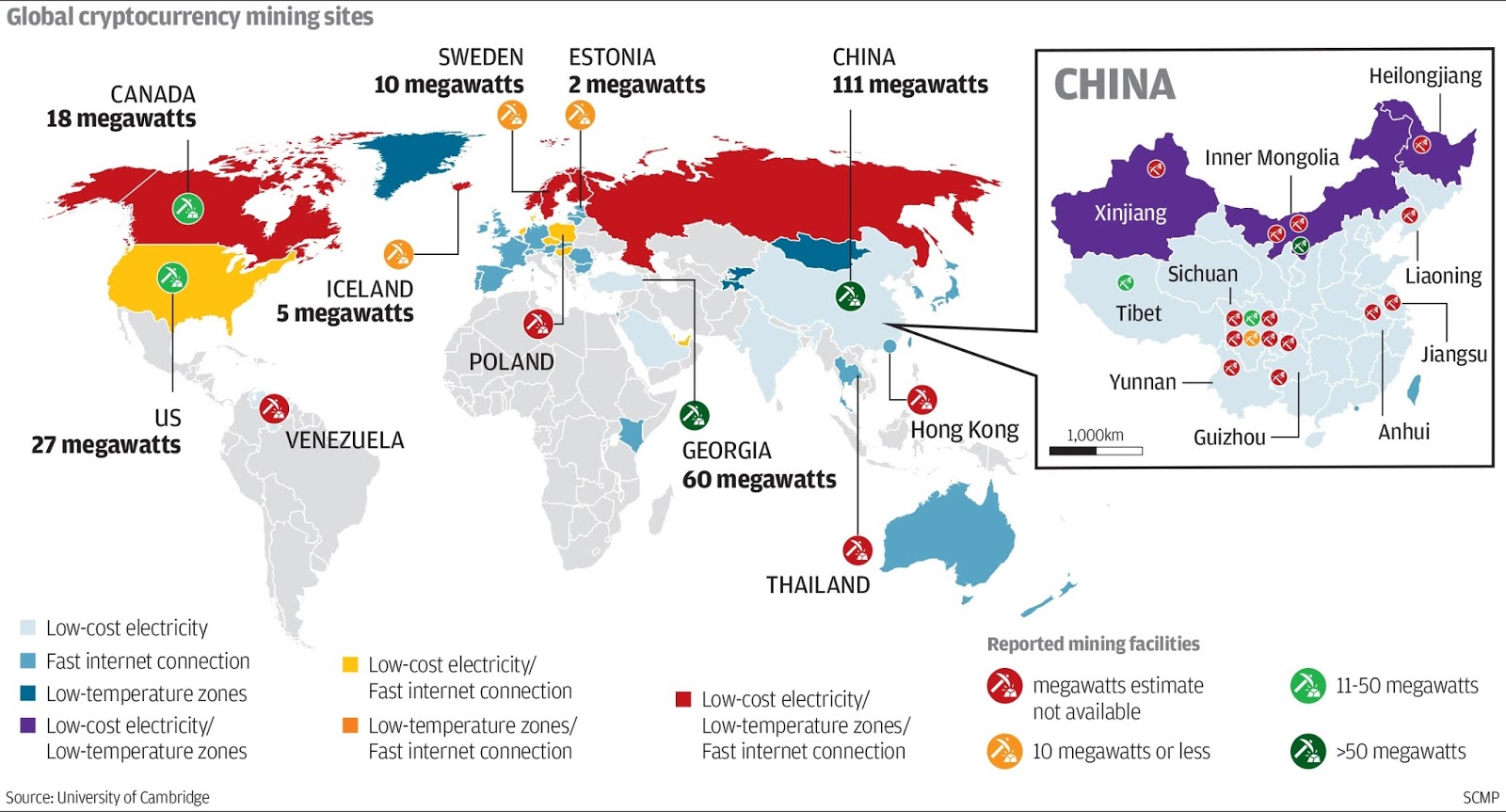
One of the key Bitcoin issues is concentration of miners. Concentration in Bitcoin markets occurs primarily due to high cost of energy used in mining. Bitfury, one of the largest miners on the market today already holds roughly 11 percent of the total mining power and is planning a major expansion. In mining equipment, Bitmain is estimated to hold some 70 percent of the market share worldwide. Here is the map - by country - of Bitcoin and other cryptos mining operations:

Source: http://www.scmp.com/tech/start-ups/article/2120373/chinas-bitcoin-miners-wary-tighter-government-scrutiny-make-plans.

The above shows not only the traditional concentration risk (with China and Georgia dominating the market), but also the unsavoury nature of geopolitical risks links. China is a highly unregulated, non-transparent market with production of miners linked closely to access to energy that can be easily shut down by the Government, were it to decide to pull the plug on cryptos and their potential distortion of the markets for Renminbi. Georgia is a country with archaic energy grid and political regime with low degree of predictability.

Current market structure for Bitcoin is skewed, in terms of financial returns, in favour of a small number of large miners, mining equipment makers, exchanges trading Bitcoin and Bitcoin payments processors. The second tier of earners - due to high transactions costs - are local dealers, a handful of leveraged investment funds and earliest holders of Bitcoin (who are, predominantly, early stage BTC companies principals).

Which means that BTC’s primary function is transfer of money from investors to intermediaries and miners.

Current technology behind the Bitcoin is also skewed. Miners - who hold their own wallets and require no exchanges - are secure in their asset holding to the point of their own security. Exchanges are security pressure points for smaller investors who cannot efficiently transfer BTC to their own wallets (due to time lags and costs involved). Intermediaries are secure only to the point of holdings transferred to own wallets, and are not secured for any trading accounts held on exchanges. In fact, they are in the worst possible state, because their exchange accounts are larger in volume (more lucrative target for attacks).

Which means that BTC’s secondary function is transfer of funds from retail investors and traders to cyber criminals.

In neither part of the transactions chain there is any value added created, except for those ‘investors’ using BTC to launder money or evade capital controls. Other returns are pure speculation on BTC’s volatility and its trend (separately for both). As information/data storage and processing platform, BTC is useless: mining - which in theory supports both functions - happens irrespective of meaningful information arrival, which means that any blockchain functionality of BTC is ad hoc, or put differently, at best accidental. This is one of the key reasons why BTC is the worst thing that could have happened to blockchain and also why it is the best thing that could have happened to private blockchain.

Because BTC has no value-added component to it, there is also no possibility for price gains (capital gains) over and above those warranted by its function as illicit money transfer mechanism. Otherwise, BTC would have had an effect of creating financial value out of zero real value-added. Which is impossible outside pure behavioural hype and speculation.

When someone compares the BTC, in the above terms, to stock markets, they are simply revealing massive degree of ignorance. Stock markets have two functions: (1) Primary issuance that raises capital for the firms, and (2) Secondary trading that determines future Weighted Average Cost of Capital for the firm. As such, stock market creates value-added. It might be not exactly what drives stocks valuations all of the time, but in the long run, it is what determines these valuations to a large extent. Stock is a claim against current and future dividends and/or sale/M&A value of the firm assets. Speculation overlays the fundamentals for BTC. In the BTC case, speculation is the only fundamental.

So you can bet on BTC at any valuations you fancy for yourself, but be aware: if you are betting on it speculatively, you are facing a severe liquidity risk. If you are betting on its fundamentals, your bet is that more people around the world will embrace it as a vehicle for tax evasion, capital controls evasion and/or money laundering. Which might be fine in theory, except that theory assumes status quo ante of zero regulation, enforcement and oversight over BTC. Which, of course, is rapidly changing, as the countries like France are calling on G20 to impose global oversight over BTC, and countries like Japan, China, U.S. et al are either imposing increasing degree of tax and regulatory controls over investors in BTC or considering imposition of such. At any rate, does global drugs trade need a USD300 billion payments technology?..

But, hey, don’t just take my word for it. Read this: http://www.businessinsider.com/one-of-the-co-founders-of-bitcoincom-has-sold-all-of-his-bitcoin-2017-12?r=UK&IR=T.

Saturday, December 16, 2017

16/12/17: Remember the Russian Attack on the Internet?


In 2016, a bot, named Mirai, wrecked havoc over the global internet with massive waves of DoS attacks on anything, from French telecoms, to U.S. web services, to Russian banks, to African airports and beyond. Per Wired, "As the 2016 US presidential election drew near, fears began to mount that the so-called Mirai botnet might be the work of a nation-state practicing for an attack that would cripple the country as voters went to the polls."

Of course, the minute there is any suspicion of the 'nation-state' actors behind the attack, we know that is the code word for 'the Russians'. And, of course, given the sheer number of 'security research' lackeys eagerly awaiting for the U.S. or UK or EU dollars/pounds/euros in grants and subsidies, the 'Russian' spectre loomed large in the wake of Mirai havoc. Here's a snapshot:

  • http://www.itsecurityguru.org/2016/10/12/research-shows-russian-hackers-could-be-behind-the-mirai-botnet/
  • https://www.nbcnews.com/news/us-news/who-shut-down-u-s-internet-friday-n671011
  • https://twitter.com/hackerfantastic/status/782840355116969984
  • https://www.networkworld.com/article/3130504/security/record-iot-ddos-attacks-raise-bar-for-defenders.html
  • https://www.csoonline.com/article/3144200/security/expect-more-iot-botnet-attacks-mirai-source-code-now-freely-available.html
  • https://www.nytimes.com/2016/10/22/business/internet-problems-attack.html


But, in the end, the famous DoS attack was down to just three U.S. students: https://www.wired.com/story/mirai-botnet-minecraft-scam-brought-down-the-internet/?mbid=social_twitter. Which, sort of, begs a question: how many 'security experts' of the 'Russian spectre looms large over everything' variety have lost their lucrative contracts with the Government, the media and the think tanks that provide platforms to the endless Russophobic hysteria? My bet is: none. Like in the good old days of the Soviet empire, you can't get fired for lying in Pravda... 


16/12/17: Dancing towards the end of QE


My article on the Super Thursday: monetary policy decisions by ECB, the Fed, PBOC, Norges Bank, SNB et al for Sunday Business Post:
https://www.businesspost.ie/opinion/dancing-towards-end-qe-405054.


16/12/17: Long-Term Stock Market Volatility and the Influence of Terrorist Attacks in Europe


Our paper

Corbet, Shaen and Gurdgiev, Constantin and Meegan, Andrew, Long-Term Stock Market Volatility and the Influence of Terrorist Attacks in Europe (August 2017). Available in working paper format at SSRN: https://ssrn.com/abstract=3033951

Was published in the Quarterly Review of Economics and Financehttps://www.sciencedirect.com/science/article/pii/S1062976917302958.


Wednesday, December 13, 2017

13/12/17: Why cryptos might not prevail? Because of their supporters...


Why cryptos might not prevail? Because of this:


Or, put differently, because the entire hype around cryptocurrencies, and increasing also blockchain technology, is based on myths.

Let's tackle the above, shall we?

Are cryptos a liquid market? No. In fact, the markets are illiquid (see here: http://trueeconomics.blogspot.com/2017/12/81217-coinbase-to-bitcoin-flippers-you.html) and worse, transactions costs for even basic movement of Bitcoin across accounts are atrocious today (in markets without a direct liquidity squeeze, amounting, sometimes to 15%). See https://www.bloomberg.com/view/articles/2017-11-14/bitcoin-s-high-transaction-fees-show-its-limits and https://www.bloomberg.com/news/articles/2017-09-29/paying-15-to-send-25-has-bitcoin-users-rethinking-practicality. Imagine what these can balloon to in a liquidity squeeze event. And then there is concentration issue: http://www.zerohedge.com/news/2017-12-08/bulgaria-government-shocked-discover-it-owns-3-billion-bitcoin and the 1,000 'whales' problem. Oh, no, these are not liquid markets.

Are cryptos global? Yes, if you consider Venezuela, China, Japan and other places where either hype or regulatory evasion or hyperinflation are driving demand for BTC. Yes, if you consider markets for illicit funds flows to be global. No, if you consider usability of BTC in standard sense of money (as a medium of exchange). See https://www.bloomberg.com/gadfly/articles/2017-12-01/bitcoin-is-hot-until-you-actually-try-to-spend-some. It turns out that as a medium of exchange (one function of money) it is utterly useless. It is also useless as a unit of accounting, which is another function of money (no one accepts 'bitcoin-priced accounts' and its volatility makes any attempt at preparing bitcoin-based accounts futile). And bitcoin is horror who as a store of wealth (third function of money), because so far, it has a combination of sky-high volatility, positive correlation with interest rates and upward trend, while also having sky-high volatility to the downside, which suggests that any trend reversal will be really ugly. Now, you do not store wealth over one month (as arguments in favour of bitcoin go), but you store it over the years. And here, bitcoin is untested at best, recklessly dangerous at worst. Take you 'happy middle' pick.

Are cryptos less susceptible to corruption? You need your head examined to believe in this: cryptos are subject to waves and rounds of pump-and-dump scams, potential insider theft, and insider hacks. Worse, they are clearly being used (at least to some extent) to sustain illicit trade and finance flows, and to launder money. Cryptos 'whales' can collude at any point in time to fix the markets in their favour. If bitcoin is susceptible to corruption, a free-for-all unregulated bazar crossed with the Silk Road would be a 'well functioning exchange'.

Possibility of a fractional ownership is clearly available to bitcoin 'investors'. No doubt. So is possibility of fractional ownership for those buying elephants as pets or condos in Bahamas. Hell, you can even have a fractional ownership of a few acres on the Moon. End of story.

Highly secure networks are not a feature of cryptocurrencies, as we all know. Frequency of hacks and other cyber events involving cryptos exchanges this year exceeds the same for large corporate IT infrastructures, according to our research data. Put differently, cryptos appear to be more frequently targeted by cyber crime and/or are more vulnerable to attacks and theft than larger publicly listed corporations. Now, notice that, for now, vulnerability is in wallets and exchanges, not in blockchain itself. 'For now' is the key bit. We do know that cybercriminals are incentivised by abnormally high returns to crime (see https://papers.ssrn.com/sol3/papers.cfm?abstract_id=3033950) and we know that cybercrime is evolving rapidly to acquire ever-expanding capabilities, tools and strategies. It is simply inconceivable that blockchain will remain 'unhackable' into the near future. More importantly, current evidence of the lack of efficient corruption of the blockchain itself rests on the assumption that it is technology that is a barrier to entry for the cyber criminals. This is an untested proposition. In reality, most likely, the reason for lack of efficient penetrations into blockchain system itself is the existence of the low-hanging fruit in the form of exchanges and wallets, as opposed to the impenetrability/security of the blockchain itself.

Blockchain 'changing incentives structure' is the daftest argument in favour of anything, including the blockchain. There is no 'incentives structure' difference between holding/investing in a BTC and holding/investing in any other speculative asset. None. Full stop. Bitcoiners and blockchainers did not change human nature. They did not rewrite our positive and negative incentives systems. To claim otherwise is to impose such a vast range of assumptions on our behavioural incentives and constraints as to make basic economics 101 sound like a reality-hugging discipline of empirical rigour.

'Code wins against theory' is another 'incentives change' mumbo-jumbo. Code, in the case of Bitcoin and cryptos, is theory. Not because it is physically disembodied from the currency. But because it is the basis for the key assumption (axiomatic theory, idiots?) of 'trust'. Bitcoiners are quick to point that there is no 'mistrusted' Central Banker behind the BTC, because there is a 'trusted mathematical algo' behind it. I rest my point, folks. Because you know 'trusted' and 'mistrusted' terms are (1) the defining terms of the bitcoiners' logic, and (2) these terms have nothing to do with logic or mathematics: they are purely subjective. 'Code is theory', morons, because it only matters as long as we believe it matters.

Do bitcoin or cryptos remove 'systems inefficiencies'? Doh! See transactions costs above, lack of exchange medium function, above, lack of storage and exchange security, above. The promise of the blockchain is to reduce systems inefficiencies when it comes to registering and storing information. This has nothing, repeat, nothing to do with BTC or cryptocurrencies. Besides that, there is a host of major problems with market efficiency of bitcoin (see https://www.forbes.com/sites/francescoppola/2017/07/26/the-fundamental-conflict-at-the-heart-of-bitcoin/2/#527d30435aac and https://arxiv.org/abs/1704.01414).  In basic terms, today, Visa and Mastercard are vastly more efficient (in cost, time and security of transactions sense) than BTC is. Worse, as bitcoin rage evolves, efficiencies of the crypto to act as an information clearing platform are further reduced by system congestion. If anything, the boom we are witnessing is 'creating inefficiencies' rather than reducing them.

Finally, there is the last argument that 'enough talented people believe' in cryptocurrencies to warrant their rise to power. Oh, dear. Enough talented people believed in the property bubble, in the dot.com bubble, in every bubble, to drive the respective assets to mad levels of valuations and the eventual crashes. Enough talented people believed that the Sun revolves around the Earth at some point in time too. Talented people beliefs are not exactly a decent test for resilience or sustainability or success of anything. Let alone, cryptos. Why 'let alone'? Because in cryptos case, 'enough talented people' pool of believers is a highly skewed pool of 'talent' defined by affinity for one type of technology. In a way, 'enough talented people' here is equivalent to the Church of Scientology. They define their own breed of 'talented people' by identifying them as believers in the Church. It is a circular argument, folks.

So, no, none of the above arguments are either necessary or sufficient to establish the future of cryptocurrencies or the BTC. Try again. Try harder.

Monday, December 11, 2017

10/12/17: Folks, there isn't a Russkie in the Alabama waste collection ditches


No, it is not Russia Today, nor Sputnik, nor some other 'foreign agent' reporting this, but the U.S. own Newsweek. The mass media, mainstream news publication headlined its recent report with this: ALABAMA HAS THE WORST POVERTY IN THE DEVELOPED WORLD, U.N. OFFICIAL SAYS (http://www.newsweek.com/alabama-un-poverty-environmental-racism-743601).

You know things are pretty much going South when the UN sends in a "Special Rapporteur on extreme poverty and human rights" to look into the, that is right, poverty and human rights record of the world's leading democracy, the Number One, the shining light on the ever-dark horizon, that marks the way for the destitute and the oppressed... ah, you know the leitmotif.

It would be a bit of a 'right, UN, say no more' if it weren't for the hard cold facts mentioned in the Newsweek article, the open sewers, the 2017 hookworm outbreak, the "nearly 41 million people in the U.S. live in poverty. That's second-highest rate of poverty among rich countries" reported by another, non-RT/non-Sputnik agency, the U.S. Government's own Census Bureau. Were it not for the fact that the UN investigator is a U.S. law professor (well, he might be a foreign agent too, who knows).

It would be, may be, discountable, were it not for a 2016 Allianz Global Wealth Report (yes, the non-commie insurance company) that shows the U.S. Gini coefficient (a measure of inequality: the higher the Gini coefficient, the greater is inequality) at 0.81 - the highest in the world and also provides this snapshot of the wealth held by the fabled and famed U.S. engine for social advancement - the middle class:

The above, of course, shows that the U.S. middle class has lowest share of national wealth in the world. Source: https://www.allianz.com/v_1474281539000/media/economic_research/publications/specials/en/AGWR2016e.pdf.

Here is the problem, folks. If the U.S. mass media ever gets its act together, and instead of chasing the ghosts of the Russian bogeys starts paying real attention to what is going on in American homes and backyards, things might get seriously testing. But, for now, the good thing is, there's always a Russian enemy hiding somewhere in the bushes. Although, most likely not in the same bushes that sit atop the Alabama waste collection ditches. 

Sunday, December 10, 2017

10/12/17: Rationally-Irrational AI, yet?..


In a recent post (http://trueeconomics.blogspot.com/2017/10/221017-robot-builders-future-its-all.html) I mused about the deep-reaching implications of the Google's AlphaZero or AlphaGo in its earliest incarnation capabilities to develop independent (of humans) systems of logic. And now we have another breakthrough in the Google's AI saga.

According to the report in the Guardian (https://www.theguardian.com/technology/2017/dec/07/alphazero-google-deepmind-ai-beats-champion-program-teaching-itself-to-play-four-hours),:

"AlphaZero, the game-playing AI created by Google sibling DeepMind, has beaten the world’s best chess-playing computer program, having taught itself how to play in under four hours. The repurposed AI, which has repeatedly beaten the world’s best Go players as AlphaGo, has been generalised so that it can now learn other games. It took just four hours to learn the rules to chess before beating the world champion chess program, Stockfish 8, in a 100-game match up."

Another quote worth considering:
"After winning 25 games of chess versus Stockfish 8 starting as white, with first-mover advantage, a further three starting with black and drawing a further 72 games, AlphaZero also learned shogi in two hours before beating the leading program Elmo in a 100-game matchup. AlphaZero won 90 games, lost eight and drew 2."

Technically, this is impressive. But the real question worth asking at this stage is whether the AI logic is capable of intuitive sensing, as opposed to relying on self-generated libraries of moves permutations. The latter is a form of linear thinking, as opposed to highly non-linear 'intuitive' logic which would be consistent with discrete 'jumping' from one logical moves tree to another based not on history of past moves, but on strategy that these moves reveal to the opponent. I don't think we have an answer to that, yet.

In my view, that is important, because as I argued some years ago in a research paper,  such 'leaps of faith' in logical systems are indicative of the basic traits of humanity, as being distinct from other forms of conscious life. In other words, can machines be rationally irrational, like humans?..


Friday, December 8, 2017

8/12/17: Coinbase to Bitcoin Flippers: You Might Flop


If you need to have a call to 'book profit', you are probably not a serious investor nor a seasoned trader. Then again, if you are 'into Bitcoin' you are probably neither anyway. Still, here is your call to "Go cash now!" https://blog.coinbase.com/please-invest-responsibly-an-important-message-from-the-coinbase-team-bf7f13a4b0b1?gi=f51a107183c9.

In simple terms, Coinbase is warning its customers that "access to Coinbase services may become degraded or unavailable during times of significant volatility or volume. This could result in the inability to buy or sell for periods of time." In other words, if there is a liquidity squeeze, there will be a liquidity squeeze.

Run.


So a couple of additions to this post, on foot of new stuff arriving.

One: Bloomberg-Businessweek report (https://www.bloomberg.com/news/articles/2017-12-08/the-bitcoin-whales-1-000-people-who-own-40-percent-of-the-market) that some 40% of the entire Bitcoin supply is held by roughly 1,000 'whales'. Good luck seeing through the concentration risk on top of the collusion risk when they get together trading.

Two: Someone suggested to me that ICOs holding Bitcoin as capital reserves post-raising are part problem in the current markets because by withdrawing coins from trading, they are reducing liquidity. Which is not exactly what is happening.

Suppose an ICO buys or raises Bitcoins and holds these as a reserve. The supply of Bitcoin to the market is reduced, while demand for Bitcoins rises. This feeds into rising bid-ask spreads as more buyers are now chasing fewer coins with an intention to buy. Liquidity improves for the sellers of the coins and deteriorates for the buyers. Now, suppose there is a sizeable correction to the downside in Bitcoin price. ICOs are now having a choice - quickly sell Bitcoin to lock in some capital they raised or ride the rollercoaster in hope things will revert back to the rising price trend. Some will choose the first option, others might try to sit out. Those ICOs that opt to sell will be selling into a falling market, increasing supply of coins just as demand turns the other way. Liquidity for sellers will deteriorate. Prices will continue to fall. This cascade will prompt more ICOs to liquidate Bitcoins they hold, driving liquidity down even more. Along the falling prices trend, all sellers will pay higher trading costs, sustaining even more losses. Worse, as exchanges struggle to cover trades, liquidity will rapidly evaporate for sellers.

It is anybody's guess if liquidity crunch turns into a crisis. My bet - it will, because in quite simple terms, Bitcoin is already relatively illiquid: it takes hours to sell and spreads on trading are wide or more accurately, wild. Security of trading is questionable, as we have recently seen with https://www.fastcompany.com/40505199/bitcoin-heist-adds-77-million-to-hacked-hauls-of-15-billion, and the market is full of speculation that some of these 'heists' are insider jobs with some exchanges acting as pumps to suck coins out of clients' wallets. The rumours might be total conspiracy theory, but conspiracy theories turn out to be material in market panics.

8/12/17: Happiness: Bounded and Unbounded


Why I love Twitter? Because you can have, within minutes of each other, in your tweeter stream this...

and this

That's right, folks. It's the Happiness Day: bounded at 0.2% annual rate of growth for the workers, and unbounded at USD11 trillion for the Governments. All good, right?

But of course all is good. We call the former - the 'great news' for the families, and the latter, 'savage austerity'.  Which is, apparently, good for the bonds markets... no kidding. At least there isn't a bubble in wages, even though there is a bubble in bonds.

8/12/17: China v U.S.: Forbes