Saturday, September 5, 2015

5/9/15: Updating America's Scariest Chart


As you know I rarely post on the U.S. economy. But recently I was updating a presentation involving the state of financial flows for retail investors and savers around the world and had to check up on my old chart that I labeled America's Scariest Chart Redux (see previous update here).

Keep in mind the dominant media meme: the U.S. economy has been growing at a robust rate and the Great Recession has been officially over now for 74 months.

So where does the current unemployment duration (in terms of average duration in weeks) stand?


Err... average duration of unemployment in the U.S. is currently at 28.4 weeks.  Over 12 months period before the onset of the Great Recession, duration averaged 16.8 weeks. Which means that even today, a full 87 months after the start of the Great Recession, average duration of unemployment is 11.6 weeks longer than it was before the crisis. Current deviation from pre-crisis levels in average duration of unemployment is consistent with this measure of labour markets performance in months 17-18 of the crisis.

Worse, we are now (still) in a situation where people on unemployment benefits are staying in unemployment longer, on average, than in any other recession on record.

Now, let's revisit the 'official' former Scariest Chart - the index of employment also plotted by each recessionary period. This chart used to be published regularly, but since end of March 2014, U.S. employment index has finally reached pre-crisis levels of employment and everyone forgot the said chart. Too bad. Here it is, updated to the latest data:


And guess what? The chart above clearly shows that the current period of 'recovery' is still the worst in terms of employment performance than any previous recovery on record.

Just thought you would like an update...

Friday, September 4, 2015

4/9/15: Russian Inflation: Forget CPI, Look at Bribes Pricing


On a 'light' Friday night note, a cheering report of inflation found somewhere (not in the ECB land, alas). Per Interfax report (link here) average bribe extended in Russia rose almost 3-fold to over RUB600,000 in Ruble terms. Between September 1, 2014 and August 31, 2015, according to the independent report prepared by anti-corruption organisation "Clean Hands", rose to RUB613,700 or USD9,440. A year ago, average bribe extended in  Russia stood at RUB218,400 or USD5,600.

That's USD inflation of 40.7% y/y or more than 2.5 times the rate of CPI in Russia.

Top 3 areas where bribery is rampant are: judiciary (>61% of all registered cases), police (39.3% of cases) and prosecution authorities (33.75%).

Perfect FX hedge... thus.


But in real news, inflation ticked up to 15.8% in August up on 15.6% in July. July push was down in part to new tariffs measures, which were supposed to be one-off, but now seemed to have fed into August too. That said, monthly increase was the second smallest this year and all of the inflation push up seemed to be down to Ruble poor showing - posting fourth straight month of declines against the USD. Next week CBR rate decision is now most likely going to come and go with rates remaining at 11%. Still, Ruble is trading within the Government 'comfort range' of RUB/USD65-70 (currently at around 68.495)


August inflation is a shocker less because of the level than because of the change in the momentum. This year, inflation peaked at 17% in March and was declining through June and rose again in July.

Thursday, September 3, 2015

3/9/15: ECB Decides to Not Decide, but Reserves a Right to Decide More


ECB decision to hold rates unchanged at today's meeting was hardly of any surprise. This means there is little news in terms of actual policy actions coming from today's council. Instead, some surprises were delivered by Mario Draghi in his statement. Here is a summary.

Firstly, ECB cut GDP projections for the euro area economy. The ECB now expects euro area GDP to grow 1.4% in 2015 (down on previous forecast of 1.5%); 1.7% in 2016 (down of previous forecast of 1.9%) and 1.8% (down on previous forecast of 2.0%). The miracle of "2% growth next year or next after next" has now been abandoned. As the following tweet sums this up:


We also got revised outlook for inflation and a warning from Draghi that inflation can be low or that we might yet see deflation. ECB now projects HICP inflation at 0.1% in 2015 (previous forecast was 0.3%), 1.1% in 2016 (previous forecast at 1.5%) and 1.7% in 2017 (previous forecast was 1.8%). Which means that the ECB is still sticking to the miracle of "close to 2% inflation a year after next" target. Of course, both sets of revisions mean that declines in forecast growth in nominal incomes are going to be sharper than in real GDP. Which means euro area will get less income, more prices. That, presumably, remains the 'good side of inflation' in ECB's mind.

Draghi warned that the 'there are downside risks to September inflation projections'. Now, who could have guessed as much, given that I posted recently the 5yr/5yr swaps chart clearly showing that euro area inflation expectations in the markets have gone soft once again. Shall we repeat that again?


Source: @Schuldensuehner

Draghi's job today, however, was to talk down the euro. Which he did by simply stating that QE will be running at planned rate (EUR60bn purchases) through planned timeline (to September 2016) and can be extended and expanded if the need arises. Promptly, Euro dropped like a rock.

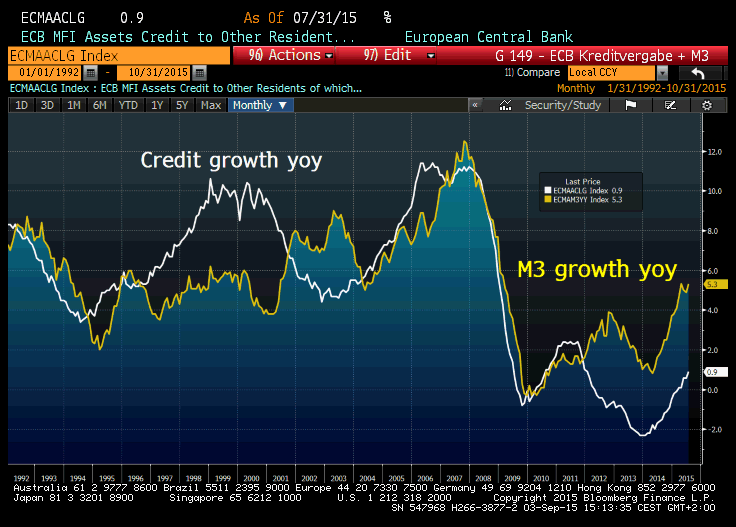
In a typical, by now ritualistic, referencing of the monetary policy transmission mechanism (still broken), Draghi referenced improved, but still poor credit conditions for euro area corporates. Chart illustrates:


Of course, there is little point of reminding all that growth in credit requires growth in demand. Unless, that is, you are a European policymaker who thinks (as they all seem to be required to do) that issuing loans to companies is a great idea to generate economic growth even if there is absolutely no need for new capacity creation in the economy with stalled demand.

In short, ECB has now reacted to the rot in the Emerging Markets (and in particular China). This is a reactive move with some serious wisdom behind it - the rot is not over yet, by all means and the ECB is out of the gates with signalling that it will continue priming the Government bonds markets pump to prevent any spiking in the rates or euro revaluations derailing already weak exports. With BRIC PMIs signalling ongoing and deepening deterioration in global growth conditions (link here), this is expected and wise. For now, doing nothing new, but promising to do it longer and more aggressively is the preferred response from Frankfurt. It might just be enough.

3/9/15: BRIC Composite PMI: August

Having covered Manufacturing (link here) and Services PMIs (link here) for BRIC countries, consider Composite PMIs next.

Note, to make series consistent with my previous indicator, I use x2 factor on composite PMI readings from Markit, going forward, so reference number here is not 50.0 but 100.0.


  • Brazil Composite PMI firmed up marginally to 89.6 in August from 86.3 in July. This is the fifth highest reading in recent months, but sixth consecutive reading below 100. Per Markit: "Rising to a five-month high… the Brazil Composite Output Index pointed to a further, although weaker, decline in private sector output. Whereas manufacturing production decreased at a quicker rate, the reduction in service sector activity softened. … New business in the Brazilian service sector decreased for the sixth straight month in August. …Order book volumes at manufacturers dipped at the fastest pace in four years. Subsequently, the contraction in total private sector new work accelerated to the sharpest in three months."
  • Russian Composite PMI was also soft, falling to 98.6 in August compared to 101.8 in July, returning the economy toward renewed recessionary momentum after fragile improvement in the first month of 3Q 2015. More on Russian Composite PMI here: http://trueeconomics.blogspot.ie/2015/09/3915-russian-manufacturing-services.html.
  • China Composite PMI too posted sub-100 reading, falling to 97.6 in August compared to 101.6 in July. Per Markit release: "Though only modest, it was the fastest contraction of output seen since February 2009. The renewed decline in overall output was largely driven by a faster contraction of manufacturing production in August. Furthermore, the latest fall in manufacturing output was the quickest seen in 45 months. Meanwhile, slower growth in service sector business activity also weighed on the headline index. Consequently, total new business at the composite level fell for the first time since April 2014, albeit marginally. ...the latest expansion in service providers’ staff numbers was the weakest seen in the current two-year sequence of job creation and fractional. Job shedding persisted at manufacturing companies, with the pace of reduction quickening slightly since July. Overall, composite employment fell for the third month in a row and at a modest pace."
  • India Composite PMI firmed up to 105.2 from 104.0 in July, marking improved growth outlook for the economy and breaking, once again, trend with the rest of the BRICs. Per Markit: "India’s private sector economy improved further in August. The seasonally adjusted Nikkei India Composite PMI Output Index rose to a five-month high… The uptick in growth was boosted by a quicker expansion of services activity, as the increase in manufacturing production softened in August. …New business across the private sector as a whole expanded at a moderate pace that was the quickest since March."


SUMMARY: As charts above show, BRICs as a block are now exerting negative drag on the global economy. This is extremely worrying especially as the core drivers for this weakness are now China and Brazil, opposed to Russia. While Russian economy remains in a recession, overall, it is responsible for lesser share of negative momentum in the BRICs index than the other two troubled economies since around the start of 2Q 2015.

3/9/15: BRIC Servies PMI: August


BRIC Services PMIs are out, so here is the summary of latest changes:


  • Brazil Services PMI rose to 44.8 in August from July's 39.1. This marks seventh consecutive month of Services reading below 50.0. July fire was horrific and cam on top of abysmal 39.9 reading in June. August reading is still below 50, but is now the second highest in 7 months. In 12 months from August 2014, the index posted above 50 reading in only two months. This confirms deep-running recessionary dynamic in Brazil's economy.
  • Russia Services PMI came in at 49.1, below 50.0 and down on 51.6 in July. Details covered here. As noted, this is a disappointing reading signalling weak contraction in the Services side of the Russian economy, compounding sharper contraction in Manufacturing.
  • China Services PMI posted 51.5 in August, down from 53.8 in July. This index has never reached below 50.0 in its history, so 51.5 is a weak reading overall. In fact, this is the slowest pace of expansion signalled by the Services sector since July 2014. Taken together with rather sharp ongoing contraction in Manufacturing, the Services PMI for China suggests that current rate of economic growth in the country is well below the target of 7% annual rate of growth targeted by the Chinese Government. Most likely, stripping out financials (supported by the Government aggressive intervention in the stock markets in recent months), China's Services PMI would be in much worse shape.
  • India Services PMI came in at 51.8 - signalling acceleration in growth from 50.8 in July. This marks second consecutive month of above 50.0 readings for this index. 

Some Markit comments on the above:

For China: "The Caixin China General Services Business Activity Index …signalled the slowest increase in activity in the current 13-month sequence of expansion. Total new order growth at service sector companies also weakened in August, with the latest increase in new business the slowest seen in just over a year. According to anecdotal evidence, relatively subdued market conditions had dampened client demand in the latest survey period."

For India: "The seasonally adjusted Nikkei Services Business Activity Index [pointed] to a faster, although modest, expansion in output. Activity growth was recorded in three of the six monitored categories, namely, Hotels & Restaurants, Post & Telecommunication and ‘Other Services’. Leading services activity to increase was a further rise in incoming new work. According to panellists, higher demand coupled with capacity improvements and increased marketing all had contributed to the latest expansion in new business. Despite quickening since July, the rate of growth was moderate. While manufacturing new work rose at a weaker pace than in July, growth nevertheless outpaced that seen at their services counterparts."


CONCLUSION: BRIC economies are suffering from the twin effects on internal structural weaknesses (domestic markets and policies) and from lack of external demand growth. These leading emerging market economies are now solidly in a recessionary dynamic (Brazil and Russia), and near hard landing territory (China). India continues to break trend with the rest of BRICs, although this remains to be seen how long its economy can sustain this decoupling. 

3/9/15: Russian Manufacturing, Services & Composite PMIs: August


Russia PMI data for Services, Manufacturing and Composite posted sub-50 performance across all three indicators in August, returning the economy back to where it was around June 2015, and erasing the fragile expectations of stabilisation that were based on July data.

As noted in my analysis of BRICs manufacturing PMIs earlier (link here):

Russia Manufacturing PMI fell to 47.9 from 48.3 in July, marking 9th consecutive month of sub-50 readings and worst performance in the sector since May 2015. August move effectively demolished previous expectations of stabilisation in Manufacturing sector in Russia.

Per Markit release: "Operating conditions in the Russian manufacturing sector continued to deteriorate during August amid reports of a deterioration in the economic environment. Output was little changed, while new orders and employment both fell to the greatest degrees since May. Notably, a depreciation in the Russian rouble against the US dollar led to a sharp and accelerated increase in average input prices by raising the cost of imported goods. …The net effect was a decline in demand and a drop off in levels of incoming new business."

Meanwhile, Services PMI posted a disappointing decline from 51.6 in July to 49.1 in August, pushing the index below 50 mark once again. The index fell to its lowest level for the period covering last 5 months.

Per Markit: "The Russian service sector registered a slight fall in business activity during August as incoming new orders were barely changed and excess resources remained evident. Backlogs of work were again cut sharply, placing further downward pressure on staffing levels… Undermining service sector activity was a general lack of growth in incoming new business. Latest data showed that new work was only marginally higher, with companies bemoaning a lack of funds at clients amid evidence of a challenging economic environment.


With booth Manufacturing and Services down, Composite PMI for Russia fell below 50.0 marker in August, reaching 49.3 against 50.9 in August. This marks the second month in the last 3 months of sub-50 readings and August Composite PMI level is at the lowest levels since April 2015.

SUMMARY: As I noted consistently in the past, any sign of stabilisation in Russian economy coming on foot of disappointing 1H 2015 will require several confirmations before we can call a switch in the growth trend. This confirmation (on foot of July upside performance) did not arrive to-date.

3/9/15: BRIC Manufacturing PMIs: August

BRICs manufacturing PMIs signalled continued worsening in growth conditions in world's largest emerging markets.


  • Brazil Manufacturing PMI fell to an abysmally low 45.8 in August compared to already poor 47.2 in July. This marks the fastest rate of decline in manufacturing activity in the economy since September 2011 and the 7th consecutive month of sub-50 readings in the index.
  • Russia Manufacturing PMI fell to 47.9 from 48.3 in July, marking 9th consecutive month of sub-50 readings and worst performance in the sector since May 2015. August move effectively demolished previous expectations of stabilisation in Manufacturing sector in Russia. In my previous posts on the subject I have consistently noted that early signs of such stabilisation were yet to be fully confirmed and we will have to wait until we see Services PMI for Russia for more analysis.
  • India Manufacturing PMI continued above-50 trend performance in August, although the index did fall to 52.3 from 52.7 in July. Statistically-speaking, 51.5 for the Indian economy is consistent with moderate growth. Overall, Indian Manufacturing PMIs have now been in continuous expansion territory over 22 consecutive months.
  • China Manufacturing PMI came in at a disappointing 47.3 in August, down on already poor 47.8 in July, marking 6th consecutive month of contraction in the sector. Overall, August reading is the lowest since March 2009. The trend suggests the economy is nowhere neat the target of 7% annual growth rate targeted by the Beijing officials.


Summary view: Overall, BRIC Manufacturing PMIs signalled deepening of the ongoing economic growth slowdown in the largest emerging economies. We will need to wait for the analysis of Services and Composite PMIs to confirm this, but August has been a disappointing month for the prospects of global growth recovery.

Wednesday, September 2, 2015

2/9/15: House prices, rents and Irish demographics


Based on latest data from CSO, Dublin has gained disproportionately in population compared to the rest of the country in 12 months through April 2015. At the top level, Dublin population rose 30,700 in 2015 compared to overall state population rise of 25,800, which implies that ex-Dublin, the country lost population at the rate of 4,900. Dublin v rest of the state population changes were even more dramatic when one considers age distribution.

  • Population aged 0-19 years rose in Dublin by 15,700 in 2015. The same group numbers increased state-wide by 19,600. Which means ex-Dublin, younger population rose only 3,900 against Dublin's 15,700. This highlights family formation dynamics in Dublin as opposed to the rest of the country.
  • Younger working-age population (age 20-29) fell in Dublin by 5,700 in 2015. Across the country, the decline was 25,400. Which means that ex-Dublin, younger working-age population has declined by 19,700.
  • The main cohort of working-age population (30-64 years old) has risen in Dublin by 15,700 in 2015 compared to 2014. Across the country the increase was 14,100, which implies that ex-Dublin, the state lost 1,600 adults in the main working age cohort.
  • Older population dynamics were also in favour of Dublin. In 12 months through April 2015, population aged 65 and older rose in Dublin by 4,900 and it was up nationwide by 25,800. Which means that ex-Dublin, older age population rose 20,900.


The above dynamics suggest demographic support for rising property prices and rents in Dublin, as was suggested by some analysts. This may or may not be so, since population dynamics work over years, not in simple y/y terms. So let's take a look at relative changes in Dublin population compared to the rest of the state:


Dublin population, as % of state-wide population of core home ownership demographic that transacts on the purchasing side of the market (30-64 year olds) has been rising overall since falling to 27.5% in 2010 and is currently standing at 28.9%, still below 29.6% high in 1996. But the rental demographic of 20-29 year olds has shown different dynamics, reaching period trough in 2013 (at 32.3%) and rising since then to 33.1% in 2015, a level consistent with 2011. Neither suggests huge uplift in demand for rentals or owner-occupied homes.

Of course, these are cohorts of 2015. Back in 2007, when house loans were last available in plentiful supply, large share of purchasers demographic today was… err… renters. And absent credit for house purchases, as this demographic moved into purchasing age, they stayed renters.  This would suggest increased pressures on rents. But the picture is more messed up by the losses of population share in 20-29 years old group, most likely due to emigration. Longer tenure for children staying in parents' homes also should have held rents back. In other words, our traditional view of demographic distribution of buyers v renters has been messed up by the sheer duration of the current crisis.

Take 2010-2015 period. Over that time, Dublin population of 20-29 year olds fell 61,000 and across the rest of the country, this cohort numbers fell 123,000. But cohort of 30-64 year olds rose in Dublin by 60,900 against a rise of 47,600 in the rest of the country. Demand based on demographics, therefore, suggests swing from renting toward purchasing. Similar picture repeats if we take 2011-2015 cumulative changes and 2012-2015 and 2013-2015. And, still, rents were rising.

What is more mysterious is that overall working age population has been relatively mildly altered in recent years. In Dublin, working age cohort (20-64 year olds) has grown by just 10,000 in 2014-2015 period and it is up only 8,000 on 2012. The cohort is still down 13,300 on 2008. Across the country, ex-Dublin, things were much worse: since 2008 the cohort fell 62,200 and compared to 2014 it is now down 21,300. In simple terms, unless children and retirees are buying homes, there shouldn't be any dramatic uplifts in demand for property in Dublin, and most certainly outside Dublin.

Which goes to say that any claims about actual demand (based on numbers of potential renters and buyers) are a bit strained. In 2008, there were 821,200 people of age 20-64 living in Dublin. Today there are 807,900. Unemployment rose over that time too. So where is that tremendous growth in demand coming from to push property prices up? Property prices in Dublin hit a period trough in 2012. Since then, there has been a net increase of just 8,000 in 20-64 year olds cohort living in Dublin. Again, where is that spiking in demand coming from?

In my view, simple demographics do not explain Irish property prices uptick from crisis lows. Speculation and latent surplus of savings in a relatively small category of Irish residents (and ex-past), plus re-distribution within cohorts between renters and buyers are the main drivers on demand side of the equation. Supply side also contributes significantly to prices uptick. And beyond that, there has to be significant behavioural component: our addiction to property - despite all the hopes of Dublin 'planners' for an Amsterdam on the Liffey - has not gone away over the years of the crisis. The first, initial shock to the economy has had an effect of scaring us put of the markets for property. Negative equity contributed more downward momentum. But once we learned to live with our fears, we simply decided o turn back to our old model of family investment: bricks and mortar. 

Sunday, August 30, 2015

30/8/15: Migration & Changes in Irish Population: Working Age Population


In two previous posts, I looked at Irish migration and population changes data from the point of:
- Top level analysis of migration and natural changes in population; and
- Migration trends by nationality.

Continuing with analysis of population data from CSO released earlier this week, let's take a look at the age composition of population.

In what follows, I define two key categories within our population:

  • Working age group - population aged 20 years through 64 years. This is an approximate definition, and I prefer it to including 15-20 year olds into it, primarily because it allows for more accurate reflection of numbers in full time education. There are many caveats applicable here, so take the approximation for what it is - indicative, rather than definitive.
  • Non-working age population (rest of population). Again, that is not to say that younger students do not work (at least part-time) or that people beyond 65 years of age do not work. Some do. Majority do not. When many do work, they work less hours than is required to sustain independent living, so they still rely on either pensions or social transfers or family transfers or any permutations of the three to sustain themselves.

In simple terms, mindful of all caveats, etc, a ratio of working age population to non-working age population tells so a bit about how high is the dependency weight in the society due to age distribution in population. Lower ratio means fewer working age adults having to sustain themselves and non-working age people. By sustain I mean economically sustain - by working and adding value in the economy.


Chart below shows distribution of changes in working age population and non-working age population in y/y and cumulatively from 2008:


What stands out in the chart?

  1. Working age population overall has been in decline since 2010. In cumulative terms, number of working age adults has fallen 2.7% on 2008 level by April 2015 - a decline of 75,500. In 2015, the rate of decline was 0.4% - more moderate than in three previous years, but still steeper than 2010-2011 average.
  2. Non-working age population remains on the rise for every year covered by the CSO series and the rate of increase in 2015 (at 2%) was the highest since 2010. Overall, over 2008-2015 period, non-working age population those 13.3% or 225,900.
  3. The gap between working age population and non-working age population is now at 798,400 - the worst reading in series history and 301,400 worse than in 2008.


As the result of the above trends, ratio of working age population to non-working age population continued to fall precipitously in 2015:


In 2015, the ratio of working age population to non-working age population was 1.42 - meaning that for each non-working age person, there were 1.42 working age adults. This does not correct for the working age adults who are not in the labour force as well as for the unemployed. The best performance year in this metric was 2007 when the ratio was 1.66. In other words, in 2015, there were 24 fewer working age adults per each 100 non-working age persons than in 2007.

Saturday, August 29, 2015

29/8/15: Migration & Natural Changes in Irish Population: Migration by Nationality


Having looked in the previous post at top level data for population changes in Ireland reported by CSO, now let's take a look at composition of migrants flows by nationality. This is going to be charts-heavy.

Let's start with immigration flows. Chart below shows Immigration into Ireland over the recent years:


Several interesting aspects of this jump out:

  1. There has been a significant increase of inflows of people from the 'Rest of the World' (ex-EU). Numbers of those coming into Ireland from outside the EU are up at 30,400 in 2015 from 25,500 in 2014. Pre-2015, average annual inflows of immigrants from outside the EU was 15,722, so last year things were pretty much ahead of the average for the third year in a row. Much of this is probably driven by big hiring numbers from multinationals which are increasingly moving their EMEA and MENA operations into Ireland. 
  2. There has been a small uptick in the number of new comers from the Accession States (EU12), the numbers of which rose to 12,800 in 2015 compared to 10,000 in 2014. This is the second highest inflow rate since the start of the crisis. 2006-2014 average for these inflows (29,078) is still significantly above 2015 figure. Again, I would suspect that much of this increase is accounted for by MNCs and also by demand for particular skills. Note: I will blogging on skills matters subsequently in a separate post.
  3. There has been virtually no change in inflows of people from the UK over the last 3 years, so nothing worth spotting here in terms of trends. Rest of EU-15 immigration flows also were relatively static, up to 8,900 in 2015 compared to 8,700 in 2014. Nonetheless, this has been the busiest year for EU15 migration inflows (ex-UK and Ireland) for some time - since 2009.
  4. Number of Irish nationals returning rose from 11,600 in 2014 to 12,100 in 2015. Which, kind of directly flies in the face of a number of media reports about 'returning migrants'. Apparently, the migrants are not quite returning, as current rate of immigration in Ireland by Irish nationals was the second slowest on record and much closer to the lowest year (2014) than to the third lowest (2013).


Now, consider emigration figures:


Again, few things worth a closer look:

  1. Irish emigration continued to decline in 2015 for the second year in a row. 2014 emigration of Irish nationals stood at 35,300 down from 40,700 in 2014 and down substantially on crisis period peak of 50,900 in 2013. The rate of emigration is now closer to 2006-2014 average of 29,444 that before, but it is still substantially above that number. Crucially, in more normal times, emigration by Irish nationals stood at around 13,700, which is well below current levels.
  2. Emigration by UK nationals out of Ireland remained pretty much stable and on-trend. Historical pre-2015 average is for annual outflow of 3,467 and in 2015 the number was 3,800. Emigration by the nationals of the EU15 states (ex-UK and Ireland) was up in 2015 at 15,600 compared to 14,000 in 2014. The rate is rising now for two years and is well ahead of 9,078 average for 2006-2014 period. This is interesting, as it reflects some shift in MNCs employment: in the past, MNCs were focusing much of their hiring on old EU markets, demanding language skills from these countries. Now, it seems the momentum is shifting toward ex-EU15 markets. Notably, pre-crisis average emigration by EU15 nationals stood at 6,667 per annum, very substantially below the 2015 figure.
  3. In contrast to EU15 pattern, emigration by the Accession EU12 nationals fell significantly in 2015 to 8,500 from 10,100 in 2014. This is the slowest rate of outflow for any year from 2007 on and significantly below the 2006-2014 average annual rate of outflow of 15,478.
  4. Rest of the World (ex-EU) emigration picked up, rising to 17,700 in 2015 compared to 14,100 in 2014 and against the 2006-2014 average of 9,9833. The reason for this, most likely, is the turnover of MNCs-employed tech workers and specialists who tend to stay in Ireland for 2-3 years and subsequently leave. 


So last remaking bit of analysis will have to cover net immigration / emigration:


As consistent with the number discussed above:

  1. Rate of net immigration from the 'Rest of the World' (ex-EU) picked up somewhat in 2015, rising to 12,700 from 11,200 in 2014. This is the highest rate of net increase in ex-EU population in Ireland for any year between 2006 and 2015.
  2. Second noticeable change in 2015 was positive contribution of EU12 (Accession states) nationals, with their net immigration at 4,300 in 2015 marking the first positive net result since 2008.
  3. EU15 (ex-UK and Ireland) net emigration remained significant and increased, with 6,700 more nationals of EU15 (ex-UK and Ireland) leaving Ireland than coming into Ireland in 2015, up on 5,300 in 2014. This marks the third year of rising net emigration by EU15 nationals out of Ireland and 6th consecutive year of negative net immigration by this group of residents.
  4. Irish nationals net emigration from Ireland remained very substantial in 2015 at 23,200. The number is lower than 29,200 net emigrations recorded in 2014 and the lowest reading in 4 years, but it is still well above the crisis period average. In simple terms, things are getting worse slower in this metric, they are not getting better.

Combined 2008-2015 net movements of people by nationality are shown in the chart below. Since 2008 through April 2015, there are 5,200 more UK nationals residing in Ireland, while the number of EU12 migrants rose 11,100. By far, the largest net emigration on a cumulative basis relates to outflow of Irish nationals: between 2008 and 2015, 132,400 more Irish nationals left the country than came back into the country - annual average rate of net emigration of 16,600 and in 2015 annual net emigration for Irish nationals was 6,700 above that.


29/8/15: Migration & Natural Changes in Irish Population: Top Level Analysis of 2015 data


Irish migration and population data for the 12 months through April 2015 have been published by CSO recently. It is a tough read. 

Let's take a look at overall picture (2015 here references May 2014-April 2015 period as per CSO data):
  • There were 67,000 births in 2015, down on 67,700 in 2014 - a decline of 700. Compared to peak births year - 2010 - births are down 10,200.
  • There were also 29,600 deaths in 2015, compared to 29,800 in 2014 which is 3,200 lower than peak year (1990), but more significantly - below 2013 and 2014 readings. 
  • Which means that natural increase in population was 37,400 in 2015, compared to 37,900 in 2014. This is the lowest natural rate of population increase since 2006 and it is driven exclusively by decline in birth rate which fell to 1.445% (births as percentage of total population) from 1.469% in 2014. Current birth rate is the lowest since 2001.
  • Immigration into Ireland amounted to 69,300 in 2015, an uplift on 60,300 in 2014 and the highest reading since 2009. Immigration has been increasing every year starting with 2013. Note: I will be blogging on quality of immigration and emigration separately, so stay tuned. Current rate of immigration is ahead of 2008-2014 average (64,500) but behind 2000-2007 average (80,100).
  • Meanwhile, emigration slipped slightly  - the good news you heard by now, most likely - from 81,900 in 2014 to 80,900 in 2015. This brings 2015 emigration closer to 2011 level (80,600) and lowest in 4 years. However, historical comparisons are still weak: in 2000-2007 average rate of emigration from Ireland was 30,700 and in 2008-2014 period it was 75,571, which means 2015 figure is higher than either pre-crisis average (obvious, really) and crisis period average. 
  • Net emigration stood at 11,600 in 2015, down from 21,400 in 2014 - a decline that is accounted for by an 8,700 increase in immigration and by 1,000 decrease in emigration. Thanks to immigrants numbers rising, we are at the lowest crisis period level of net emigration


Over 2009-2015, cumulated net outflows of people from Ireland stand at 153,800 - or 3.3% of our population in 2015 - close to 4 last years of combined natural increases in population (births less deaths). Over the last 6 years, average annual net emigration from Ireland stood at 25,900. During the 6 years of 1987-1992 the average was 21,050. even with 2015 decline in net emigration rate, we are still sending more people abroad in the current crisis than in the late-1980s -early 1990s crisis.

Which brings us to the 'opportunity cost' of this emigration, or in simple terms - what would our population be were it not for the crisis. 

First up, our current population estimates: per CSO, in April 2015 there were 4,635,400 people living in Ireland - an increase of 25,800 on same period 2014. The rate of increase was the highest since 2009. Which is all good news. However, the rate of annual population increase in 2015 was lower than 2008-2014 average (33,386) and was way below the 2000-2007 average of 80,100.

Now, let's take three scenarios. Starting with 1997 - the year when majority of us think Ireland's catching up with EA15 states was pretty much well underway and things were not yet fully 'mad' in a Celtic Garfield sense. This is also happens to be the year when net immigration posted the first above zero trend, with 7 year average through 1997 at 4,600 being the first positive 7 year average on record (note, 7 year average is chosen because of the cut-off period and because it corresponds to the duration of the current crisis too). Now, let's define 3 scenarios:
  1. Scenario 1: take an average for net migration over 1997-2000 (capturing the period all of can agree was pre-bubble in the property markets) and take projection from 1987 through 2015 at this average net immigration rate and accounting for actual realised natural rate of population change. You get 2015 population at 4,662,700 or 27,300 more people than current official estimated population.
  2. Scenario 2: take an average for net migration over 1997-2003 (7 years period), capturing the period that some think was still pretty much pre-Garfield craze and, crucially, before the Accession of 2004 that brought into Ireland significant inflows of Eastern European workers. You get 2015 population of 4,784,500 or 149,100 more people than current official estimated population.
  3. Scenario 3: while a bit outlandish, let's just consider the period of the entire Celtic Garfield and take the average net immigration rate at 1997-2007. Extreme, I know, but what the hell. You get 2015 population of 5,701,300 or 1,065,900 more people than current official estimated population.


Stay tuned for more analysis of net migration flows.

Friday, August 28, 2015

28/8/15: Core Retail Sales for July: Less of a Cheer, More of a Smile


With much of hullabaloo around it, the Retail Sales figures for July were published today. The CSO headline on the matter read: "Retail Sales Volume increased by 11.6% in July 2015". Which is, of course, correct... to a point. The figure references sales inclusive of automotive sales. And it references volumes of sales.

So here are the actual retail sales figures, for retail sales excluding motors.

First, consider seasonally-adjusted sales allowing m/m comparatives:

  • Value of core (ex-motors) retail sales increased 0.3% m/m in July and this only partially (albeit substantially) corrects for 0.3% decline m/m in June. Compared to 2005 average level, value of sales today is only 1.09% higher, which is... before inflation is factored in. 3mo MA of Value indices in July was down 0.03% on 3mo MA average through June, while a month ago the same was 0.7% higher. In other words, there is nothing 'convincing' in the value of sales data. And this is concerning, because retailers don't get their revenues and profits from volumes of sales. They get them from value of sales.
  • Volume of retail sales (ex-motors) was up 0.64% m/m in July, having previously posted a decline of 0.12% in June. So July volumes of sales significantly over-compensated for June decline. Which is good news. Compared to 2005 average, July figure is 12.1% higher for the volume of sales, which means that deflation has resulted in more sales by volume, but barely any change in value: selling more stuff but getting less per unit sold is the retailers' margin nightmare and it has been going on for some years now. But the good news on Volume run out when you consider 3mo MA: 3mo MA through July was down 0.12% compared to 3mo MA through June, having previously been up 0.7%. So on 3mo MA basis (smoothing a bit volatility) value and volume of retail sales both fell in July.
  • Meanwhile, the never-ending exuberance of Irish consumers, as measured by Consumer Confidence Index posted some moderation in July, falling 3% m/m. Still Consumer Confidence in July 2015 is 97% (that's right - 97%) higher than the 2005 average. You really gotta wonder...
Two charts to illustrate the above trends:


As can be seen from the chart above, there is now divergence in the series for Value (rising slower) and Volume (rising faster) of core retail sales. This, with Value of sales running now persistently above the trend (suggesting risk of downward correction in the future), whilst Volume series running along the trend. Volume is converging with Consumer Confidence, while Value is diverging. Closer look at the latter next:


 And now to y/y data based on unadjusted series:


Per data charted above y/y changes were:

  • Value of core retail sales rose 3.40% y/y - which is a good performance, but not exactly stellar. In June, y/y increase was 2.0% and in July 2014 y/y rise was 1.2% which means this July growth was stronger. However, pre-crisis average y/y growth rate in Value of retail sales was 6.93% and this means that current rate of increase is just under 1/2 the rate of average rise in pre-crisis years. Smoothing out some volatility, 3mo average through July was 99.3 which is stronger than 3mo average through April 2015 (93.6) and is up 3% on 3mo average through July 2014. These are good figures, no arguing there.
  • Volume of retail sales, predictably, was up 6.7% y/y in July - double the rate of growth in Value of sales and above the pre-crisis average rate of growth of 6.2%. Volume of sales gained in July in annual rate of growth compared to June (4.7%) and compared to July 2014 (3.2%). And on 3mo average basis, the index was up 6% y/y for 3mo through July - double the rate of growth in Value.
  • Hence, overall we have the same picture in unadjusted data: rates of growth in Value of sales are healthy, but not spectacular, while rates of growth in Volume are strong. Volume is diverging from Value and there is nothing new here - it has been thus since the end of 2013.

Good news is that on 3mo average basis, May-July 2015 figures were

  • Positive in y/y terms for majority sub-sectors in value terms (excluding Food, Beverages & Tobacco and Motor Fuel) and for all sub-sectors in volume terms
  • The picture was a bit more fragmented for 3mo change through July compared to 3mo change through April, as shown in the table below.

Thus, overall, there are some good news in the retail sales figures. Do they warrant a huge wave of congratulatory backslapping exercises in the media? No. Do they warrant much of optimism that the sector is experiencing a big revival? Not exactly. 


28/8/15: Gold & Silver: Does technical analysis beat the market?


An interesting piece of research co-authored by Brian Lucey on efficacy of technical analysis in gold & silver markets: http://papers.ssrn.com/sol3/papers.cfm?abstract_id=2652637.

"This paper studies whether intraday technical trading rules produce significant payoffs in the gold and silver market using three popular moving average rules."

And the conclusions are (emphasis is mine): "The initial results show that the SMA, WMA and EMA trading rules generate significant negative payoffs using the parameters common in the literature in the high-frequency gold and silver markets. This suggests that there is no significant profit to be gained from technical trading in the gold and silver markets. However, our parameter sweep results show that there are a number of parameter combinations that generate significant profit in the gold market, but none in the silver market. Further, the best performing rules have different parameters to those used the existing literature. We show that longer run averages should be used by investors on intraday data and that investors need to employ different parameters when utilising technical analysis on daily and intraday data. In order to examine whether investors could have actually utilised the best performing rules, we perform an in- and out-of-sample test and show that only the SMA rule for gold generates significant profits in the in-sample as well as the out-of-sample period. All of the other best rules in the in-sample period generate either insignificant or negative payoffs in the out-of-sample period."

28/8/15: Inflation Expectations: Euro and U.S.


Having earlier posted a chart on Central Banks balancesheets expansion (see here), here is an interesting chart plotting inflation expectations (5yr5yr swaps - effectively markets expectations for 5 years from now inflation average over subsequent 5 years)


The above shows that although there has been an uplift in Euro area inflation expectations over the course of 2015 to-date, consistent with QE carried out by the ECB, the expectations have tanked since the start of Q3 2015 in line with those in the U.S.

More ominously, expectations remain in the territory where neither the Fed nor the ECB are capable of convincingly exiting monetary easing.

While the U.S. expectations are closer to target (at 2.23%) but still weak, Euro area expectations are exceptionally weak at 1.63%. Gotta do some more printing (for ECB) and less talking about tapering (for both the Fed and the ECB)...

28/8/15: Patents & R&D expenditure effects on equity returns in pharma industry


Martina Feyzrakhmanova and myself have a new paper out with Applied Economics Letters titled "Patents and R&D expenditure effects on equity returns in pharmaceutical industry". Working paper (ungated version) is available here: http://papers.ssrn.com/sol3/papers.cfm?abstract_id=2438461.

28/8/15: CBR and Ruble: Fiscal Balance in Oil's Shadow


As I noted earlier this month, Russia has officially entered the recession. The key drivers for 3.4% contraction in 1H 2015 were the same as the key pressures on growth back in 2H 2014: oil prices, investment collapse on foot of high interest rates, inflationary environment that restricts CBR's room for cutting rates, and sanctions (or rather geopolitical risks and pressures, linked in part to sanctions).

That said, in June and early July there were some hopes for economy starting to stabilise, although fixed investment was down 7.1% y/y in June, marking 18th consecutive month of y/y declines. These are now once again under pressure and the cause is... oil price.

Here is how closely paired has Russian Ruble been to oil prices in trend terms since July 2014, although correlation was weaker in preceding period. Overall, as the chat shows, there are two very distinct periods of Ruble valuations catch up with oil prices: June 2014-February 2015 and mid-July 2015 through present.


Russia's Central Bank is switching between little concern for Ruble to interventions and back to staying out of the markets appears to be more than a simply random walk. Instead, it is a game consistent with rebalancing Ruble valuations to fit budgetary dynamics.

The reason for this is that (as shown in the chart above) Ruble strengthening above oil-linked fundamentals earlier this year was an actual threat to budgetary dynamics, and over the last couple of weeks, correcting valuations of Ruble re-established closer connection to oil prices. Hence, in July, CBR managed to deliver a shallower cut to interest rates (-50bps) compared to June (-100bps).

With CBR continuing to stick to its June 2016 forecast for inflation to fall to 'under 7%' by then and hit 4% in 2017 compared to July 2015 CPI at 15.6%, Russia went on to issue its first CPI-linked bonds / linkers amounting to RUB75 billion (OFZ-IN, 8 year notes) at 91% of nominal, on cover of RUB200 billion (more than 25% of demand coming from foreign investors). Real yield at issuance was 3.84% - relatively high-ish, implying underpricing of the bond in a market with relatively hefty demand and forward expectations for significant easing in inflation. Something is slightly amiss here.

In line with up-down interventions, the CBR continued to trend flat on foreign exchange reserves. End of June, total Russian FX reserves stood at USD361.575 billion, and by end of July these fell to USD357.626 billion. As of last week, the reserves were back up at USD364.6 billion.


Weekly data from CBR does not allow for compositional analysis of reserves, but looking at the monthly data the pattern repeats.


Actual liquid FX reserves and gold stood at USD347.1 billion at the end of July against USD350.957 billion at the end of June. This is barely up on end-April period low of USD345.373 billion, although well within the FX- and gold-valuations range of change.

Meanwhile, data through July 2015 shows net purchases of dollars of USD3.76 billion against USD3.831 billion in June and USD2.531 billion in May by CBR. Overall, from January 2015 through July 2015, CBR bought (net) USD7.8 billion and there were no net purchases/sales of euro.


All of the above suggests that CBR will likely resume rate cuts if Ruble firms up from its recent valuations. Two weeks ago, RUB/USD was at 64.947 (72.197 to Euro), peaking at 70.887 four days ago (82.373 to the Euro) and currently at 66.8875 (74.984 to Euro), not exactly warranting a move by the CBR yet, but back in the relative comfort zone for the Bank to sit on its hands once again.

28/8/15: Central Banks' Activism in a Chart


Having been out of contact due to work and summer break commitments, I will be updating the blog over the next few days with interesting bits of information that have been overlooked over the last 10 days or so. So stay tuned for numerous updates.

To start with, here is a picture of the Central Banks' monetary activism to-date:

Source: @Schuldensuehner 

The chart above sets 2005 = 1000 and indexes the uplift in Central Banks' balancesheets expansions: Fed almost x5.6 times; PBoC almost x6.4 times, ECB almost x2.3 times and heading toward x3.3 times under the ongoing QE, BoJ almost x2.1 times... not surprisingly, the old Fed 'put' is now pretty much every Central Bank's default option...

Much of this mountain of money printing has gone to grease the wheels of sovereign debt markets. Much of the resulting revaluation of financial assets is simply not sustainable under the premise of the Central Banks' 'puts' withdrawal (monetary tightening).

In simple terms, the ugly will get uglier and we have no idea if it will get any better thereafter.

Monday, August 17, 2015

17/8/15: Euro: The Land Where Growth Goes to Die


So we have had a massive QE - even prior the current one - by the ECB. And we are having a massive QE again, courtesy again, of the ECB. And the bond markets are running out of paper to shove into the… you've guessed it… the ECB. And the banks have been repaired. And we are being fed our daily soup of alphabet permutations (under the disguise of the European Union 'reforms' and policy initiatives): ESM, EFSF, EFS, OMT, EBU, CMU, GMU, TSCG, LTRO, TLTRO, MRO, you can keep going… And what we have to show for all of this?

2Q 2015 growth is at 0.3% q/q having previously posted 0.4% growth in both 4Q 2014 and 1Q 2015. This is, supposedly, the fabled 'accelerating recovery'.


So what do we have? Look at the grey lines in the chart above that mark period averages. Pre-euro period, GDP growth averaged 0.9% in quarterly terms. From 1Q 2001 through 4Q 2007 it averaged 0.5%. Toss out the period of the crisis when GDP was shrinking on average at a quarterly rate of 0.1% between 1Q 2008 and through 1Q 2013 and look at the recovery: from 2Q 2013 through 2Q 2015 Euro area economy was growing at an average quarterly rate of less than 0.27%.

Meanwhile, monetary policy is now stuck firmly in the proverbial sh*t corner since 2012:


You'd call it a total disaster, were it not for Japan being one even worse than the Euro area… and were it not for the nagging suspicion that all we are going to get out of this debacle is more alphabet soups of various 'harmonising solutions' to the crisis... which will get us to becoming a total disaster pretty soon. Keep soldering on...

Saturday, August 15, 2015

15/8/15: Irish Universities: None in Top 100, One in Top 200 & Top 300


Academic Ranking of World Universities 2015 are out (see details here: http://www.shanghairanking.com/ARWU2015.html) and Ireland is not exactly shining.

Only 3 Irish Universities are ranked in top 500:

TCD managed to post flat performance on 2014, reaching its highest Institutional rank since 2003. Which is the best news we had.


Meanwhile, UCD ranking fell pretty substantially, with university ranked in 201-300 place in 2014 now ranked in 301-400 place:


UCC posted second consecutive year of declines in 2015, although it stayed within the 401-500 ranking group.

I will be blogging on data coming out of the survey more later this month, but for now, top line conclusion is: things are not getting better in top Irish Unis relative performance.

Time for more self-congratulatory government talk, promises and awards… and let's get few more Unis designated, just because stretching already scarce resources thin is, obviously, the best way to achieve greatness...

15/8/15: EEU: Kyrgyzstan the latest addition


On August 12, Kyrgyzstan became a member of the Eurasian Economic Union (EEU), joining Russia, Kazakhstan, Belarus and Armenia. Kyrgyzstan is the least developed of the EEU economies, relatively proximate only to Armenia in the group.


15/8/15: Russian External Debt: Big Deleveraging, Smaller Future Pressures


Readers of this blog would have noted that in the past I referenced Russian companies cross-holdings of own debt in adjusting some of the external debt statistics for Russia. As I explained before, large share of the external debt owed by banks and companies is loans and other debt instruments issued by their parents and subsidiaries and direct equity investors - in other words, it is debt that can be easily rolled over or cross-cancelled within the company accounts.

This week, Central Bank of Russia did the same when it produced new estimate for external debt maturing in September-December 2015. The CBR excluded “intra-group operations” and the new estimate is based on past debt-servicing trends and a survey of 30 largest companies.

As the result of revisions, CBR now estimates that external debt coming due for Russian banks and non-financial corporations will be around USD35 billion, down on previously estimated USD61 billion.

CBR also estimated cash and liquid foreign assets holdings of Russian banks and non-bank corporations at USD135 billion on top of USD20 billion current account surplus due (assuming oil at USD40 pb) and USD14 billion of CBR own funds available for forex repo lending.

Here are the most recent charts for Russian external debt maturity, excluding most recent update for corporate and banks debt:


As the above table shows, in 12 months through June 2015, Russian Total External Debt fell 24%, down USD176.6 billion - much of it due to devaluation of the ruble and repayments of maturing debt. Of this, Government debt is down USD22.1 billion or 39% - a huge drop. Banks managed to deleverage out of USD59.9 billion in 12 months through June 2015 (down 29%) and Other Sectors external liabilities were down USD88.8 billion (-20%).

These are absolutely massive figures indicating:
1) One of the underlying causes of the ongoing economic recession (contracting credit supply and debt repayments drag on investment and consumer credit);
2) Strengthening of corporate and banks' balance sheets; and
3) Overall longer term improvement in Russian debt exposures.


Friday, August 14, 2015

14/8/15: IMF on Two Unfinished Bits of Greek Bailout 3.0


IMF's Ms. Christine Lagarde statement on Greece:


Key points are:

1) Per Lagarde, “of critical importance for Greece’s ability to return to a sustainable fiscal and growth path", "the specification of remaining parametric fiscal measures, not least a sizeable package of pension reforms, needed to underpin the program’s still-ambitious medium-term primary surplus target and additional measures to decisively improve confidence in the banking sector—the government needs some more time to develop its program in more detail." In other words, the path to Eurogroup's 3.5% long term primary surplus target on which everything (repeat - everything) as far as fiscal targets go, hinges is not yet specified in full. The Holy Grail is not in sight, yet...

2) "…I remain firmly of the view that Greece’s debt has become unsustainable and that Greece cannot restore debt sustainability solely through actions on its own. Thus, it is equally critical …that Greece’s European partners make concrete commitments in the context of the first review of the ESM program to provide significant debt relief, well beyond what has been considered so far." In simple terms, for all the lingo pouring out of the Eurogroup tonight, Greece has not been fixed, its debt remains unsustainable for now and the IMF - which ESM Regling said tonight will be expected to chip into the Bailout 3.0 later this autumn - is still unsatisfied with the programme.

"Significant debt relief" - off the table so far per Eurogroup - is still IMF's default setting.

14/8/15: Two Facts About Irish Minimum Wage


Having recently spoken about the issues of minimum wage, especially in the Irish context, here are some facts, based on Eurostat latest data.

Firstly - about the level of minimum wages in Ireland relative to the EU counterparts.

In monthly terms, Irish minimum wage comes in at EUR1,462 per month (1Q 2015 data). Despite some claims that we have the second highest minimum wage in Europe, this puts us in the 5th position just below 4th ranked Germany (EUR1,473 per month) and ahead of the sixth ranked France (EUR1,458 per month). It is worth noting that Denmark, Italy, Cyprus, Austria, Finland and Sweden have no national minimum wage.

However, when comparing minimum wages in different countries, it is worth looking at figures, adjusted for Purchasing Power Parities (controlling for cost-of-living differences, albeit imperfectly). Chart below shows these:


In terms of PPP-adjusted figures, Irish minimum wage is 6th highest in the EU at EUR1,238 per month (PPP). This is quite significantly ahead of the UK (ranked 7th at EUR1,114 per month PPP-adjusted), but below France (at EUR1,337 per month PPP-adjusted).

Another possible comparative is in terms of 'replacement rate' for minimum wage earners - in other words, how much worse-off (relatively-speaking) minimum wage earners are compared to, say, average wage earners. Chart below illustrates that:


Per chart above, minimum wage earners in Ireland earn on average around 41.6% of the gross average wage on a monthly basis. Comparable, but slightly more than their counterparts in the UK.

What the above two charts illustrate is that Irish minimum wage is not set at an extremely high level, as some claim. 

They also show that crucial point for people earning minimum wages is the cost of living in Ireland, rather than just the level of wages they earn. 

My view, within the context of the Irish minimum wage debate is that we must focus more of our efforts on the cost of living side, less on incrementally increasing minimum wage. And more crucially, there is little point, in my opinion, to increase minimum wage by a small (token) amount, as variability of hours worked and zero hours contracts offered will erase much of the benefit to be gained by those still holding minimum wage jobs after the wage increase. 

Sadly, for politicians, small/marginal give-aways to well-defined groups of voters bring in political returns. Large-scale, longer-term reforms bring in dissatisfaction of vested interest groups & lobbies. No prizes for guessing what path Irish Government will opt for ahead of the elections...

Update: with thanks to Seamus Coffey ( @seamuscoffey) here are two charts detailing tax burden for minimum wage earners:

Given the levels of progressivity in Irish tax system, it is quite un-surprising that Irish minimum wage earners are carrying low tax burden on tax side, which does push after-tax minimum wage in Ireland to higher poll position in the league tables. On the other hand, the Eurostat data on which my analysis was based uses 39 hour weeks for computing minimum wage earnings, without adjusting for working days. Which, probably, pushes our minimum wage earners' annual incomes down (especially given the prevalence of low hours and zero hours contracts in some sectors).

Thus, as a note of caution, all of the above data should be read as all economic data should be read: with caution and without attempting to make sweeping generalisations.

14/8/15: Individual Consumption and the Irish Crisis


Couple of interesting charts showing the latest annual data on individual consumption in the EU.

First, volume indices of real expenditure per capita in PPS (with index for each year set at EU28=100) (these figures are adjusted for inflation and exchange rates differences.


The chart shows how growth in consumption in the EU28 over time was coincident with decline in relative position of Ireland in terms of individual consumption throughout the crisis period. In 2003-2004 Irish individual consumption stood 8 and 7 percentage points above EU28 average. This was marginally below the EA12 average. In 2005-2007, Irish individual consumption grew faster than consumption for EU28 and EA12, rising to 110 in index terms, or 10 percentage points above the EU28 and roughly 2 percentage points above the EA12. Since 2008, however, Irish individual consumption fell both relative to EU28 and EA12 figures. In the second year of 'robust recovery' - 2014 - Irish individual consumption (adjusting for inflation and exchange rates differences) hit the period low of 93 - full 7 percentage points below EU28 and 14 points below EA12.

As the result of the crisis, our real consumption per capita was down 16.2% on 2007 levels, which is the second worst performance after Greece (down 17%). Our performance was much worse than a 13.6% decline registered in the U.K., 10.6% decline registered in Iceland, 9.9% drop in Cyprus, 9.7% decline in the Netherlands, 8.2% drop in Spain and so on.

In nominal terms (without adjusting for inflation), our individual consumption record was equally abysmal (comparing only euro area states to remove distorting effects of exchange rates variation):


In summary, even after the onset of the 'fastest recovery' in the euro area, Ireland's actual individual consumption of goods and services remained au-par. In 2014 itself, our individual consumption grew 6.0% y/y - second fastest in EU28 after Luxembourg - but years of past devastation meant that our consumption remained second worst hit compared to pre-crisis levels. In 1999, Ireland ranked 12th in terms of individual nominal consumption in the EU 28 group of states. Our best year was attained in 2008 when we ranked 3rd. In every year between 2011 and 2014, we ranked 11th. In simple terms, the entire history of the euro area membership for Ireland has been equivalent to, largely, standing still in terms of our relative wellbeing compared to other EU states.