Sunday, February 12, 2012

12/2/2012: A road map to a cooperative solution for Greek crisis

Papandreou: 'this is a battle between the markets and democracy'.

Greek political discourse - mirroring the received wisdom of the crowds has been reduced to a blatant, and populist lie.

The battles in Greece today are between democracy and European/ECB dogma of preserving the status quo of existent statist system, of which patronage by the State of some markets participants is just an element. Here's why:

  1. The markets did not impose ANY conditions on Greece - EU/ECB did. The markets simply refuse to be conned any longer into subsidizing the Greek state through cheap credit. This is the basic right of any participant in the markets - to refuse investing or lending to anyone, just as it is the right of any baker to refuse selling bread to someone with no money and no desire to pay on credit.
  2. The markets investors are the injured party - excluding the bottom-fishing hedge funds who bought Greek bonds very recently at hefty discounts. The investors are the only ones who were first deceived by the Greek Governments cooking books and fudging numbers in official statistics. The investors should have known better, but that is not a valid defense of the case against them - they were deceived by fraudulent data reporting by the Greek State (yes, right - politicians, Governments, civil servants). The markets/investors are also the only ones who have to take any writedowns. The ECB and the European Union are taking no writedowns on Greek bonds, and are, in fact, lending Greece 'rescue funds' at a profit. 
I am pointing this not to prevent imposition of losses on Greek bonds investors. They deserve to lose and they should lose more than 70-75% of the face value of their investments in Greek bonds.

I am writing this to point that the battle we are facing in Athens today is between people pushed to a breaking point by the policies of the Governments past, and the EU/ECB.

And there is a way out, folks. Here's what should be done:

  1. Impose full losses on Greek bondholders to bring debt/GDP ratio in Greece to 75%. Do same for banks bondholders in Ireland and Spain, and combine these sovereign and banking measures to achieve the same in Portugal and Belgium. Seniority under these arrangements should be as follows: private sector debt holders take the first hit, followed by the public debt holders.
  2. All PIIGS bonds held by the ECB are to be transferred into a separate holding fund. This fund is to run between 2012 and 2021. Bonds are to be held in the fund not at face value, but at purchase value to instantaneously reduce debt overhang in these countries. Note: this imposes no loss on ECB until the fund is wound up.
  3. The ECB Special Fund (outlined in (2) above) is to monitor the conditions of compliance with real (not the currently identified) reforms aiming to restructure PIIGS economies to put them on the path of private sector-driven growth and fiscal sustainability over 10 years horizon.
  4. No coupon payments or principal repayments to be accepted by the ECB on these bonds between 2012 and 2021 to reduce debt overhang drag on the participating economies and improving their fiscal capacity to implement reforms.
  5. The bonds held in the ECB fund are to be automatically written down to zero face value in 2021 as long as the participating country meets conditions of implementing the reforms.
The above proposal will eliminate or severely restrict the problem of moral hazard, as countries participating in the programme will be subject to strict reforms programme implementation. The plan will also reduce the burden of repayment of debt on the countries that do stick to the conditions of the reforms. The plan will also bring, gradually, these countries economies to more competitive institutional, fiscal and regulatory environment. In other words, the proposal contains both the sticks (under items (2), (3) and conditionality) and the carrots (items (4) and (5)).

In other words, the fund, as outlined above, would satisfy core objectives of the crisis resolution framework:
  • Allow for meaningful change and reforms
  • Create an incentive to participate actively in reforms for the countries engaged with the fund
  • Reduce moral hazard problem
  • Help to establish popular support for reforms by providing real, tangible improvement in the economies ability to sustain reforms
We can't keep fighting battles driven by noble objectives, but based on faulty logic that simply serves the very same elites that have created this crisis. We need to find a cooperative solution to the problems we face.

Saturday, February 11, 2012

11/02/2012: Labor Productivity - some cross-EU comparatives

There has been much of talk about Euro area (and EU27) competitiveness trends recently in the media. Some of the commentary I've seen references the issue of decoupling in competitiveness across EU states. In light of this, I decided to take a look at productivity trends. Using eurostat data, I was able to:

  1. Take eurostat main series for per person aggregate (total) productivity index that sets 2005=100
  2. Rebase the index to Q1 2000=100 and recompute entire set of EU27 countries, plus EA17 and EU27 aggregates
  3. Obtain via (1) and (2) above new set of productivity indices that reflect dynamics in per person productivity since Q1 2000 through Q3 2011
  4. Note: data is seasonally adjusted and I am only reporting countries where data is hours adjusted as well.
Here are the core charts (I added Ireland and EU 27 average in every chart):


So few trends are apparent:

  • Ireland performs - since the beginning of the crisis extremely well in terms of productivity improvements and levels - much due to the massive destruction of its employment base (I commented on this effect a number of times before). Overall - this is remarkable performance albeit at huge cost.
  • Spain has posted some significant increases as well, mostly due to destruction of employment - much more so than Ireland.
  • Italy is performing poorly as does Greece. In fact, Greece is the third worst performer in the entire EU27 in terms of productivity growth since the beginning of the crisis (Q1 2008).
  • Portugal improvements appear to be largely consistent with the pattern for Spain.
  • Finland clearly leads the pack (after Ireland) in the group of Small Open Economies (SOEs)
  • Strong trends in growth in East-Central Europe (ex Hungary and Slovenia) 
Now, let's take a look at cumulative growth in productivity since the beginning of the crisis - note: green boxes mark countries that outperform EU27 average by more than 1/2 STDEV, while red boxes mark those countries that underperform the EU27 average by more than 1/2 STDEV:
And similar analysis for cumulative growth in productivity since Q1 2000:
 So is there 'decoupling' going on in terms of labor productivity? Not really. Here's what's happening:

  • Spain shows highest gains in total productivity since Q1 2008 but weak (roughly average) gains since Q1 2000
  • Ireland shows second highest gains since Q1 2008 and above average (6th highest in EU27) gain since Q1 2000
  • Slovakia doing spectacularly well, albeit, of course, from low levels, as is Estonia (though not too great during the crisis period)
  • During the crisis, Belgium, UK, Greece, Hungary, Italy, lux & Sweden all posted below average (more than 1/2 STDEVs) performance
  • Since Q1 2000, Italy and Lux were the only two statistical underperformers.
So unless we go beyond Q1 2000 (the period for which we don't really have coherent comparable data) there is no 'decoupling' going on in labor productivity. There is shallow growth in it on average, but no dramatic 'decoupling'. In other words, much of core Europe is pretty poor in terms of labor productivity growth, while East-Central Europe and Ireland are performing pretty well.

11/02/2012: Globe & Mail 9/02/2012

Here's the link to my latest article for Economy Lab with Canada's Globe & Mail.

Friday, February 10, 2012

10/2/2012: Two charts for a Friday night pint

Two charts for some Friday night thinking instead of (or even while) drinking. One courtesy of Lorcan Roche Kelly flagging it on twitter (link here):


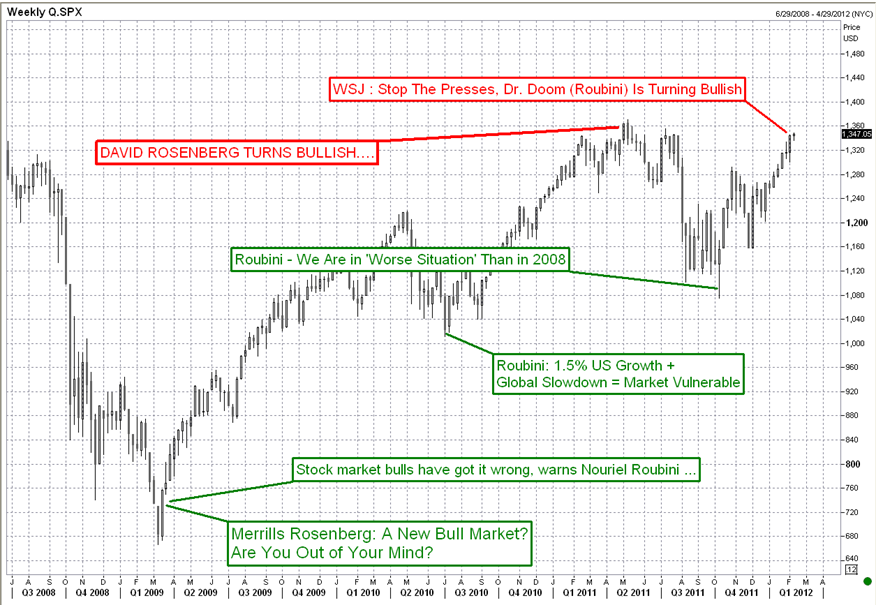
No, it's not Nouriel Roubini references that are of import in the above - entertaining as they might be - it's the likely pending reversal in the series that some techies have noticed. Hope you are not too long into the weekend...

Second chart is my own. I took a simple ratio (expressed in %) of General Government Deficit to Structural Deficit to highlight the extent of the spending related to excess over structural imbalances, in other words - to show some pro- and counter-cyclicality. Underlying data came from IMF WEO.


Some points worth noting: US has been running expansionary (in excess of structural) deficits since 2007 and these have peaked in 2009. UK started slightly later - in 2009 and will be running these through the entire forecast period. Here's an interesting thing - for all the austerity claims in the UK, ordinary deficits are expected to run above structural deficits all the way through 2016. 

10/2/2012: Few thoughts on the global policy crisis

What makes me really concerned nowdays is not the ongoing crisis, but the logical and numeric impossibility of the mounting policy "solutions' to the crisis. Here's a quick synopsis. Take a look around the world:

  • Bank of England repeated QE rounds in the face of £1 trillion+ debt pile is a strategy for growth via debasement of the currency
  • Fed's continued unrelenting QE is much the same
  • ECB has been debasing any real connection between banks, real economy and banks profits via uninterrupted injection of cash into banks - giving a license to earn free profits on interest margins while monetizing already excessive Government debts. Real economy, of course, gets hammered by sterilization via reduced real credit flows. The end game - moral hazard of massive proportions in the financial sector across Europe
  • EU itself is hell-bent on debasing real incomes and wealth of its citizens by implementing the Fiscal Compact as the sole policy tool for dealing with the crisis
  • Obama Administration is debasing, in contrast with EU, the future generations' wealth and income by continuing to spend Federal dollars like a drunken sailor arriving in a casino
  • Ireland's Government is actively debasing the entire domestic economy, oblivious to the reality that households and businesses deleveraging is being prevented by banks and Government deleveraging - all for the sake of grand posturing of "We will pay all our debts" variety
  • Japan is engaged in an active pursuit of debasing Government balancesheet as the debt bubble spreads to Japanese Government bonds - now in negative yields
  • China is debasing its monetary and fiscal policies to deliver a 'soft landing' to the massive train wreck of its vastly bubble-like property and banking sectors
Close your eyes and think - how will the world be able to reverse out of these disastrous desperate policies in years ahead without completely shutting off growth via high interest rates, destabilized savings-investment links and in the presence of ever-rising public, private and corporate debts? What levels of inflation will be required to 'inflate' out of this mess? What degree of real wealth destruction has to be imposed on the ordinary people to sustain these gambles without a structured, orderly and coordinated restructuring of debts? What asset class and geography hedge can protect you from this avalanche of disastrous policy choices by the Western leaders?

Thursday, February 9, 2012

9/2/2012: Interesting chart on Euro area deposits

Here's an interesting chart from Credit Suisse via zerohedge:


Now, it's not the blue line that worries me and the others (EAP5=Euro Area Periphery states or PIIGS). It's the massive dip in the grey line. Given there's little deleveraging of consumers and corporates in France and Germany and that there is little it terms of concerns for stability of German banks (whether or not this sense of security is justified or not), the chart suggests that deposits are flying out not just in fear of local banks risks, but in fear of the euro risks.

The link to zerohedge post is here.