Wednesday, January 21, 2009

Update: Mushroom Cloud III

Here is an updated chart...

After talking to a couple of fellow economists - both admittedly gloomier than myself - I came to a conclusion that Brian Lenihan simply must face the nation on what is holding him back from putting forward a real rescue plan for Ireland's bettered economy:
  • is it the internal opposition by the Cabinet to do anything that will potentially anger public sector trade unions, or
  • is it his own Department inability to provide logistical support for a credible and effective plan?
It is now clear, despite a recent 'consensus' amongst the Government-fed economists, that the country needs rapid and significant cuts in public spending, a tax stimulus (across income tax, VAT and payroll tax) and a round of privatizations (carried out in voucher form to transfer ownership of state enterprises to the public, improving private households' balance sheets). These must be enacted before the end of February. In the medium term, we need a dramatic reform of the stamp duty on property (moving in the direction of a land value taxation system), a long-term reform package for public services and a political reforms pack to include reduction and consolidation of local authorities, reduction of the number of TDs and the size of the Cabinet and an overhaul of our Byzantine system of Departments and Quangoes.

Given the above chart, we have no longer the luxury of time to wait for various Committees and Commissions' reports - it is time to act now!

A View From the Musroom Cloud III

As another day of carnage ensues, there are several new and old issues worth giving a thought to:

(1) Recall S&P ratings update (here): now that Irish 10-year spreads, predictably, are pushing beyond 300bps spread on German bund, what service did S&P provide to the bonds buyers who subscribed to the latest Irish issue of 5-year bonds on the back of AAA rating? The yields, as I have predicted (see here and here) on our bonds have moved in above the Greeks' leaving a wave of devastation behind in the balance sheets of those who bought into this paper on the back of S&P's ratings;

(2) Despite Mr Lenihan's assurances to the contrary on last night's Prime Time, the government is appearing to run thin on actual liquidity (in addition to running thin on any ideas). Do the maths. Mr Lenihan (who was, it must be said, trying to do his best in answering tough questions and did solicit some real compassion from this observer for being, evidently, under immense pressure both inside the Cabinet and in the wider world) stated that banks recapitalization requirements were ca €10bn in 2009.

Now, we know this figure was hammered out but the incompetent risk-pricing non-entities in the Department of Finance on the basis of the following assumptions:
(a) BofI and AIB raising some €2-3bn of their own funding,
(b) Anglo's depositors staying put (saying nothing about other banks' depositors),
(c) shares valuations for the three banks at twice above current, and
(d) no skeletons in the closets when it comes to loan books.

All four of these assumptions have now been challenged. So why is Mr Lenihan sticking to this figure? Is it because he has nothing new coming in with the morning briefing papers from our civil service mandarins?

Some commentators estimate the state exposure under recapitalization/guarantee schemes at €30bn. I would put the figure at a more modest €16-18bn. This would leave Mr Lenihan with just €2-4bn reserve to finance, in 2009 alone:
  • a 10% deficit (ca €8bn in borrowing in excess of already acquired funds);
  • a 'stimulus' package (ca €2bn);
  • state credit pumping operations (via Anglo) (ca €5bn); and
  • €5bn worth of maturing bonds...
In other words, no matter how you spin things, we are in the hole for, in the better case scenario, €16-18bn in 2009. Can the Minister really look straight into the voters eyes (as he did last night) and tell us - 'It's ok, folks, we'll just tap the credit markets for that. We have low sovereign debt'?

(3) David McWilliams brought back the specter of external rescue yesterday (here) with Ireland using a threat to leave the Euro if the ECB/EU Commission to get some funds. I am not sure this is going to be necessary. It is more likely that the Government will tap ECB/EUC for money under the argument that Ireland is yet to have a second Lisbon vote and that denying it emergency aid will be detrimental to the cause of getting us to vote Lisbon in. The funds will arrive in a combination of a straight ECB loan, acceptance of state paper as a collateral for more borrowing, some mixture of the 'knowledge' economy and capital spending investment assistance from the EUC and support for dwindling multinational employment in the likes of Limerick. Saving the face publicly, however, will not fool the debt markets and the yields will go further up.

(4) And while we are on the subject of the Euro - imagine our current Gang of Three running the monetary policy and managing our currency if we were to exit the common currency area? Close your eyes and watch Mary Coughlan trying to compute a three-party FX arbitrage parity, while Brian Cowen discusses a helicopter drop of money with Mr Hurley... Frightening!

(5) More from the bond markets - as our 10-year spreads moved above 300 bps, our short and medium term paper (6-24 months) breached 290bps last night. This suggests a temporary compression in the time structure of the bonds, implying that our 5 year yields will be climbing up and up and up in days to come.

(6) On the positive side, we have the latest comprehensive Government programme for dealing with this crisis (hat tip to Brian, courtesy of the source) in line with our closest competitor for being the worst performing economy in Europe, Latvia (here):

Monday, January 19, 2009

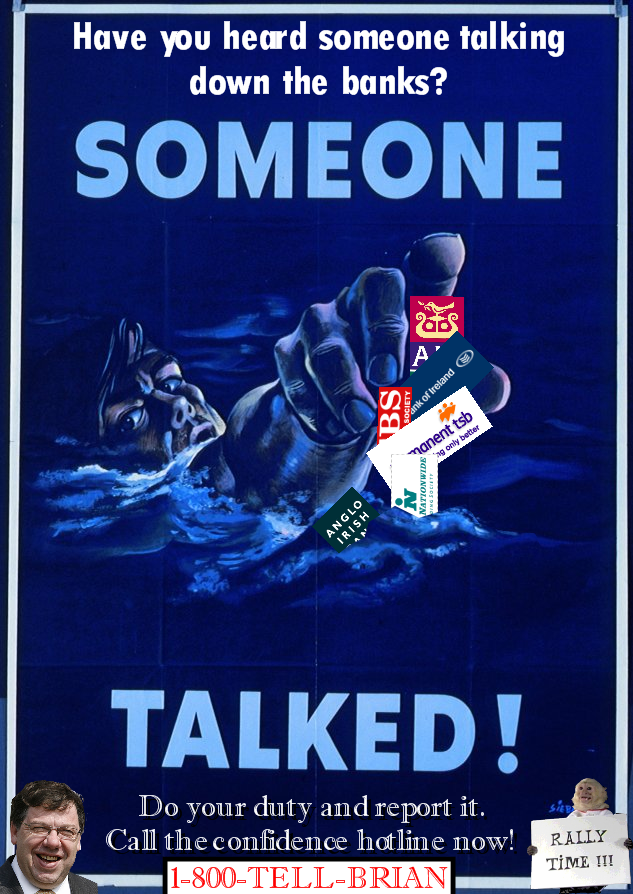
Talking up our economy

Today, Brian Cowen has issued a Bertiesque warning to commentators 'talking down Irish economy'. I beg to disagree. Firstly, the problem Ireland is facing is not that some commentators want to uncover the truth, but that our Government is failing to listen to anyone, save for a handful of public sector mandarins and political appointees. Secondly, lest anyone accuses myself of scaremongering, I remind our Taoiseach and his Cabinet that I have publicly put forward a constructive proposal for dealing with the current crisis as far back as in August 2008.

Here are few details:

In August 2008 edition of Business&Finance magazine, I predicted that Ireland will continue its downward trajectory in terms of stock market valuations and economic performance unless the Government were to tackle the issue of public sector overspend and consumer debt. In early October, from the same platform, I re-iterated a call for the Government to get serious with the problem of rising household insolvencies and corporate debt burden. At that time, I provided an outline of a basic plan that I hereby reproduce (some of the modifications to the original plan were featured in my article in Business&Finance in November).

Here is a bold, but a realistic proposal for moving the Government beyond its current position of playing catch up with deteriorating fundamentals. The Exchequer should:
  • Announce a 10% reduction across the entire budget and an up to 60% cut on the discretionary non-capital spending under the NDP, generating ca €12-15bn in savings. The cut should include a 100% suspension of all overseas assistance until the time the economy returns to its long-term growth path of ca 2.5-3%.
  • Cut, permanently, 10% of the public sector employment (effecting back office staff alone), saving ca €1bnpa after the costs of the measure are factored in.
  • Freeze pensions indexation in the public sector for 2008-2015 and make mandatory a 50% contribution to all pensions plans written in the public sector, generating ca €1-2bn in savings.
  • Stop the unfunded contributions to the NPRF, saving some €1.5bn per annum.

Combining all the savings, the Government should be able to :
  • Bring 2009-2010 deficits to within the Eurozone limits; and
  • Supply temporary tax refunds of ca €5,000pa per household in 2009-2010 ring-fenced for pensions plans and mortgages funding only.
The resulting capital injection of ca €7.5bn pa will be able to:
  1. de-leverage the households (amounting, by the end of 2010 to a ca 25% reduction in the total households’ debt), improving consumer sentiment and re-starting housing markets;
  2. help recapitalize the banks and improve their loans to capital ratios more efficiently than a debt buy-back, a nationalization, a direct injection of capital from the Exchequer or a debt guarantee.
It will result in a sizeable (ca 5% of the entire economy) annual stimulus, without triggering inflationary pressures associated with the Santa-like Government subsidies or consumption incentives.

This proposal implies no burden on the future generations, as the entire stimulus will be paid from the existent fiscal overhang and the set-aside public funds, with the public pensions covered by the contributory schemes.

Lastly, to achieve a morally justifiable and economically stimulative recapitalization of the banks, the plan would require Irish institutions receiving any additional public financing to issue call options on ordinary shares with a strike price set at the date of the deposit and maturity of 5 years. These shares should be distributed to all Irish households on the flat-rate basis.

Thus, assuming the need for additional capital injections of €6-9bn in the Irish financial institutions through 2010 (over and above the €7.5bn pa injected through mortgages repayments and pensions re-capitalizations), Irish households will be in the possession of options with a face value of €4,000-6,000 per household, thus increasing their financial reserves. At the time of maturity, assuming options are in the money, the Exchequer will avail of a special 50% rate of CGT on these particular instruments. Assuming that share prices appreciation of 40% between 2009 and 2014, the CGT returns to the Exchequer will yield ca €1.8bn, ex dividend payments.

Mushroom Cloud II

No words needed... (Hat tip to an anonymous reader pointing to July 9 event)

Watching a mushroom-shaped cloud rising

Sadly, my quick prediction last night has turned into a reality - bleaker than I could have anticipated. As, at the time of writing, FTSE EUROTOP100 index is trading in the green territory, ISEQ-FINANCIAL is over 34% in the red, with AIB down 41.5%, and BofI and IL&P both down 27%.

We are now safe to assume that the Anglo Irish Bank, taken over by the state last week, was on the verge of becoming a moneyless institution. That despite the tough talk from Mr Lenihan about freezing some deposits, all sizeable corporate deposits have now left the bank's vaults. That the Exchequer downside from the bank 'rescue' is going to be in excess of €10bn, prompting his yesterday's remark that the other banks are now effectively on their own, and in effect admitting that the Exchequer itself may be now out of money, if commitments to date were to be honoured!

All of this has not been lost to international investors, who are currently dumping anything they might still have in the form of Irish banks shares. The surprising thing for now is that Irish bonds yields appear to be holding.

The question, however, is: for how long. If the Black Monday is not reversed, and unless the Government comes out in public with the actually believable statement on its current financial position (including a detailed and credible forecast as to how it plans to manage its exponentially increasing commitments for 2009), Irish yields will rise and prices will fall.

Whatever you do, I would think thrice before switching into Irish bonds... they are far from being a safe harbour...

Will mayhem begin?

This is an unusual post for this blog - short and an attempt to 'call' the market - but given the comments, reportedly, given on RTE today by Mr Lenihan, I would venture to attempt to predict this week's start of trading (6 hours 30 min from now). With the Government once again faltering at the banks recapitalization policy and talking gibberish (with RTE reporting that "Brian Lenihan said each bank had to take responsibility for its own bad debts"), it is difficult to see how we can avoid another deep meltdown in the markets. I hope I am wrong, but today might be the first Black Monday of 2009... Stay safe, ye all who trade today!