Tuesday, April 23, 2019

23/4/19: Income per Capita and Middle Class


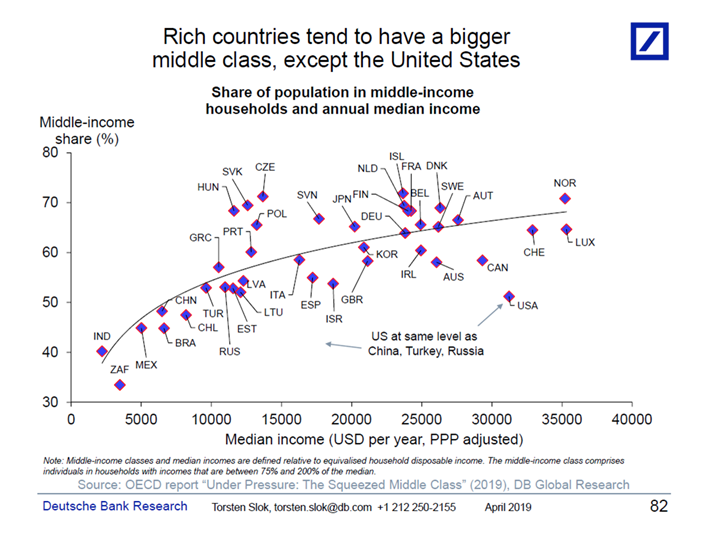
New research reported by the Deutsche Bank Research shows that, on average, there is a positive (albeit non-linear) relationship between the per capita income and the share of middle class in total population:
Source: https://pbs.twimg.com/media/D42GiWNXkAMpID2.png:large

There is an exception, however, although DB's data does not test formally for it being an outlier, and that exception is the U.S. Note, ignore daft comparative reported in chart, referencing 'levels' in the U.S. compared to Russia, Turkey and China: all three countries are much closer to the regression line than the U.S., which makes them 'normal', once the levels of income per capita are controlled for. In other words, it is the distance to the regression line that matters.

Another interesting aspect of the chart is the cluster of countries that appear to be statistically indistinguishable from Russia, aka Latvia, Estonia and Lithuania. All three are commonly presented as more viable success stories for economic development, contrasting, in popular media coverage, the 'underperforming' Russia. And yet, only Latvia (completely counter-intuitively to its relative standing to Estonia and Lithuania in popular perceptions) appears to be somewhat (weakly) better off than Russia in income per capita terms. None of the Baltic states compare favourably to Russia in size of the middle class (Latvia - statistically indifferent, Lithuania and Estonia - somewhat less favourably than Russia).

23/4/19: Property, Property and More Property: U.S. Household Wealth Bubble


According to the St. Luis Fed, U.S. household wealth has reached a historical high of 535% of the U.S. GDP (see: https://www.zerohedge.com/news/2019-04-16/where-inflation-hiding-asset-prices).


There is a problem, however, with the above data: it reflects some dodgy ways of counting 'household wealth'. For two primary reasons: firstly, it ignores concentration risk arising from wealth inequality, and secondly, it ignores concentration risk arising from households' exposure to property markets. A good measure of liquidity risk controlled allocation of wealth is ownership of liquid equities (note: equities, of course, and are subject to Fed-funded bubble dynamics). The chart below - via https://www.topdowncharts.com/single-post/2019/04/22/Weekly-SP-500-ChartStorm---21-April-2019 shows a pretty dire state of equity markets (the source of returns on asset demand side being swamped over the last decade by shares buybacks and M&As), but it also shows that households did not benefit materially from the equities bubble.


In other words, controlling for liquidity risk, the Fed's meme of historically high household wealth is seriously challenged. And controlling for wealth inequality (distributional features of wealth), it is probably dubious overall.

So here's the chart showing just how absurdly property-dependent (households' home equity valuations in red line, index starting at 100 at the end of the Global Financial Crisis) the Fed 'wealth' figures (blue line, same starting index) are:


In fact, dynamically, rates of growth in household home equity have been far in excess of the rates of growth in other assets since 2012.  In that, the dynamics of the current 'sound economy' are identical (and actually more dramatic) to the 2000-2006 bubble: property, property and more property.

Monday, April 22, 2019

22/4/19: At the end of QE line... there is nothing but QE left...


Monetary policy 'normalization' is over, folks. The idea that the Central Banks can end - cautiously or not - the spread of negative or ultra-low (near-zero) interest rates is about as balmy as the idea that the said negative or near-zero rates do anything materially distinct from simply inflating the assets bubbles.

Behold the numbers: the stock of negative yielding Government bonds traded in the markets is now in excess of USD10 trillion, once again, for the first time since September 2017


Over the last three months, the number of European economies with negative Government yields out to 2 years maturity has ranged between 15 and 16:


More than 20 percent of total outstanding Sovereign debt traded on the global Government bond markets is now yielding less than zero.

I have covered the signals that are being sent to us by the bond markets in my most recent column at the Cayman Financial Review (https://www.caymanfinancialreview.com/2019/02/04/leveraging-up-the-global-economy/).

Monday, April 15, 2019

15/4/19: One order of "Bull & Sh*t" for the U.S. Labor Market, please


The 'strongest economy, ever'...


Despite a decade-long experiment with record-low interest rates, despite trillions of dollars in deficit financing, and despite headline unemployment numbers staying at/near record lows, the U.S. economy is not in a rude health. In fact, by two key metrics of the labor force conditions, it is not even in a decent health.

As the chart above clearly shows, both in terms of period averages and in terms of current level readings, Employment to Population Ratio (for civilian population) has remained at abysmally low levels, comparable only to the readings attained back in 1986. Meanwhile, labor force participation rate is trending at the levels consistent with those observed in 1978.

Dire stuff.

Update: Here is a chart showing how the current recovery compares to past recoveries (hint: poorly):


Wednesday, April 10, 2019

10/4/19: Rewarding Reckless Risk Pricing, Again


Markets are supposed to be efficient. At least, on the timeline that allows to price in probabilistically plausible valuations of the firms. Markets failed to be efficient at the time of the dot.com bubble. And, it appears, they are back at the same game:


As the chart above shows, share of IPOs issued at negative earnings (companies losing money) is now at the levels last seen during the height of the dot.com bubble. What can possibly go wrong?

10/4/19: Russian Foreign Exchange Reserves and External Debt


As recently posted by me on Twitter, here are three charts showing the evolution of Russian foreign reserves and external debt:

Remember the incessant meme in the Western media about Russia eminently in danger of running out of sovereign wealth funds back at the start of the Western sanctions in late 2014? Well, the chart above puts that to rest. It turns out, Russia did not run out of the reserves, and instead quite prudentially used funds available to carefully support some economic adjustments (especially in agriculture and food sector), while simultaneously balancing out its fiscal deficits.

Do note that the reserves above exclude over USD 91 billion worth of Gold that Russia holds and continues to buy at rising clips.

The result of the prudentially balanced management of the reserves and the economy was deleveraging out of debt (a lot of this was done via restructuring of intracompany loans and affiliated enterprises refinancing), with a reduction in the external debt (chart below), without use of sovereign funds:


As of current, Russian foreign exchange reserves ex-gold are more than sufficient to cover the entirety of the country public and private sectors external debts.

If the above chart is not dramatic enough, here is a contrasting experience over the same years for the U.S. economy:


Nothing that CNN and the rest of the Western media pack ever managed to capture.

10/4/19: How US Tax Inversions Affect Shareholder Wealth


Our article on how corporate tax inversions impact shareholders' wealth is now available on Columbia Law School blog: http://clsbluesky.law.columbia.edu/2019/04/10/how-u-s-tax-inversions-affect-shareholder-wealth/.


Saturday, April 6, 2019

6/4/19: Industrial Production and Global Trade are Tanking


The great convergence of simultaneously declining global trade flows and industrial production:

Via topdowncharts.com

The trend is also evident from the global manufacturing and composite PMIs (see https://trueeconomics.blogspot.com/2019/04/4419-bric-manufacturing-pmis-for-1q.html and https://trueeconomics.blogspot.com/2019/04/6419-bric-services-lead-manufacturing.html).

Note the range bounds for two periods (pr-GFC and post-GFC) in the first chart above.

6/4/19: Student Loans: The Bubble Is Still Inflating


A neat chart from Bloomberg summarizing the plight of student debt overhang in the U.S. economy:


In effect, education is the most leveraged, over the recent cycle, form of household investment out there. Second to it, is only investment in health. Via https://www.healthsystemtracker.org/chart-collection/u-s-spending-healthcare-changed-time/#item-total-health-expenditures-have-increased-substantially-over-the-past-several-decades_2017:


6/4/19: BRIC Services Lead, Manufacturing Lag Global Growth Momentum


I have blogged recently on BRIC and global PMIs for manufacturing and services, covering the data for 1Q 2019, as well as monthly PMIs for BRIC economies. Here are the 1Q 2019 PMIs for composite economic activity across the same:


In 1Q 2019, only Brazil posted improving Composite PMI reading, with the rest of BRIC economies showing deteriorating growth conditions, in line with continued drop in Global Composite PMI. Over the last 5 quarters, Global Composite PMI has dropped from its peak of 54.23 in 1Q 2018 to 52.5 in 1Q 2019, with current reading at its lowest in 10 quarters.

Of all BRIC economies, India and Russia are outperforming the Global Composite PMI, with Russia posting the fastest growth at 54.1 of all BRIC economies in 1Q 2019. Brazil is statistically in line with Global Composite PMI, while China is a clear under-performer.

Sectorally, the main weakness amongst the BRICs is in Manufacturing, with Services outperforming Global Composite index:

6/4/19: U.S. Tax Compliance Costs and Lobbying


Not a fan of The Atlantic on a range of topics, especially geo-politics, but a great write up on the relationship between tax accounting industry, lobbying and U.S. tax codes (painfully and daftly complex) here: https://www.theatlantic.com/ideas/archive/2019/04/american-tax-returns-dont-need-be-painful/586369/. Worth a read:


Of course, the solution is to make tax filing for ordinary income taxes simple, and to make tax codes more streamlined. A flat tax would work. Charged across all income at one rate. Or a flatter tax, with a schedule of just two or three bands, applying, again, across all income.

Friday, April 5, 2019

5/4/19: Does Government Debt Matter? The Reality of Fiscal Multipliers


There has always been a lot of debate in economics about the effects of debt (especially sovereign debt) on growth and fiscal dynamics. And, despite numerous papers on the subject, the debate is far from settled.

Here is an interesting new study that looks at the effect high levels of government indebtedness have on the effectiveness of fiscal policy stimulus. The reason this topic is important is simple: fiscal policy can and is used to offset or smooth out recessionary shocks. The extent to which fiscal policy is effective in doing so (the impact expansionary fiscal policy may have on unemployment and output) can be varied across different economies and under different crises conditions. But, does this extent vary under different debt conditions?

In theory, the debt levels carried by a given sovereign can impact the size of fiscal multipliers (the effectiveness of fiscal policy) through two main channels:

  1. The so-called Ricardian channel: a government with a weak fiscal position (high debt) deploying fiscal stimulus (an increase in public spending) can cause households to expect future tax increases. The result is that in economies with high public debt levels, deploying fiscal stimulus can trigger increased savings by households, reducing consumption, and lowering the size of fiscal policy multiplier.
  2. An interest rate channel: when the government debt is high, so that the government fiscal position is weak, fiscal stimulus can increase concerns about sovereign credit risk amongst government bond holders and buyers. This can increase bond yields, raise borrowing costs, lower liquidity of bonds for the sovereign, but also increase cost of capital across the private sector. The result is the crowding out effect, whereby public spending crowds out private investment and credit-finance consumption.

In theory, both channels imply that fiscal policy is less effective when fiscal stimulus is implemented from a weak initial fiscal position (position of high starting government debt levels).

A new World Bank paper, authored by Huidrom, Raju and Kose, M. Ayhan and Lim, Jamus Jerome and Ohnsorge, Franziska, and titled "Why Do Fiscal Multipliers Depend on Fiscal Positions?" (March 2019, World Bank Policy Research Working Paper No. 8784: https://ssrn.com/abstract=3360142) considers the two theoretical channels operating simultaneously. Using data for 34 countries (19 advanced economies and 15 developing economies),  over 1Q 1980 through 1Q 2014, the authors show that "the fiscal position helps determine the size of the fiscal multipliers: estimated multipliers are systematically smaller when the fiscal position is weak (i.e. government debt is high).


Looking at the longer run panel in the chart above, fiscal multipliers rapidly reach into negative territory as Government debt rises to around 37-40 percent of GDP. Over a medium term horizon, of 2 years, multipliers hit negative values for debt levels above 75 percent of GDP.

Similar dynamics are confirmed in the chart below:


The authors subsequently "show that when a government with weak public finances conducts expansionary fiscal policy, the private sector scales back on consumption in anticipation of future tax pressures (Ricardian channel) and risk premia rise on mounting concerns about sovereign risk (interest rate channel)." In other words, high starting debt position does trigger both theoretical effects to reinforce each other.

This is an unpleasant arithmetic for uber-Keynesians who hold that fiscal policy is always effective in stimulating economic growth during periods of economic crises. The findings also support the view that the 'fiscal policy space' is indeed bounded by the reality of pre-crisis fiscal policy paths: there is no free lunch when it comes even to sovereign financing.