Tuesday, May 29, 2012

29/5/2012: Fiscal Compact - one very interesting view

I rarely post articles by others on this site, usually preferring links, alas the following article is not available on the web. Its full attribution goes to the Irish Daily Mail (Monday 28, 2012 edition) and it is written by one of the best - if not the best - commentators in the paper both sides of the pond - Mary Ellen Synon.

It is a must-read to understand the context of the Referendum, because it places our vote into the broader and more real context than any domestic debate we might have on merits or failings of the Treaty.

Please note, I am not advocating you follow Mary Ellen's conclusion on the vote - as you know, I am not advocating in favour of any direction of the vote. Make your own choice. I am posting this because I think that many risks highlighted in the article are real.

To be fair to the 'Yes' side, if any of you, readers, spot an excellent article on that side of the argument, I will be delighted to post it. So far, I have not come across one, but that might be due to the omission, rather than lack thereof. (see update below)

Thus, judge for yourselves:


Update: I remembered - the best argument for 'Yes' side I ever read is from another economist, one whose opinion I respect and who has provided many clarifications during this debate to my own occasionally erroneous positions - Professor Karl Whelan. Here's the link and here are his full remarks on the Treaty - certainly worth reading.


Sunday, May 27, 2012

27/05/2012: RPPI for April 2012: Implications for Nama

In the previous post I looked at the potential changes in the trends relating the RPPI and its components. Now - a quick update, as usual on implications of April Residential Property Price Index on Nama valuations.

Please keep in mind two things: 1) this relates only to residential property and is not fully reflective of the entire Nama portfolio, as both selection effects and portfolio composition effects would introduce significant differential for Nama actual losses, 2) LTEV and burden sharing assumptions apply in terms of averages, not specific to each type of property covered here. In other words, these numbers are simply comparative approximations and not exact forecasts of Nama losses.

  • Overall residential property price index has posted a decline of 49.89% on peak in April 2012. This corresponds to a decline of 36.7% on Nama LTEV valuations and 33.67% decline on Nama valuations inclusive of LTEV and net of burden sharing.
  • Recall that Nama first called 'the bottom' for property markets to occur at the end of Q1 2010. Alas, since then property prices have fallen - on aggregate - 27.09%.
  • Nama holds some houses. These are now down 48.41% on peak and 36.31% down on Nama cut-off valuation date, implying a decline of 33.27% on Nama valuations inclusive of LTEV and burden-sharing.
  • Nama holds loads of apartments, which are down 59.07% on peak and 41.13% down on Nama cut-off valuation date, implying that these are down 38.33% on Nama valuations inclusive of LTEV and burden-sharing.
Some pretty big figures out there.

27/05/2012: Residential Property Prices: April 2012

Much has been made in the media on the foot of the latest (April 2012) data for residential property prices in Ireland.

In light of this, let's do some quick analysis of the data. The core conclusions, in my opinion are:

  1. Data from CSO - the best we have - only covers mortgages drawdowns reflecting actual sales. So this is tied to mortgages issuance activity and is of limited use in the markets where cash sales are significant.
  2. If increases in prices are sustained, mortgages drawdowns might be reflective of improved credit flows or credit flows fluctuating along the bottom trend.
  3. The above two points strongly suggest that we need to see more sustained trend to draw any conclusions on alleged 'stabilization' of the market.
  4. Aside from seasonality, the data shows patterns of false bull-runs or 'stabilization' episodes in the trends that usually were followed by downward acceleration on the pre-stabilization trend. Not surprisingly, the core improvements in March-April 2012 are in exactly the segments of the markets where such false starts have been more pronounced in the past.
So caution is warranted. 

Top stats:
  • Residential property price index has fallen from 66.1 in February and March 2012 to 65.4 in April implying m/m change in overall prices of -1.06% - the shallowest monthly decline since July 2011, other than zero change in m/m prices recorded in March 2012. 
  • This m/m pattern of slower decline (to near zero rate of fall) from a steep previous drop, followed by re-acceleration in decline is something that is traceable to October 2010-January 2011, June-August 2011, July-September 2010, February-April 2010, October-December 2009, so caution is warranted in interpreting short-term 'stabilization' episodes.
  • Y/y index fell 16.37% in April, an acceleration on March 2012 y/y decline of 16.32%, but a very slight one. Current y/y decline is the second shallowest since November 2011, so no signs of stabilization here either. In fact, April 2012 y/y rate of decline was the 5th sharpest for any month since January 2010.
  • Index reading continues underperforming its 3mo MA which currently stands at 65.87.
  • Relative to peak, the index is now down 49.89%.
  • Thus, overall, by both, its absolute level, and its 3mo MA, as well as relative to peak, the index is at its new historic low. Stabilization is not happening anywhere at the levels terms.


Chart below shows sub-indices performance for houses and apartments. While it is clear that houses sub-index is the driver of overall prices, the apartments sub-index received much of attention in recent months. The reason for it is two consecutive months of increases in apartments prices. Details are below:


  • Overall, House prices fell in April 2012 to index reading of 68.1 from 68.9 in March, registering a m/m drop of 1.16%. This represents an acceleration from -0.14% m/m decline in March 2012. However, April m/m drop is the shallowest since July 2011. 
  • Despite the above, bot the index and the 3mo MA have again hit their lowest point in history of the series.
  • Y/y house prices are down 16.24% and this is the fastest y/y decline since November 2011. 
  • Relative to peak house prices are now down 48.41%.
  • Apartments prices index has improved from 48.6 in March 2012 to 49.6% in April 2012 (m/m rise of 2.06% following a 0.41% rise in March 2012).
  • However, m/m rises are not rare for the sub-index. Apartments prices subindex rose - in m/m terms - in November 2011 (+2.68%), December 2010 (+0.31%), December 2007 (+0.50%) and posted falt or near-flat (1/4 STDEV from zero reading) in February 2008, January 2011, May 2011, and December 2011. 
  • 3mo MA is now at 48.87% and this is the lowest on the record 3mo MA reading for the sub-index.
  • Y/y the decline in April was 17.88% while March 2012 y/y decline was 20.33%. This is the lowest y/y decline reading since January 2012. However, back in April 2011, y/y decline was 'only' 15.29% - shallower than in April 2012.
  • Relative to peak apartments prices are now down 59.97%.

Conclusion: any talk about 'price trends improvement' in apartments will have to wait for further confirmation of the upward trend.

Chart below shows trends for prices in Dublin - another focal point of attention for those claiming substantive change in property prices trends.


  • Dublin property prices sub-index has improved from 58.0 in march 2012 to 58.3 in April 2012, reaching exactly the same level as in January 2012. Thus, m/m index rose 0.52% which is slower than March 2012 m/m rise of 0.69%. Last time the sub-index posted non-negative m/m change was in July 2011 when it remained unchanged m/m and last time sub-index actually posted positive growth was in May 2011.
  • To see two consecutive monthly rises in the index, however, is rare. We would have to go to January-February 2007 for that. However, index posted a number 'near trend reversals' in the past marked on the chart. All turned out to be false calls and virtually all led to re-acceleration of the downward momentum compared to pre-event.
  • Y/y sub-index posted a decline of 17.30% against 18.31% in March 2012. In April 2011 y/y change was 12.96% - much shallower than current y/y decline.
  • 3mo MA is unchanged in April 2012 at 57.97 compared to March 2012, and is much lower than 71.27 registered in April 2011.
  • Relative to peak, house prices in Dublin are now 56.65% down which is identical to their position in January 2012.

Overall, all data points to potential stabilization that is in a very nascent state. However, this is certainly a local phenomena for now - with Apartments and Dublin properties showing some potential signs of improvement. Only the future can tell if:
  1. we are witnessing actual flattening of the trend, and/or
  2. we are witnessing a reversal of downward trend toward a positive (sustained) trend.

Friday, May 25, 2012

25/5/2012: Why I don't like Eurobonds


Three reasons I don't like the idea of the Eurobonds:


  1. Issuing Eurobonds to swap for existent Government debt is equivalent to attempting to treat debt overhang by relabeling the debt. While it might reduce the interest burden on the sovereigns suffering from more severe debt overhang, but that is a relatively shallow improvement, especially given that the heavier-indebted sovereigns are already being financed or about to be financed from a collective funding source of ESM.
  2. Issuing Eurobonds to create capacity for new borrowing is equivalent to fighting debt overhang with more debt. In addition to being seriously problematic in terms of logic, there is also a capacity constraint. Eurozone will sport 89.964% debt/GDP ratio this year and under current IMF projections this debt will remain above 90% (+/-1%) bound for 2012-2015. At these levels, debt exerts long term drag on future growth potential for the Euro area as a whole. And this region doesn't have much of cushion in terms of growth rates to sustain such drag.
  3. Issuing Eurobonds to generally drive down or harmonize the borrowing costs across the EA will simply replicate the very same conditions of cheap credit misaligned with relative sovereign risks that have been instrumental in creating the current crisis during the loose monetary policy pursued by the ECB. Except with a major difference this time around - loose credit costs will only apply to one side of the economy, namely the Public Sector. This is double troubling, because, in my view, it is the nature of the European disease that our policymakers are incapable of thinking about growth outside that supported by subsidies and neo-protectionism vis public expenditure. 
For these three reasons (not to mention lack of political infrastructure and the fact that once borrowing costs come down the sovereigns will simply engage in diverting 'savings' achieved to priming the public spending pump once again, setting their economies up for the scenario of lax structural reforms and raising the risk of increasing the strength of automatic fiscal destabilizers in the future cyclical downturns) I do not think Eurobonds represent a correct approach to dealing with this crisis.

Nor do I think it is reasonable to label Eurobond issuance a 'burden-sharing', unless Eurobonds are raised by a fully federal power presiding over the entire Euro Area - a power that is hard to imagine emerging for a number of reasons, including that Euro area is only a subset of a broader EU27 block.

I am with the Germans on this one - Eurobonds are a dangerous illusion of a solution.


Update: an interesting side-proposal is contained here. And a polar opposite to that - the senile ideas of one ex-ECB chief here.

25/5/2012: Mortgages in Arrears: Q1 2012

Latest mortgages arrears data from the CB of Ireland came in with a slight surprise that most of the media should have anticipated. During the launch of the annual report, the CBofI has pre-leaked some of the top-level figures for arrears, with media reports of 10.5% (or ca 80,000) of mortgages in arrears expected in Q1 2012 figures. Of course, given the usual tactic of first exaggerating, then underwhelming (presumably there's some psychological strategy working its magic somewhere here), it should have been expected that actual numbers - bad as they may be otherwise - will 'surprise' to the positive side relative to the leak-related expectations. It might have worked.

Alas, the end numbers - whether or not they are better than leaked out 'estimates' - are pretty dismal.

In Q1 2012, there were 764,138 mortgages outstanding amounting to €112,688.5 million. The latter number is €789 million down on Q4 2011 and€3.27 billion lower than Q1 2011 figure. So in 12 months, with foreclosures and restructuring factored in, Irish mortgagees were able to pay down just 2.82% of the mortgages outstanding. This is not exactly a massive rate of de-leveraging for heavily indebted households.

Of these, 77,630 mortgages were in arrears over 90 days (up 9.4% qoq and 56.5% yoy), with total outstanding amounts of €15,386 million (up 10% qoq and 60.3% yoy). Previous quarter-on-quarter increases were, respectively, 12.7% and 13.1%.

Repossessions in Q1 2012 stood at 961 up from 896 in Q4 2011.

Restructured mortgages:

  • At the end of Q1 2012, there were 38,658 mortgages restructured, but not in arreas, up 5.06% qoq (against previous qoq rise of 1.16%) and up 5.44% yoy.
  • In addition, there were 41.054 restructured mortgages that were in arrears, up 9.23% qoq against previous quarterly rise of 12.67%, and up 56.25% yoy.
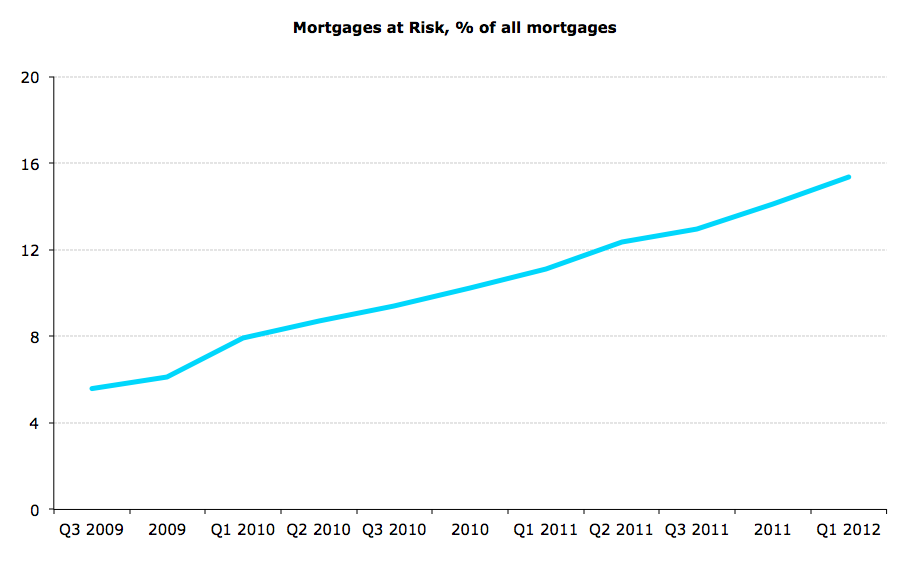
Overall, defining at risk or defaulted mortgages as those mortgages that are currently in arrears (including restructured and in arrears), plus restructured but not in arrears mortgages and repossessions:
  • At the end of Q1 2012 there were 117,249 at risk or defaulted mortgages, constituting 15.34% of all mortgages outstanding and amounting to €21.72 billion, or 19.27% of total volume of mortgages outstanding.
  • Number of mortgages at risk or defaulted has increased 7.93% qoq in Q1 2012 as compared to a rise of 8.39% qoq in Q4 2011. Annual rise in Q1 2012 was 34.83%.
  • Volume of mortgages at risk or defaulted has increased 8.09% qoq in Q1 2012 as compared to a rise of 9.8% qoq in Q4 2011, and there was an annual increase of 37.67%.
  • In Q4 2011, mortgages that are at risk or defaulted constituted 14.13% of the total number of mortgages, while in Q1 2011 the proportion was 11.11%, and this rose to 15.34% in Q1 2012.
CHARTS:


Note: more on this next week.

Monday, May 21, 2012

21/5/2012: Quick note on US Markets' Crash Indices

The risk-off thingy is starting to bite - with a few frantic calls over the weekend from across the Atlantic. People are shifting strategies like feet in Swan Lake's pas de deux. Here's an nice set of charts that shows we are in a precarious starting point to the risk-off market indeed.

The Yale University Crash Index - latest data takes us only through April, shows that the base off which we have entered May markets is already loaded with high risk:


April 2012 Institutional Index came in at 26.94 reading, which compares unfavorably to historical average of 36.86 and to crisis period average of 31.27. Jittery markets mean that 2011-present average is 29.88 - worse than crisis period average and that April 2012 was even worse than that. Meanwhile, individual investors index showed usual lags, with lower pessimism in April at 28.47, which is a better reading than 26.57 for crisis period average and better than 24.76 for 2011-present average. Still, individual investors are more risk conscious than historical average of 33.70.

One interesting bit - disregarding the issue of lags, historical correlation between two indices is 0.76 while crisis period correlation is 0.82, which suggests that May reading should come down like a hammer for individual investors. The same is confirmed by looking at changes in indices volatility. Standard errors for Institutional investors responses have compressed from historical 3.82 average to crisis period 2.99 average to 2.85 average for the period since January 2011. Similarly, for individual investors, historical average standard error is 3.36, declining to 2.731 for crisis period and 2.724 average since January 2011.

Note that per charts above, since the beginning of the crisis in mid-2007 (data shows clear break in data at June 2007), Individual investors index has been flat trending (volatile along trend), while Institutional investors index has been trending down (with loads of volatility, too).