Monday, November 19, 2012

19/11/2012: Links on Irish Corporate Tax Haven


Due to page loading restriction on post links, I am moving this list to a new location.

Here is the original page with a number of links on the topic of Ireland as a Corporate Tax Haven. And here's a link to the Irish Government 'defense' of the same.

Updated 19/11/2012: And a new article on US Multinationals facing tax demands / pressures in Europe with explicit referencing of Ireland: http://www.nytimes.com/2012/11/19/technology/19iht-tax19.html

Updated 20/11/2012: No country named, but you know who they are talking about here: http://www.ft.com/intl/cms/s/0/798f30d2-3242-11e2-916a-00144feabdc0.html#axzz2CaviTlTt

Updated 9/12/2012: And more on Google using Ireland as a conduit for tax minimization: http://www.independent.ie/business/irish/google-pays-just-014-tax-in-seven-years-3319796.html
The core problem highlighted here is not the headline 0.14% tax rate, but €47 billion worth of revenues booked via Ireland - an exemplification of Ireland's beggar-thy-neighbor economic policies.

Updated 20/12/2012: Here's The Economist article on Starbucks UK case, mentioning Google use of Irish tax system: http://www.economist.com/news/business/21568432-starbuckss-tax-troubles-are-sign-things-come-multinationals-wake-up-and-smell?fsrc=scn/tw/te/tr/wakeupandsmellthecoffee

Sunday, November 18, 2012

18/11/2012: Housing equity and retirement dis-savings


A new paper "Home Equity in Retirement" by Makoto Nakajima and Irina A. Telyukova (September 20, 2012) looks at the effects of homeownership on savings/dissaving by retirees, using the US data for 1996-2006.


Using an estimated structural model of saving and housing decisions, the study finds that "homeowners dissave slowly because they prefer to stay in their house as long as possible, but cannot easily borrow against it. Second, the 1996-2006 housing boom significantly increased homeowners' assets. These channels are quantitatively significant; without considering homeownership, retirees' savings are 24-43% lower."

Some more details:

Figure 1 shows over the period 1996-2006, median net wealth remains high very late into the life cycle. The observation that many people die with significant savings, which is puzzling in the context of a simple life-cycle model, has been termed the \retirement saving puzzle. However, the picture changes dramatically if we consider the saving behavior of retirees who
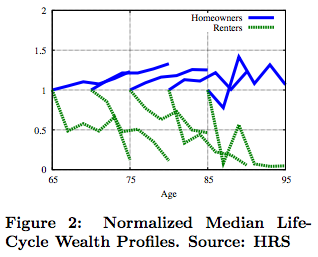
own homes, compared to those who do not. Consider figure 2, which documents the cohort profiles of median net worth over the same period, normalized by the first observation, for homeowners versus renters.


The difference is stark. Homeowners have flat or increasing profiles of net wealth over this period, while renters display a far faster rate of asset decumulation. This suggests that housing may play a major role in determining how retirees save or dissave."

Overall, the paper finds that:
  • "…high homeownership rate late into the life-cycle that we observe in the data is crucial to consider for understanding retiree saving behavior."
  • "Housing-related channels are significant contributors to the retirement saving puzzle. Retirees stay homeowners late in life, but become increasingly locked into their home equity as they age; 
  • "...we find that borrowing constraints on retirees tighten considerably. This means, on the one hand, that those who remain homeowners do not decumulate their home equity, thus creating the kind of flat housing profile that we see in the data, while those who face a large expense may come up against their borrowing constraint and be forced to sell the house. 
  • "We also use the model to understand why people retirees choose to remain homeowners late in life. We find that the leading motivators are utility benefits of owning a house (which capture also financial benefits, such as tax advantages) and bequest motives. 
  • "In contrast, precautionary motives in the face of medical expense risk do not a effect homeownership significantly, but play a role in the puzzle through financial asset accumulation, although overall this role is quantitatively modest and affects younger retirees more than older ones. 
  • "Quantitatively, we find that the housing channels {utility benefits of ownership, collateral constraints, and the housing boom} jointly account for between 24 and 43% of the median net worth profile, depending on age.
  • "The bequest motive accounts for up to 31% of the median net worth profile, and its importance increases with age. 
  • "Medical expense risk accounts for maximum 8% of median net worth, and its importance generally falls with age, due to interaction with Medicaid.
  • "..we conduct an experiment where we allow households to make a decision on whether or not to maintain their home. We want to evaluate this as an additional, possibly hidden, channel of asset decumulation, consistent with data evidence that homes of elderly owners depreciate more quickly than those of younger owners. We treat this as a hidden channel because we assume that self-reported housing values of owners who remain in their houses do not take into account the depreciation rate unless they have the house appraised for sale, for example. We find this to be a significant channel of asset decumulation. 30% of our model homeowners choose not to maintain their homes in the 75-85 year old cohort; for the younger cohort, that proportion is over 50%, while it is lower for the oldest cohort. We show that this channel affects median housing asset profiles as well."

All of this has huge implications for countries like Spain and Ireland that have undergone a massive property prices bust. Declines in property prices have wealth effects, negative equity has wealth effects. Both, however, have also direct behavioural effects that are also adverse, as outlined above. In my view, we have not even started to count the real costs of the property busts in our fiscal and economic forecasts.

18/11/2012: Innovation, Professionalization of Risk, Stagnation?


The recurrent theme in forward thinking nowdays is the decline of technological 'revolutions' cycle. I wrote about this on foot of earlier research (here) and in recent weeks there has been another - most excellent - article on the same topic from Garry Kasparov and Peter Thiel (link here).

Two quotes:

"During the past 40 years the world has willingly retreated from a culture of risk and exploration towards one of safety and regulation. We have discarded a century of can-do ambition built on rapid advances in technology and replaced it with a cautiousness far too satisfied with incremental improvements."

The irony has it that in our collective / social pursuit of certainty, we have surrendered risk pricing and risk taking to the professional class of the 'bankers' who proceeded to show us all that they are simply incapable of actual investing. The delegation of risk authority to them, compounded with over-taxing risk taking via tax systems and strict bankruptcy regimes, has meant that real equity and real investment have been replaced with financial instrumentation of debt and financial instrumentation of creativity.

"Many investors practise a fake form of long-term thinking. Portfolio managers see the returns of the 20th century and project those far into the future. Tomorrow’s retirees are betting their fortunes on the success rates of yesterday’s companies. But the vast wealth registered by modern capital markets came from technological feats that cannot be repeated. If nobody takes the risk to invent products that produce new industries and new profits, then analysing historical returns from the 20th century will be no better guide to our future than researching crop yields from the 10th century. Without innovation, faith in the stock market is a kind of cargo cult."

We are no longer thinking - as a society - in terms of risk as an input into production of new goods, services, value-added in the economy, but see it as both as a negative utility good (something to avoid and reduce) and as a fertile ground for taxation (a logical corollary in the world where risk is a matter of 'professional' fees collection, and not an input into innovation). The social structures of modern democracies in the West are now wholly committed to reducing risk impact on households - the Nanny State - and thus taxing risk returns.

"Above all the future will be created by individuals. Those with the most liberty to take on risk and make long-term plans, young people, should consider their options carefully. ...The coming generation of leaders and creators will have to rekindle the spirit of risk. Real innovation is difficult and dangerous but living without it is impossible."

Note: beyond 'professionalization' of risk, there also remains the issue of 'financialization' of risk. While Kasparov and Thiel clearly focus on the latter aspect, my comments focus on the former. But the two are not, in fact, separate - the financialization is impossible without professionalization, and vice versa.

18/11/2012: Irish Services Index - September 2012


Per CSO recent release (catching up with the data lags): Monthly Services Index for Ireland declined 2.9% m/m and rose 3.3% y/y in September 2012.

The dynamics were not great in m/m terms, but remain relatively firm on y/y basis:


The overall index hit second highest reading in series short history in August at seasonally adjusted 105.4 (highest reading was recorded in May 2012 at 105.9) and declined to 102.3 in September. 3mo MA through September is at a healthy 104.2, up on 103.6 3moMA through June 2012 and up on 98.7 3moMA through September 2011. In quarterly terms, 3Q 2012 ended up at 104.2, 0.6% ahead of previous quarter, marking the lowest q/q rate of growth since Q4 2011, however y/y Q3 2012 is up 5.6% - fastest growth on record so far (the records start at Q1 2011).

The slowdown in September was very broad:


In m/m terms:
  • Wholesale & Retail Trade sector posted a decline of 2% to 108.7, with 3mo MA at 110.1 still ahead of previous 3moMA (through June 2012) at 108.3 and ahead of Q3 2011 of 104. 
  • Wholesale Trade activity is down 5% to 118.3 in September.
  • Information and Communications sector posted a massive drop of 6.7% in September 2012
  • Business Services dropped 1.9% in September 2012 and posted an annual decline of -0.3%.
  • Transportation & Storage declined 1.9%, although the sector is up 14.2% y/y
  • Accommodation & Food sector is down 2.9% m/m and up 3.4% y/y
  • Other Services declined 0.5% m/m but are still up 2.1% y/y.

Looking at more stable, quarterly data:
  • Wholesale & Retail Trade sector index stood at 110.1 in Q3 2012, up 1.7% q/q and up 5.9% y/y
  • Wholesale Trade index was at 122.3, up 2.2% q/q and 10.6% y/y, which suggests that Retail Trade activity was rather subdued.
  • Information & Communications index was at 106.9 in Q3 2012, down 3.4% q/q and up 7% y/y. This marks the first quarter of q/q declines in the index reading since Q1 2011.
  • Business Services were up 2.1% q/q and y/y in Q3 2012
  • Transportation & Storage activity was up 2.7% q/q and 13.3% y/y - the fastest annual rate of growth in series history
  • Accommodation & Food Services is up 3.6% q/q and 3% y/y
  • Other Services activity fell 2.7% q/q in Q3 2012 and posted zero growth in y/y terms.
So overall, poor showing in September, relatively strong Q3 overall y/y performance, but a clear slowdown in growth in q/q terms. A mixed bag suggesting Services sectors are looking for some catalyst, most likely on the side of exports restart.


18/11/2012: US debt, deficits and spending


One of the best papers analysing the US spending, deficits and debt issues over historical perspective (link here to the older version and to latest version, published this month in Economic Affairs, Vol. 32, Issue 3, pp. 97-101, 2012).

Two charts from the paper:


I have done analysis of deficit / debt dynamics by Presidential Administration ( see link here ) and ehre's a chart from zerohedge on Federal deficits, spending and revenues (click to enlarge):


The above chart puts to rest the assertions made in the media that Bush Jr Administration was more profligate in spending than Obama Administration. Furthermore, as per evidence shown in my note (see link above), the above clearly shows that the current Administration is burning through deficits at a rate not once witnessed since the end of the World War 2.

Saturday, November 17, 2012

17/11/2012: A tradeoff Ireland does not have an option of facing


"Banking Competition, Housing Prices and Macroeconomic Stability" by Oscar Arce and Javier Andres (The Economic Journal, Vol. 122, Issue 565, pp. 1346-1372, 2012 | http://papers.ssrn.com/sol3/papers.cfm?abstract_id=2174836):

The paper develops a macroeconomic model "with an imperfectly competitive bank‐loans market and collateral constraints that tie investors’ credit capacity to the value of their real estate holdings".

The model shows that "lending margins are optimally set by banks and have a significant effect on aggregate variables." [Something that can be potentially magnified by the market structure, such as, for example duopolization of the market, as in the case of Ireland today].

"Fostering banking competition increases total consumption and output by triggering a reallocation of available collateral towards investors." In other words, that 'creative destruction' works - flows of collateral are made more efficient by a competitive banking system.

"Also, stronger banking competition implies higher (lower) persistency of credit and output after a monetary (credit crunch) shock."

"In the short‐run, output, credit and housing prices are more responsive on impact to shocks in an environment of highly competitive banks." "…Key to this last result is the reaction of housing prices and their effect on borrowers' net worth. The response of housing prices is more pronounced when competition among banks is stronger, thus making borrowers' net worth
more vulnerable to adverse shocks and, specially, to monetary contractions."

"Thus, regarding changes in the degree of banking competition, the model generates a trade-off between the long run level of economic activity and its stability at the business cycle frequency."

Of course, the problem for Ireland in the current crisis is that
1) we have an ongoing monetary crisis (with interest rates and FX rates policies out of synch with the economy needs);
2) a solvency crisis (debt overhang); and
3) a liquidity crisis

We are also experiencing a dramatic collapse of competitive forces in the banking sector just when we would hope for the competition in banking to start generating those efficiencies in funding allocations and thus sustaining recovery.

In other words, we have - per paper above - the worst of both worlds, we neither had a cushion of the rigid downward shocks responses in the economy going into the crisis, nor do we have the salvation option of using a competitive banking system to drive up recovery. All that, plus no controls over monetary policy.

And we are still hearing the drivel about a 'Lost Decade' for Ireland? Try decades...